

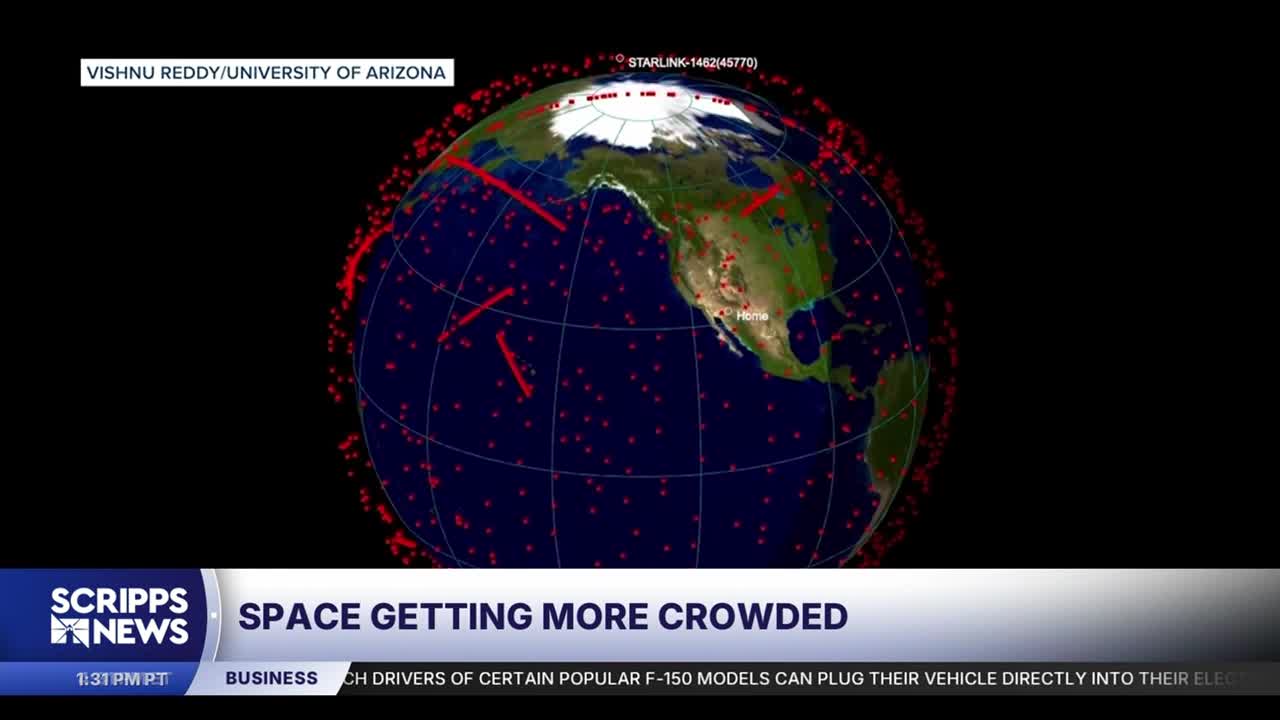


As the number of satellites orbiting Earth continues to grow, so does the risk of crashes between these spacecraft. Such collisions could create fields of debris, potentially rendering entire areas of orbit useless.
Objects in space have crashed, or had near misses, in the past. But while such incidents remain extremely rare, there are now more than 18,000 active and inactive satellites in orbit — a number that has more than doubled in the past six years alone. And the vast majority of them are located in the same region, low-Earth orbit, where the increased congestion is making collisions statistically more likely.
IN CASE YOU MISSED IT | Kessler syndrome: How crowded satellite orbits could lead to a runaway space debris problem
Now, the US Federal Communications Commission has adopted a new set of rules, which is largely supported by the industry, that would “modernize” the approval process for satellites and create new “space safety” provisions. Specifically, the rules would require satellite operators to share real-time tracking data so that space traffic managers can gain a more holistic understanding of where objects are in orbit. Historically, it has been dangerously difficult to predict potential collisions.
But while the FCC rules themselves are not widely objectionable, they are reigniting a turf war over who gets to call the shots on space.
The FCC has been the de facto satellite regulator for decades because of its authority to manage spectrum, or the radio waves that allow data to be beamed wirelessly from space or aircraft. But as the commercial space industry has boomed, lawmakers have sought to give space regulatory authority to the Department of Commerce instead. Their argument is that Commerce could handle oversight of the sector and work closely with companies to ensure the US space industry remains globally competitive.
Officials on both sides of the aisle have shown support for the switch. In fact, the two ranking members on the House Science Committee — Republican Brian Babin and Democrat Zoe Lofgren — sent a letter to the FCC in February urging the commission to abandon or alter the new rules. They argued that federal law “contains no clear congressional authorization empowering the FCC to regulate space safety, space traffic management, or broader non-communications space operations.”
FROM THE ARCHIVES | Why Space Junk Is A Compounding Issue For Missions, Astronauts
When reached for comment, Republican House Science Committee staff on Tuesday said Babin and Lofgren had sent a follow-up letter to FCC chair Brendan Carr, urging him to postpone the vote and begin discussing the matter with lawmakers.
The commission moved to adopt the space traffic rules anyway in a unanimous vote Wednesday morning.
The regulatory conundrum highlights the rapidly shifting dynamics in the space industry: As companies such as SpaceX, OneWeb and Amazon deploy hundreds to thousands of new satellites, questions remain about who has the authority to police them.
The-CNN-Wire™ & © 2026 Cable News Network, Inc., a Warner Bros. Discovery Company. All rights reserved.
