

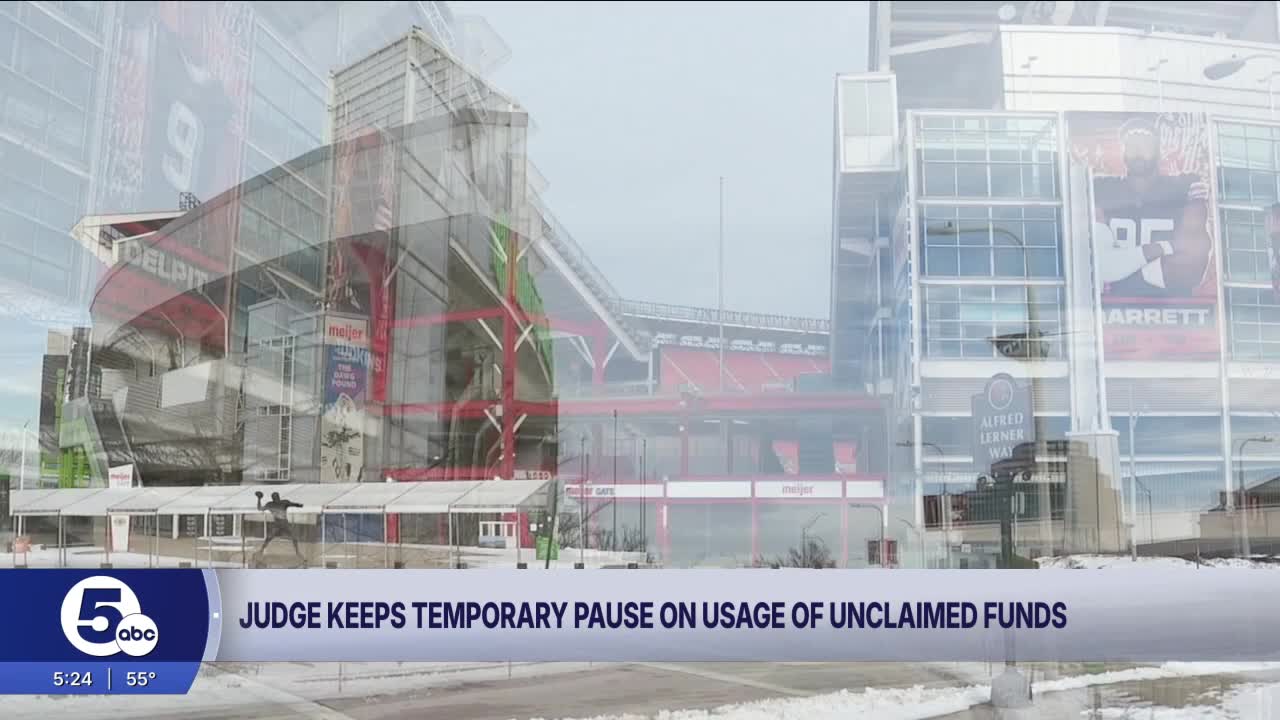



COLUMBUS, Ohio — A state court has extended a temporary block on Ohio's plan to tap unclaimed funds to help pay for a new Cleveland Browns stadium in Brook Park — along with other sports and cultural facilities across the state.
The TRO (temporary restraining order) is extended until the judge rules on if she will grant a preliminary injunction or not (meaning a pause on the law while the case is litigated).@WEWS @WCPO @OhioCapJournal @mjarboe pic.twitter.com/k2KpXApt6O
— Morgan Trau (@MorganTrau) January 8, 2026
A temporary restraining order preventing the state from moving money around was set to expire at 5 p.m. Thursday. Now it will stay in place, while the court weighs whether to approve a preliminary injunction to block the state from taking permanent ownership of $1.7 billion to $1.9 billion in misplaced money while a legal battle plays out.
"The TRO's going to remain in effect until this preliminary injunction hearing is decided," said Jennifer Hunt, a Franklin County Common Pleas Court magistrate who presided over a hearing in Columbus on Thursday.
"So the status quo will stay in place?" asked Jeff Crossman, one of the lawyers representing Ohioans with unclaimed funds.
"Yes," Hunt said.
That unclaimed funds at the center of this fight are from old bank accounts, insurance policies, uncashed checks, utility deposits and other sources. The state is sitting on nearly $5 billion that belongs to people, businesses, nonprofits and local government entities.
RELATED: Fire departments struggle to get their unclaimed funds from Ohio
The Ohio General Assembly voted last year to move unclaimed funds the state has been holding for at least a decade into a new fund dedicated to sports and cultural facilities.
The first $1 billion originally was scheduled to transfer into that sports and cultural facilities fund on Jan. 1, with $600 million of it earmarked as a grant for the new Browns stadium project in Brook Park. But a Franklin County judge issued the temporary restraining order on Dec. 23, delaying the move.
RELATED: Ohio judge temporarily blocks state from giving unclaimed funds to Browns
Lawyers representing Ohioans with unclaimed funds are fighting the state's move, calling it an unconstitutional taking of private property that will ultimately benefit the Browns and team owner Haslam Sports Group. Those attorneys, led by Marc Dann and Jeff Crossman of DannLaw, also argue that Ohio needs to do much more to notify people about their unclaimed funds before cutting off their rights to the money.
They're asking a Franklin County Common Pleas Court judge to maintain the status quo by issuing a preliminary injunction.
"Isn't there a tension now between the state's purpose of reuniting owners with their property — and using that money to transfer into another account to pay for sports facilities?" Crossman said during Thursday's hearing.
Attorneys for the state, meanwhile, argue that people with unclaimed funds that have been sitting for more than a decade have had ample time to file claims. They assert that the General Assembly's recent changes to the state's unclaimed funds program don't violate the Ohio or U.S. constitutions.
And they're fighting the preliminary injunction request.
The state's lawyers say the division of unclaimed funds still has plenty of money left to fulfill claims. They've pointed out that anyone whose missing money gets claimed by the state this year can still seek repayment until Jan. 1, 2036, under a grace period created by state lawmakers.
Going forward, people will have a decade to file claims and get paid. The clock will start ticking when a bank or other business turns missing money or property over to the state, which acts as custodian — a lost and found for owners.
It's unclear when Franklin County Common Pleas Court Judge Julie Lynch will make a decision about the preliminary injunction.
A separate, but similar, lawsuit is playing out in federal court over the state's plan to set a clock — for the first time — on people's ability to claim their missing money. In December, a federal judge declined to issue a temporary restraining order and preliminary injunction to keep the state from moving the money.
The lawyers representing Ohioans with unclaimed funds appealed — and asked the appeals court to approve an injunction.
On Thursday, the appeals court declined to do that. In a two-page order, the court said "plaintiffs have not even remotely shown that they face irreparable harm absent an injunction."
A spokesman for the Browns declined to comment on the litigation Thursday afternoon. But he said the team remains confident in its timeline for the Brook Park stadium project, with a groundbreaking expected this year.

