
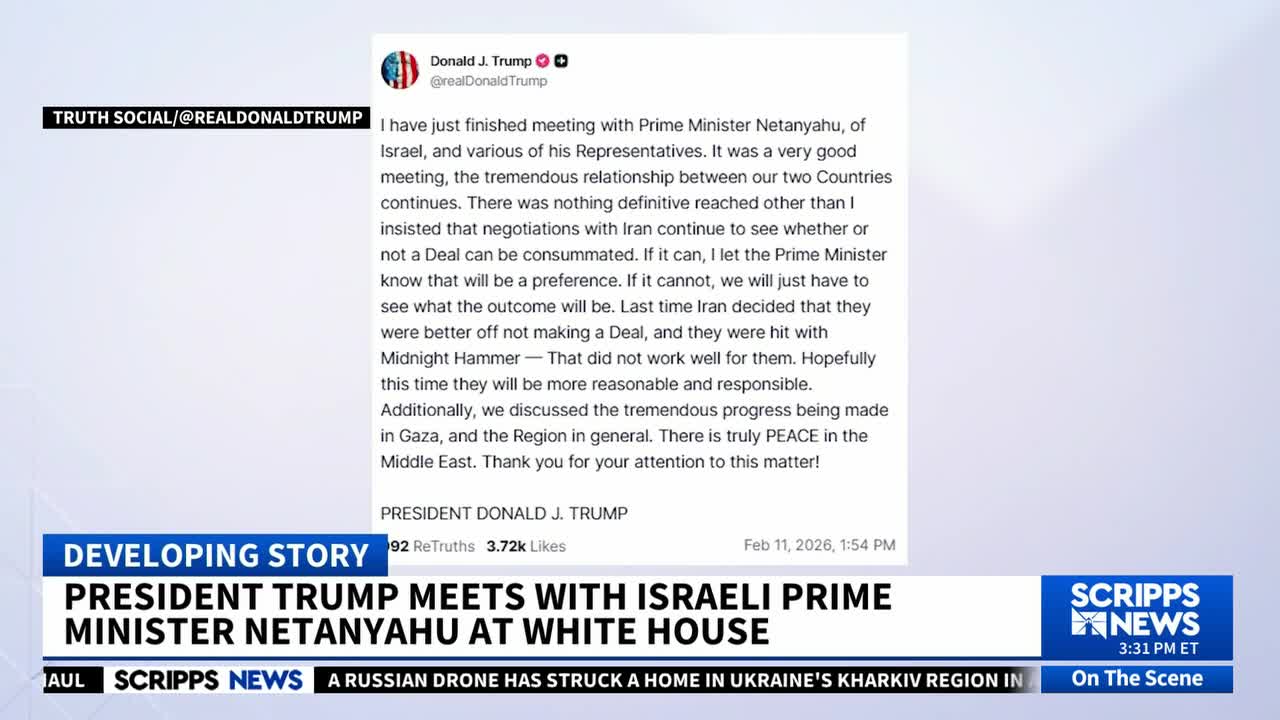


President Donald Trump hosted Israeli Prime Minister Benjamin Netanyahu at the White House on Wednesday, marking the fifth time the two have met since Trump's return to office.
The leaders were expected to discuss a range of pressing issues, including rising tensions with Iran and efforts to find a long-term resolution to Israel's conflict in Gaza. President Trump described it as "a very good meeting" and said they discussed "tremendous progress being made in Gaza," but noted diplomatic relations with Iran remain uncertain.
RELATED STORY | Iran's supreme leader warns any US attack would spark 'regional war'
"There was nothing definitive reached other than I insisted that negotiations with Iran continue to see whether or not a Deal can be consummated," Trump wrote on his Truth Social platform. "If it can, I let the Prime Minister know that will be a preference. If it cannot, we will just have to see what the outcome will be. Last time Iran decided that they were better off not making a Deal, and they were hit with Midnight Hammer — That did not work well for them. Hopefully this time they will be more reasonable and responsible."
The meeting comes as tensions in the Middle East remain high. The U.S. and Iran held indirect talks in Oman last week that appeared to return to a starting point in discussions over Tehran’s nuclear program.
For the first time, America brought its top military commander in the region — U.S. Navy Adm. Brad Cooper, head of Central Command — to the table. His presence, in dress uniform, served as a reminder of the USS Abraham Lincoln and other warships stationed off Iran’s coast in the Arabian Sea.
Trump has repeatedly threatened to use force to compel Iran to reach a deal after deploying the aircraft carrier to the region following Tehran’s crackdown on nationwide protests. Gulf Arab nations worry that an attack could spark a regional war.
The threat appears tangible: U.S. forces recently shot down an Iranian drone near the Lincoln, and Iran attempted to stop a U.S.-flagged ship in the Strait of Hormuz just days before the talks in Muscat.
IN CASE YOU MISSED IT | Iran expresses cautious optimism after nuclear talks with US
Omani Foreign Minister Badr al-Busaidi, who oversaw multiple rounds of negotiations before Israel’s 12-day war on Iran last June, described the recent discussions as “useful to clarify both the Iranian and American thinking and identify areas for possible progress.”
Before the June war, Iran was enriching uranium up to 60% purity — just shy of weapons-grade levels. The International Atomic Energy Agency (IAEA) has said Iran is the only country in the world to enrich to that level without having a nuclear weapon.
Iran has refused IAEA requests to inspect sites bombed in the June war, raising nonproliferation concerns. Inspections have also been restricted since Trump’s 2018 decision to withdraw the U.S. from the nuclear deal.
