

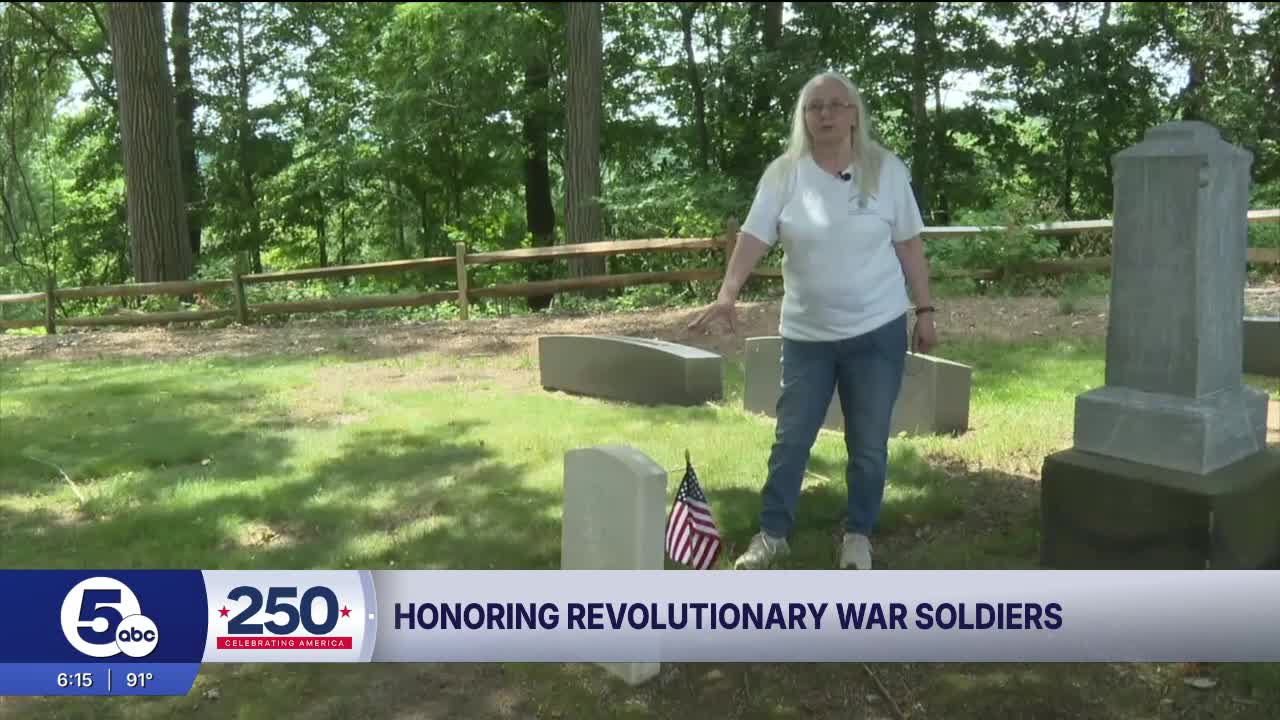


CLEVELAND — Tucked away in small, overlooked cemeteries across Ohio lie the deteriorating graves of thousands of Revolutionary War veterans, sparking a new statewide effort to map and preserve their legacies.
One such cemetery is off of Lorain Road in Fairview Park.
"That is a Revolutionary War veteran, this is a Revolutionary War veteran and then the one in the tree is also,” said Chris Gerrett during a recent tour of the site that she has been involved with preserving for decades.
“He enlisted when he was nine years old,” she said at the grave of Josiah Kellogg. “He was just a fifer at the time, so he was just playing an instrument; he wasn’t actually fighting. But his father and brother had joined, so he went ahead and joined at nine years old.”
Kellogg would serve again later in life during the War of 1812. Through Gerrett's work, Kellogg’s story and those of the other Revolutionary War veterans buried are being documented and preserved, but that’s not the case everywhere.
"These are some of the oldest gravesites we have in Ohio,” said Krista Horrocks. “It's very well possible that a lot of these gravesites won't be around in another 50 years."
And so was born the Ohio History Connection’s Revolutionary War Graves Project, which Horrocks is overseeing.
“We thought it would be really nice to get a dashboard set up so that people could easily go see the locations of gravesites, kind of just be able to just on their desktop, be able to research veterans in their area, see pictures of the gravestones, kind of get like an idea of what condition they're in, do they need help?” she said.
“There's an estimated 7,000 Revolutionary War veterans buried here in Ohio, so we're like, that's a lot of veterans, that's a lot of cemeteries, we're going to need it to be like a public effort. That's really kind of how it started.”
Over the last year, volunteer documenters have fanned out across the state to small, often overlooked cemeteries nestled in communities that have grown up around them, where people have little idea of the role these Ohioans played.
Moses Cleaveland founded his namesake city 20 years after the Declaration of Independence was signed, and Ohio itself didn’t become a state until 1803.
“We don't have Revolutionary War veterans who died in battle here; we have all of the ones that survived,” said Horrocks.
“Ohio had hundreds and hundreds of acres of these military lands that were given to these veterans for payment for their service. Some of them moved here, and they brought their families. Some of them just chose to sell their bounty lands off, maybe to other veterans who might not have received land,” she said of these early settlers.
“I think people don't just really realize how much of an involvement we have because of that post-settlement,” she said.
This is a continuation, in a sense, of the efforts that began in the Bicentennial year of 1976, she said.
“So being 50 years later it's a great opportunity for us to use modern-day technology and really get the best information we can get off these gravestones so that hopefully for the 300th anniversary, folks can see the information we have.”
While they hoped to have much of the work done and ready to post on the 4th of July, she said that’s just a milepost on this journey, not an end date.
“Kind of the whole point is this is a living project, it's going to go on well after the 250th Anniversary is over,” she said. “People can still get out there and collect gravesites, there are still definitely gravesites that need recorded.”
CLICK HERE to learn more about the Veteran Graves Project.
