




Daniel Smith's childhood was filled with war stories about his Aunt Maj. Margaret E. Barnes Jones.
“She would talk about her service to her country, but more importantly, the sacrifice the women made,” said Smith.
The Oberlin native was a member of the historic 6888th Central Postal Directory Battalion, or the "six triple eight”. The unit's 850 African American women were the only black females to serve overseas in World War II.
Historian and Maritime Museum Director Molly Sampson has been studying the 6888 Battalion for six years.
"There had been white female units being sent overseas from late 1942, but Black women repeatedly were denied the opportunity to serve overseas. There was a letter in May of 1944 from first lady Eleanor Roosevelt to the director of the Women's Army Corps, and in it she says when are they going to get their opportunity to go?” said Sampson.
In December 1944, Charity Adams, the highest-ranking African American woman in the army, agreed to assemble the women who would become the 6888.
“They knew they were going to Europe, but they didn't know what they were going to be doing. Overseas training was highly secretive. They were pretty cut off from the outside world during training,” said Sampson.
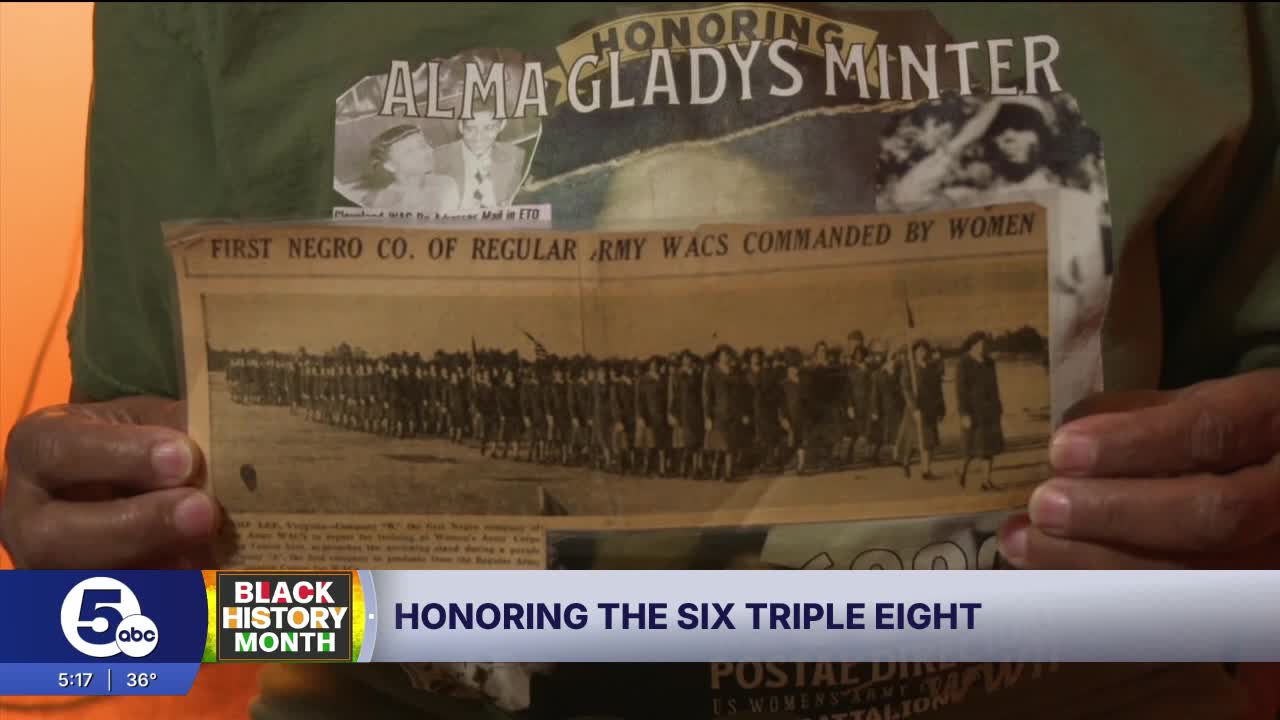
Newspapers across Northeast Ohio celebrated the local women who were heading to Europe, including Clevelander Alma Minter, whose daughters Debbie Madison and Donna Wilson still have her original documents.
“She didn’t talk about it a lot; all I knew was that my mom was in the army, she was a sergeant and she drove a jeep," said Madison.
What they didn’t know was that their mother and the rest of the 6888 were responsible for raising the morale in the army. When the women arrived in France, they were given an assignment to tackle an enormous mail backlog of 17 million pieces of mail dating back three years.
“They really viewed this as an assignment that they were being set up to fail, that no one thought they could succeed at it because no one had succeeded at it before. The 6888 was given six months as far as I've been able to tell no one else was given a time frame to ameliorate the problem,” said Sampson.
But the 6888 was given time boundaries; through their innovation of changing some of the efficiencies with the locator cards, moving from a 20-hour workday to a 24-hour workday, they accomplished it in three months instead of the given six months.
“The fact that the 6888 was able to clear that backlog, to streamline the mail services at a point when the war was beginning to become unpopular and make that connection for our service members was crucial. Even General Eisenhower recognized how important mail was for the morale of his troops, so it was recognized from the top levels down,” said Sampson.
The story of the 6888 was brought to a wider audience in 2024 when Tyler Perry debuted "The Six Triple Eight” movie on Netflix.
“I was just so proud of these women, and I watched it over and over again,” said Wilson.
Many of the families were eager to see their family members' names in the end credits.
“We were waiting to see her name and we saw it, it just felt surreal. And we were just so excited about them finally having some national notoriety about the things and the struggles they had and how they overcame them,” said Smith.
Sampson was a historical consultant on the film.
“It's exciting to see how this spread, because it’s not such a hidden or forgotten thing that nobody knows about anymore. People are starting to recognize it and go the next step,” said Sampson.
As the women's legacy continues to live on, Minter's daughters came up with the idea of putting their mom's name on a local post office.
“Here in this country, she had to eat her ice cream on the curb; she wasn't allowed to go inside the ice cream parlor to eat, and she couldn't sit on the bench because the bench said white only. But today her name can be on the front of a building.
Congresswoman Shontel Brown liked the idea and is working on renaming the Collinwood post office after Minter.
"The fact that she was able with her Battalion to take on this challenge and really shift the morale of the men to thrust us towards victory is a monumental achievement that really deserves to be highlighted,” said Brown.
Brown says this is an important time to celebrate Black history.
“I think it's important to just give us a sense of encouragement, a sense of pride, especially at a time right now where we have an administration who is working to erase it,” said Brown.
Brown says they have bipartisan support, and it has passed out of the committee. Now it must go to the house, and then once it passes out of there, then it'll go to the Senate, and it'll be signed into law. So, one step at a time, but we are moving in the right direction,” said Brown.
And in Oberlin, March 9 will be known as Maj. Margaret E. Barnes Jones Day, a day for all to learn from.
“It's baked into their DNA, it’s who they are. They are Margaret Barnes Jones walking around. And they may not know it yet but soon they will, and I’m just a keeper of the flame, and I’m passing it down to them,” said Smith.
May 05, 2025. Decades after their service, the Women's Army Corps 6888th Central Postal Directory Battalion was awarded the Congressional Gold Medal.
