



CUYAHOGA COUNTY, Ohio — Seventy-five out of 88, or 85%, of Ohio counties are currently experiencing a mental health resource shortage, according to a recent Health Policy Institute of Ohio (HPIO) report.
The only counties that are not shortage areas are Hancock, Marion, Delaware, Montgomery, Butler, Clermont, Lorain, Ashland, Lake, Geauga, Portage, Trumbull, and Mahoning, according to the study.
It's the first study of its kind for the HPIO, according to the study's author, Becky Carroll.
"We did some research prior to this report that looked at the rates of those mental health conditions and found that they (Ohio data) are increasing and in some cases worse than the rates for the overall U.S.. We wanted to look at access to care and try to determine whether those kids who need care are able to access it," Carroll told me.
According to Carroll, there are only 365 child and adolescent psychiatrists working in Ohio.
"Just not many," she said. "That's about one for every 7,000 kids."
According to experts interviewed for HPIO's study, there are serious access challenges at all levels of care, but challenges can be particularly notable for children with higher levels of need (e.g., inpatient or residential treatment).
Carroll told me there are only 11 facilities across the state that provide inpatient psychiatric services, four of which are in Northeast Ohio.
"We've always heard that there are workforce shortages, but I didn't understand the extent to which it was a problem," Carroll said.
Mental health access data, according to the HPIO report, indicates:
- Ohio families seeking mental health services for young children, ages 6-11, report more difficulty than for older children
- Families with private (e.g., commercial) insurance frequently experience greater difficulty finding treatment for their children than families with public insurance (e.g., Medicaid)
- At the same time, there is a higher percentage of children with Medicaid who do not receive needed care than children with commercial insurance
Carroll said when kids don't receive appropriate and timely mental health treatment, it can result in a crisis.
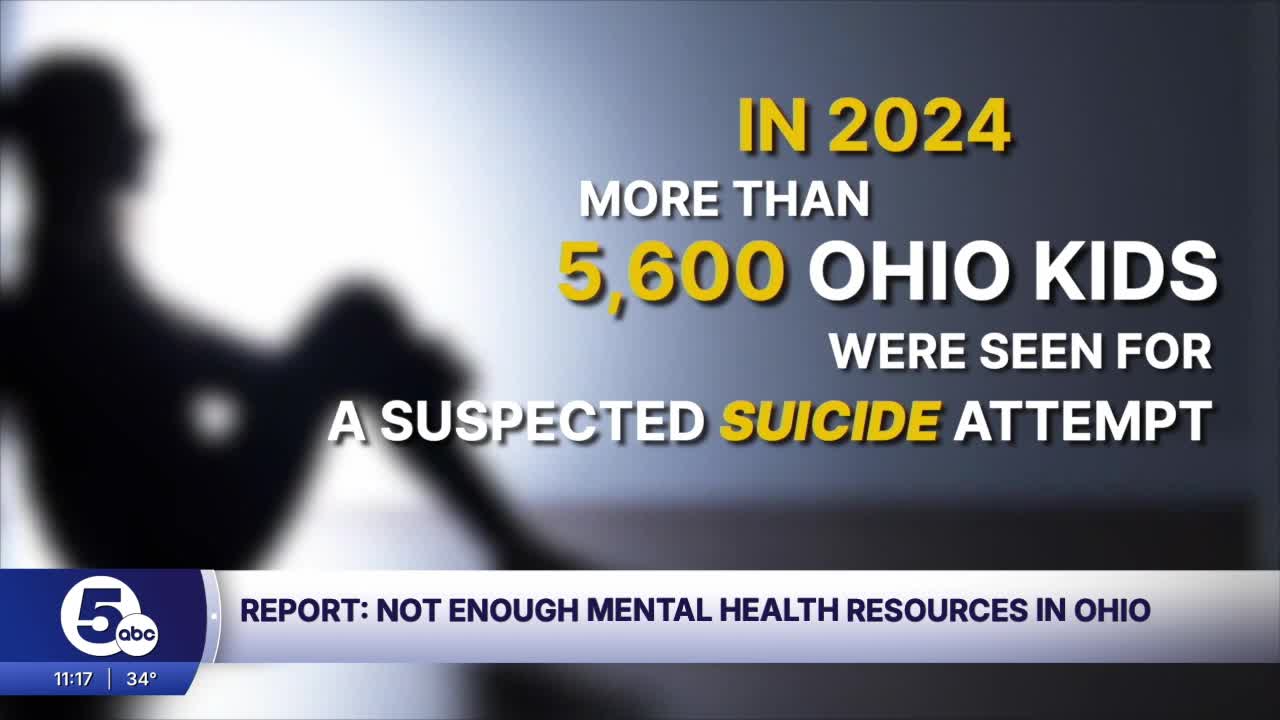
According to her study, more than 5,600 Ohio children were seen for a suspected suicide attempt in 2024.
"This is, of course, problematic because without treatment, those conditions can worsen," Carroll said.
Carroll explained that throughout her research, she also found a lack of data surrounding mental healthcare in Ohio.
"Without this information, policymakers cannot make informed, data-driven decisions on where to allocate resources within the mental health care system," the HPIO report reads.
I stopped by the Alcohol, Drug Addiction and Mental Health Services (ADAMHS) and talked with CEO Jason Joyce about the state of mental health resources in Cuyahoga County, since it's among the 75 counties reportedly experiencing a shortage.
"I'd say we're quite rich. Our ADAMHS Board in Cuyahoga County serves about 72 different providers. We provide funding to 72 providers. For comparison's sake, in Columbus in Franklin County, they only serve 30, so we are really making efforts to connect with every provider whether that's really large ones or really small ones," Joyce said.
Joyce told me the Board is focusing on retention and incentivization of mental health professionals, admitting more of that is needed across the state.
"The work that behavioral health providers do is incredibly hard, difficult. A lot of burnout, so we make sure that we can help agencies through training purposes, so making sure that they're getting the right training that they need. We also have offered incentives and support for providers in the past as well. Lastly, Medicaid pays for quite a bit of behavioral funding. For the stuff that Medicaid won't pay for us, the ADAMHS Board helps cover that cost," Joyce said.
Joyce said recruitment should also be at the forefront of this conversation.
"One of the programs that they (Kent State) came up with was called a chemical dependency counselor assistant program. Within 40 hours, those providers can be out there in the field working with clients, with the support of Kent State, with the support of supervision, of course, but just trying to get more people out in the field," Joyce added.
Joyce said ADAMHS is also working in collaboration with a program called BHEACON, which is a website where people can find all sorts of behavioral health information.
BHEACON was created through a partnership with the Mental Health & Advocacy Coalition of which ADAMHS is a member.
Carroll said HPIO does plan to present the study to local and state policymakers in hopes of real change.
Despite the abundance of alarming data collected, Carroll said she did find some positivity in the state's mental healthcare.
"We are seeing some bright spots on this issue, and one is mental health services that are provided in schools. In the previous school year, more than 80% of Ohio schools partnered with a community behavioral health services provider, and so the kids are able to access services right at school," Carroll said.
The Ohio Suicide and Crisis Intervention hotline is also being utilized, she told me.
Carroll said in August 2025, there were nearly 23,000 calls into the hotline.
If you are in need of immediate mental health support, please call 988.
For more information on 988, check out the national website.
For other mental healthcare resources, see below.
Joyce wants to remind those experiencing a mental health crisis that they're not alone.
"If you're a family member or someone that's, you know, looking for help, you can reach out as well for support. Having some of those hard conversations, you know, can be difficult, but you don't have to have them all at once," Joyce said. "The first thing you wanna do is, say someone's struggling with substance use, try to show as much love, care, kindness, consideration as you can for someone going through that."
Carroll said the plan to run another report updating the data as years go on is currently not in the cards, but that HPIO will use this study as the foundation for more mental health research.
