

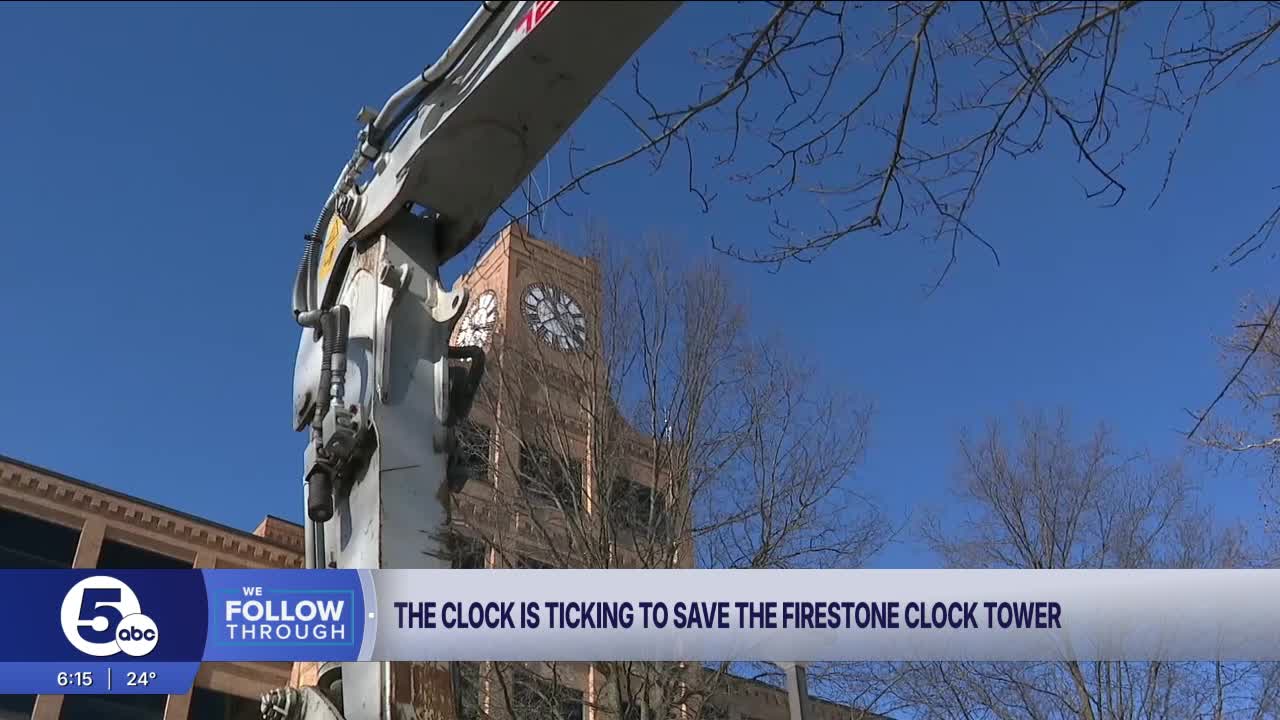


AKRON, Ohio — The clock is ticking for Akron as it tries to save the historic clock tower at a former Firestone plant, with demolition plans on hold until the city reaches an agreement with state preservation officials.
Rising above the 116-year-old Firestone Plant Number One building is the iconic 8-story-high clock tower that means a lot to many in Akron. The structure may not look like much now, with broken and boarded up windows and asbestos remediation nearly completed, but it represents decades of the city's industrial heritage.
"Tens of thousands of families were employed by Firestone," said Summit County Councilman Jeff Wilhite, who doesn't want the clock lost to time. "We need a city that recognizes who and what we were because that tells us where we're going and to erase a historic landmark like this doesn't serve us well."
WATCH:
The city was planning to move forward with plans to tear down the former plant, but that's on hold for now. Akron was awarded demolition funding but is no longer eligible to be reimbursed for the costs until it comes to an agreement with the State Historic Preservation Office on a way to save the clock tower.
"As we were moving forward, fell into a dispute them and so we need to realign intentions with the State Historic Preservation Office," said Suzie Moore, Akron's director of economic development.
Dana Noel from the group Progress Through Preservation has been pushing to save the clock tower and expressed cautious optimism about recent developments.
"I don't want to say it's a miracle because that's over the top, but it's encouraging," Noel said.
In a press release, the city detailed the five preservation options under consideration, along with the challenges each could face.
- Retention of the "1910" part of the easternmost building, including the clock tower:
- This alternative would assess the structural feasibility of retaining the 1910 portion of the easternmost structure, including the clock tower. Cost estimates will include options for roof repair, as well as blocking windows on lower floors to help reduce security and vandalism challenges. Key challenges include cost, structural integrity to mitigate vandalism, ongoing ability to secure the site/structure against vandalism, nuisance behavior, safety/liability, and the ability to redevelop the building structure, given environmental considerations/limitations.
- Retention of full easternmost structure and clock tower:
- Key challenges include cost, feasibility of regaining the structural integrity of the entire easternmost structure, additional costs to mitigate vandalism, ongoing ability to secure the site/structure from vandalism, nuisance behavior, safety/liability, and ability to redevelop the building structure, given environmental considerations/limitations.
- Retention of clock tower only on-site:
- Key challenges include cost, the feasibility of restoring the tower's structural integrity as a free-standing structure, and the site's developability.
- Preservation of clock tower elements within a new structure built in homage to 1200 Firestone:
- This concept could be constructed at a location on site at 1200 Firestone, or at an alternate location of significance, such as Firestone Park or Firestone Stadium (where the Firestone signage is preserved). Key challenges include cost depending on scope, design ambiguity, and time to develop with the community. This strategy offers a second option: incorporating historic elements into a new clock tower, honoring the past alongside a more modern tower.
- Preservation of clock elements for inclusion in a new development yet to be determined on-site at 1200 Firestone:
- This concept includes preserving elements of the existing structure and incorporating them into future development. Key challenges include an unknown timeline for site redevelopment, unknown cost, and ambiguity with the community.
Noel feels moving the historic clock defeats the purpose of preservation.
"That's really not truly preservation. It disassociates it from the place," Noel said.
Moore hopes there's a solution to save the clock next month so that demolition can start. Environmental concerns make redevelopment on the site questionable, but the city isn't ruling it out.
"But certainly having less of a building there for a re-use project makes it a more doable equation for us to look at in the future," Moore said.
Wilhite remains focused on the primary goal.
"As long at the tower is saved, that's the piece I'm focused on," Wilhite said.
The city will present these options to the Urban Design and Historic Preservation Committee at a special meeting on Feb. 17. Akron has requested an extension from the State Historic Preservation Office to respond to their dispute letter since the committee cannot consider the proposals until that date.
Progress Through Preservation wants more input from the community about what to do with the clock tower, so they're hosting a public meeting Feb. 5 at St. Vincent de Paul Catholic Church.
WATCH:
- The future of Akron's former Firestone Plant has been decided
- Time could be ticking for iconic Akron clock tower and former Firestone plant
