

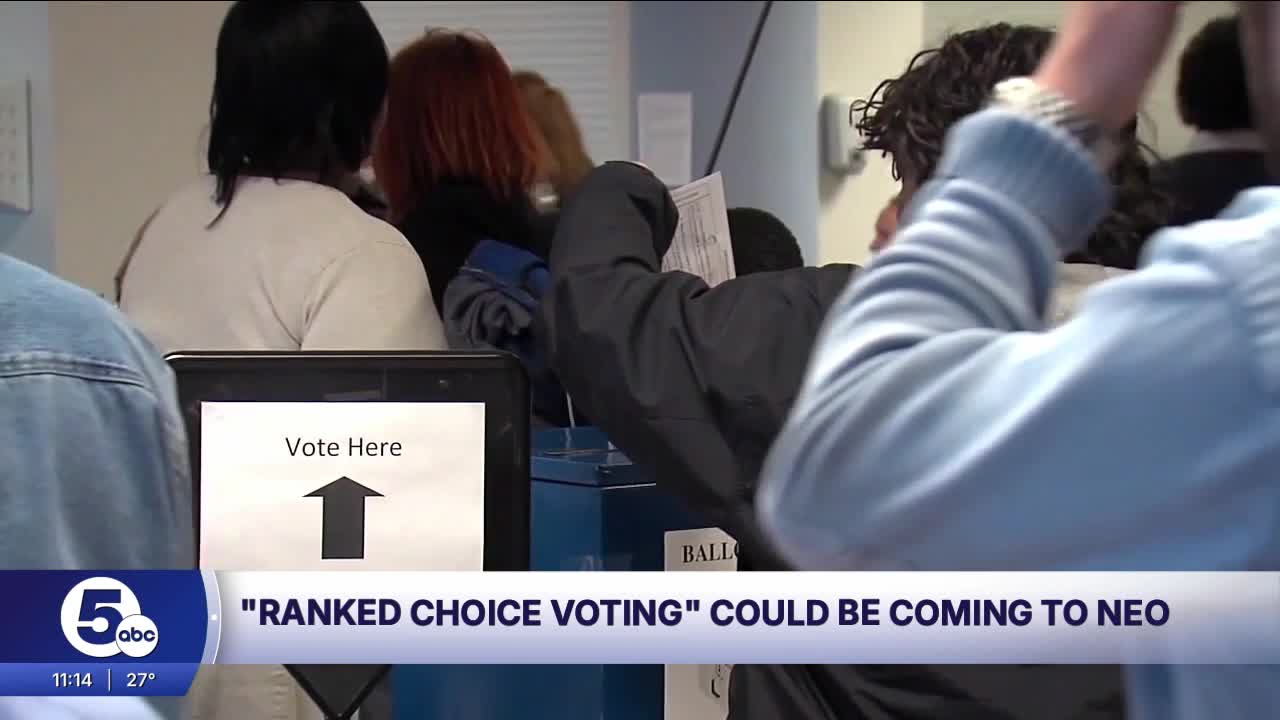


CUYAHOGA COUNTY, Ohio — The process in which Ohioans vote could change, but lawmakers on both sides of the aisle are looking to keep it the same.
"Basically, right now, when you go to the polls, you have your choice of one person, one option. If there are five people running, whoever gets the most votes wins, even if they only had 30% of the votes," Lakewood volunteer for Rank the Vote Ohio, Christopher Bindel explained. "That is not a majority of people."
There's been a conversation, however, about allowing cities to decide whether to switch from traditional voting to ranked-choice voting.
What is ranked-choice voting?
Instead of making a single choice, ranked-choice voting allows voters to rank candidates in order of preference. Whoever receives more than 50% of the votes would win.
"If your first choice person doesn't win, then your vote goes to your next choice person. This keeps happening until we reach somebody who has over 50% of the vote," Bindel said.
The renewed push for ranked-choice voting in Ohio has been in the works for the past few years, according to Bindel.
"Ohio is actually one of the first places to ever have ranked choice voting. Back in the earlier part of the 20th century, Cincinnati, Ashtabula, Cleveland, and a number of other cities actually had ranked-choice voting, and we were one of the earliest places to adopt ranked-choice voting. It's cool. It's disappeared over the years, but we're hoping to bring it back," Bindel told me.
The concept of ranked-choice voting could become a reality in Lakewood and Cleveland Heights, as their respective Charter Review Commissions have recommended it for a charter amendment.
Lakewood and Cleveland Heights City Councils are now deciding whether to place it on this year's November ballot.
For either city to adopt ranked-choice voting, though, voters will need to make that ultimate decision.
"I'm listening to what the residents and the members of the charter review commission have recommended. I'm personally pretty cautious about process changes, so maybe it could be good, maybe it could have side effects. I'd personally like to learn and think through what those side effects could be, but I think some of my colleagues are enthusiastically in support. Maybe others are still also considering it, but it's on our docket just for the whole purpose of considering it and having the discussion," Lakewood Councilman-At-Large Tom Bullock said.
However, the concept of ranked-choice voting is now up in the air as both the House and Senate have voted to ban it.
Speaker of the House Matt Huffman describing ranked-choice vote as simply confusing.
"I think even the people who want to put them on aren't quite sure who wins and who makes the finals and all of that. That's number one. And number two, we don't have a voting infrastructure set up to do that," Huffman said last week.
Bullock said the statewide ban would go against the state's home rule.
"The state constitution says cities and villages have the right of general government. This would fall in with that. It's better if we can make our own decisions and not have state government make it for us," Bullock said on Monday.
Bindel believes lawmakers are targeting ranked-choice voting because of the power it keeps in the hands of Democrats and Republicans.
"If you bring in ranked-choice voting, it allows more third-party people more easily. There's a lower bar of entry. It allows more people to try running with having to spend less money. You don't have to be selected by the party," Bindel said.
Here's the thing: cities like Lakewood and Cleveland Heights could still put ranked-choice voting on the ballot this year, even if it were signed into law, which Governor Mike DeWine has yet to do.
If ranked-choice voting were passed in either city, though, they would face financial risks.
According to the bill's language, the Secretary of State would deem local governments ineligible to receive any general funding from the state if ranked-choice voting were to be adopted.
The funding, per the legislation, would cease within a month of ranked-choice voting passing.
"Is that something that you would be willing to risk?," I asked Bullock.
"Probably not, to be honest. We've got to be sound stewards of the public's tax dollars. We've got plenty of expenses. We're in a stronger financial position, but we wouldn't want to imperil that. But that said, what a frustrating move for state government to do. You shouldn't have to be in that bind between making your own decisions about how to govern your community versus having ample funds. The local government fund, by the way, is paid for by Lakewood residents, so that's a dividend that comes back to us from state sales tax that originally it was larger about 20 years ago, and the state has been chomping down upon that, reducing it, and that frankly is putting too much pressure on people's local property taxes," Bullock responded.
Lakewood City Council is still deciding where to go from here.
Bullock said whether ranked-choice voting is placed on the November ballot could be decided by council members as soon as within the next two to four weeks.
"Most typically, we take longer than that to have time to be thoughtful and hear from community members, pro and con. There's a bunch of other things like City Hall potential renovation discussions that have been on the agenda too, so I think that the idea is to make a thoughtful study and recommendation, and then if it's on the ballot, you talk to the community, and you have all summer," Bullock said.
Rank the Vote Ohio told me, regardless of the potential ban, the organization will keep pushing back.
"It's a freight train you can't stop at this point. I'm just going to keep focusing on Lakewood and helping Lakewood council move through these new obstacles and find the best way forward, and I do think there is a way forward where we could still put it on the ballot in November," Bindel said.
Rank the Vote Ohio said it has also drafted a legally sound escape clause for cities that still wish to invoke rank-choice voting.
Bindel said a citizen's ballot initiative is also not out of the question.
"I just really would hope that [Gov. DeWine] would see that this is a power grab by the state against cities who have home rule. Cities are supposed to be able to choose how they govern their own elections and themselves, and there have been a lot of things lately where the state legislature has been trying to chip away at those freedoms. They're trying to play this off as ranked-choice voting is corrupt and complicated, which it is neither of those things if you actually learn about it," Bindel said. "He's [Gov. DeWine] looked at things that the legislature has done and realized that they aren't right, and he's vetoed them. I'm not sure if he'll do that in this case, but I can hope."
I reached out to Cleveland Heights for comment, but one wasn't provided on Monday.
We'll Follow Through as this story develops.
