



CLEVELAND — As we get ready to mark the nation's 250th birthday, we are taking time out to recognize Cleveland's role in the growth of the country.
Part of that is our place in the nation's financial system, the roots of which date back to pre-Cleveland to Alexander Hamilton, the first Secretary of the Treasury, who established the nation's first central bank.
By the time our current Federal Reserve System was created by an Act of Congress in 1913, Cleveland was then the largest city between the East Coast and Chicago and as such was chosen as the site of one of just 12 Federal Reserve Banks in the country.
A role it continues to carry out to this day, keeping banks in its multi-state region supplied with the currency its customers and, in turn, the country need to operate.
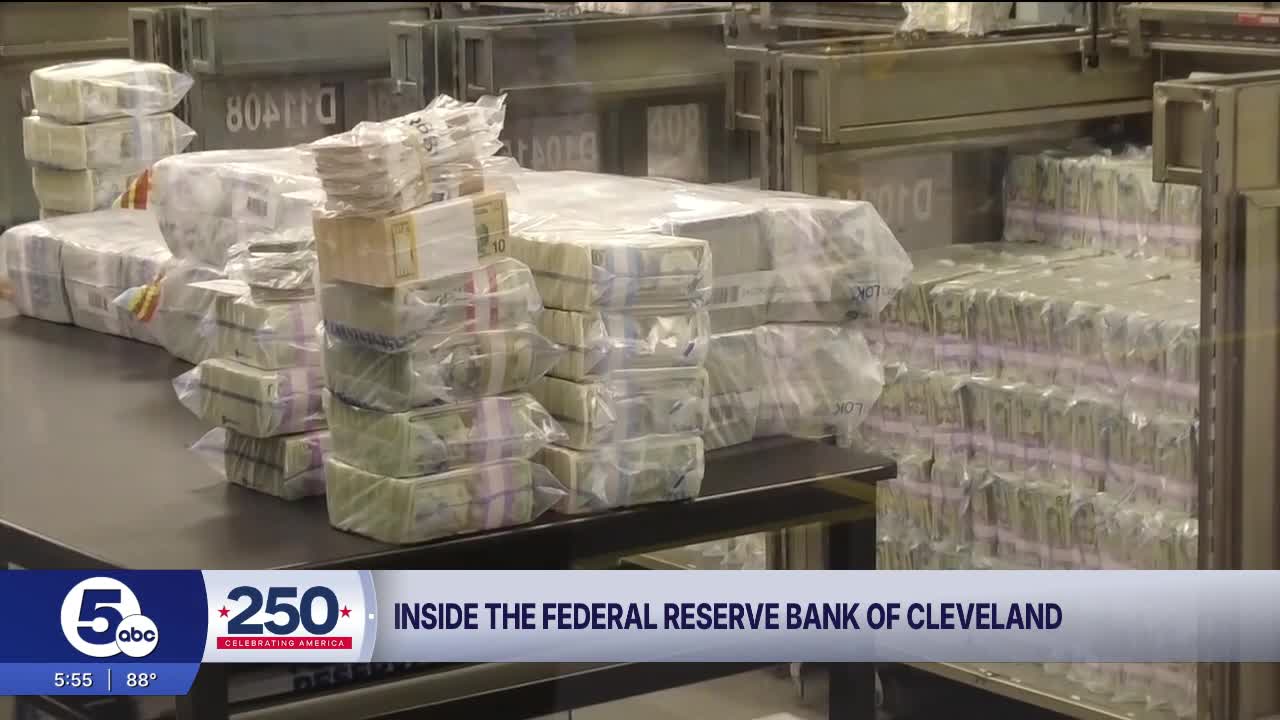
As such, it is safe to say the cash in your wallet right now, whether you got it from a bank or a store as change, has spent time at East 6th Street and Superior Avenue in the cash department of the Federal Reserve Bank of Cleveland. Within the Cleveland Fed's 4th District, nearly 11 million notes a day are processed, each studied for fitness.
"When the currency is deposited, we're looking for rips, tears, obviously, we're looking for accuracy, we're looking for authenticity as well," said the Cleveland Fed's Brad Smith, the vice president for district cash.
Authenticity means counterfeits. A $20 bill popped up while News 5 was given a rare look at the operations. At first glance, it looked normal, until you noticed the words "for motion picture purposes." The bill was one used in a movie shoot in Cleveland, where a scene called for fake bills to go flying everywhere.
"All of that currency that you saw was pretty close to being authentic, but not authentic at all," said Smith.
Paper money has a lifespan ranging from 5.7 years for $20s up to 24 years for the lesser handled $100s. So they're also looking to make sure it's still serviceable; 15% of the bills they process each day are destroyed. So that torn $10 bill you taped up?
"It will be shredded, that's correct," said Smith. "Even when folks start to write graffiti or anything like that, it's going to be taken out of circulation."
So exactly how much of the nation's more than $2.2 trillion notes currently in circulation are here in the bank's three-story automated vault?
"So we know exactly how much is in here, and we cannot say," said Smith, pointing out that a full container carries 430 bundles of cash.
If that cash were all hundred-dollar bills, that would come to $43 million, and there are 2,000 containers when completely full, though they usually operate at about 65% capacity.
As Americans move to electronic transactions, credit cards, Venmos and the like, they say they're seeing about a 3% decline in cash usage each year, but to be clear, cash is still a big part of our lives, said Cleveland Fed President and CEO Beth Hammack. Especially in times of crisis.
"We paid out almost three months' worth of currency in the first days of the pandemic, and we find these moments when cash is really critical," said Hammack, who spoke highly of the workers carrying out the jobs that keep the nation's economy moving.
"In the early days of the pandemic, we didn't have a single person call out sick. They knew that processing cash, making sure that individuals had fit cash in our wallets, was of critical importance," she said.
Hammack is also one of the 12 voting members of the Federal Open Market Committee, which determines the nation's interest rates. Hammack and the FOMC voted to hold rates steady during their April meeting.
"Right now, what I see is a lot of uncertainty in the economy. I see a labor market that's right around our full employment, which means that anyone who wants a job can find a job, and I see growth that's continuing to move at a healthy pace, but I see inflation that's too high," said Hammack. "When I'm out in the district talking with businesses or individuals, what I hear is the pain of inflation is real, and it's making things very difficult."
Hammack is just returning from Western Pennsylvania, meeting with businesses and workers there late last week.
"We sat down with a group of workers who were talking about how difficult things are, how difficult it is to make ends meet right now. Particularly, we heard from one worker who said that he would travel to go see all of his son's football games, but with the cost of gas right now, he's not able to do that."
"We've been missing on that side of our mandate for five years, and it's important that we focus to bring that back down to our 2% objectives," she said.
Hammack will weigh all of the data before making her decision on interest rates in June, but she relies a lot on what she sees and hears in the field.
"What I find is that the data and statistics that we get through official sources are incredibly robust, they're very thorough, but they tend to be somewhat backward-looking," she said, noting that what she heard in Erie last Friday is to her an indicator of where the economy is going, not where it's been.
"Right now, what I'm hearing is there's a lot of uncertainty. The conflict in Iran has been going on for much longer than I think many people would have expected. The pricing pressures on the gasoline side are real, but what could happen is those price pressures, as they stay elevated, could start to impact the demand side of the equation. And if demand gets impacted, that could start to impact employment," she said.
"We've got two sides of our mandate, the full employment and the price stability. We have to balance both of those, and so right now, what I see is that uncertainty in the economic outlook should translate into uncertainty in the path of policy. So, to me, I think it's an open decision as to what the next move is from a policy perspective."
As inflationary concerns rise with the bottleneck continuing in the Strait of Hormuz as the war in Iran drags on, would she then rule out the possibility of a potential rate hike in June?
"I won't rule out anything right now. I think it's important that we keep an open mind," she said. "I keep an open mind as I walk into every meeting to help make sure that I'm setting policy to work in the best interest of all Americans."
