

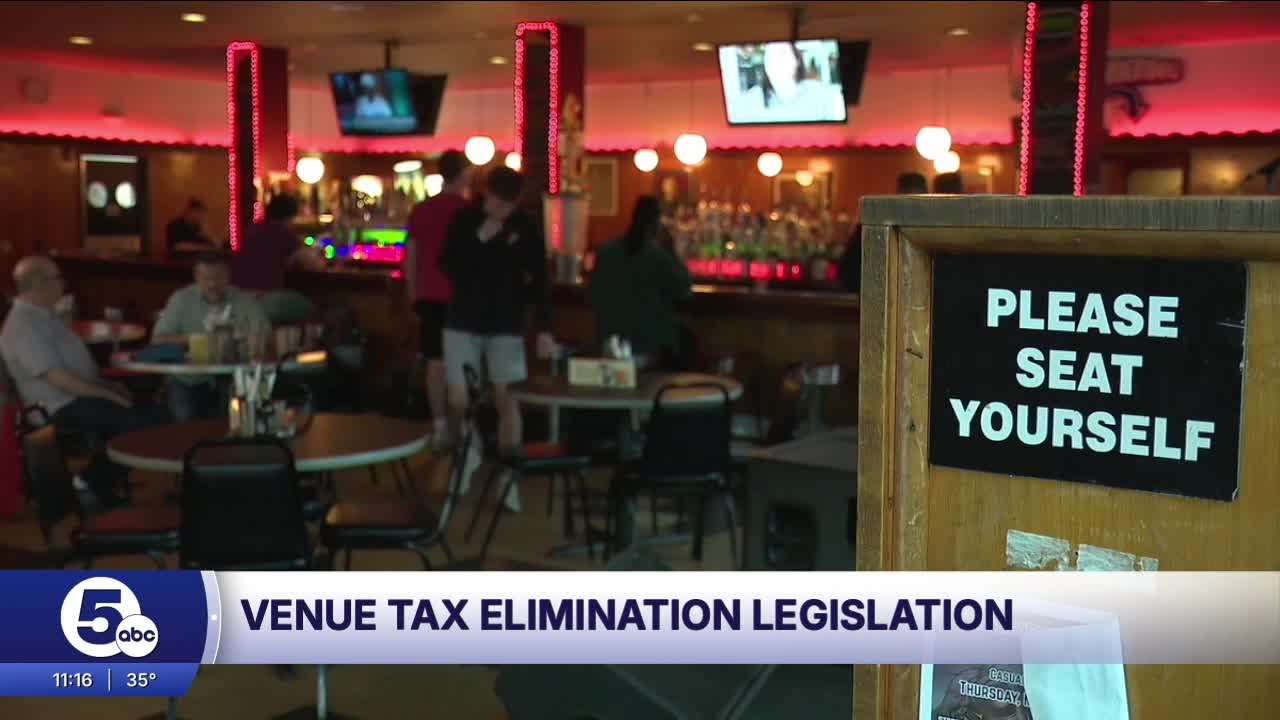


CLEVELAND — For 14 years, small venues in Cleveland have paid a 4% admission tax to the city. But now, council members are considering doing away with that.
Legislation drafted by Cleveland Councilman Kris Harsh would exempt live entertainment venues that sell 750 tickets or fewer from the ticket tax.
As it currently stands, the city has a tier-level admissions tax for events across Cleveland, charging 8% for large events, 4% for events with a capacity between 150 and 750 attendees, and no charge for events with fewer than 150 people.
The proposal, if passed, to eliminate the admissions tax for those with a capacity of 150 to 750 people would impact venues like Happy Dog, Hilarities, Beachland Ballroom, Music Box Supper Club and Brother's Lounge.
Happy Dog co-owner Sean Watterson told me he's excited that this legislation is even on the docket for consideration.
"It doesn't generate a lot of money for the city, but for each of us, where the margins are so, so thin, if they're even above break even, and that hasn't always been the case, especially post-COVID, it means everything," Watterson said. "If you add up what they're getting from these smaller clubs, it's probably either side of $100,000 a year."
Happy Dog doesn't offset the tax onto customers, instead absorbing it on the venue's dime.
"For us, that's between $4,000 and $5,000 a year, which doesn't sound like a lot, but you know, when the margins are super tight, every dollar counts," he said. "We've been paying that tax out of our hot dog and beer money for over a decade now."
Happy Dog can accommodate up to 200 people and typically charges people $10 at the door. But 100% of the money collected goes towards the band that night.
For venues like Music Box Supper Club, the customer takes on the admission tax as it's not feasible for the business to do so.
"It has raised our prices fundamentally, you know, our ticket prices to our customers," Music Box Supper Club CEO Mike Miller said.
Miller said talks around this proposal have been happening for some time, but he was shocked to see how quickly it was put in front of Cleveland City Council this month.
"Costs have been increasing for us across the board, and to take a step to kind of reduce those costs and get the customer in and to see a little bit of savings, to come out and see a show at a smaller club, I think, again, it's just a big step," Miller said.
Miller said a lot of bands get their start through small venues, so he hopes the city will continue supporting that where it can.
"They are doing something unusual. They're lowering taxes, but it's not gonna have a huge impact on the overall city budget," Miller said.
Watterson said not only would this slash in taxes save businesses and their customers money, but it would help continue the upward trend of economic growth in Cleveland.
"I'm part of an organization and the National Independent Venue Association, and we commissioned research for the first time ever. We have research about live independent local music, and we have the data for Cuyahoga County, and it shows what a huge economic impact we have," Watterson said.
The National Independent Venue Association, according to Watterson, is reporting that $1.1 billion annually flows through Cuyahoga County based on small live entertainment venues, 6,100 jobs are available, and more than $450 million in wages and benefits are provided.
He told me that small venues managed to collect $35 million in state and local taxes every year in Ohio.
"That study also showed that 75% of us lost money in 2024. With that data in hand, I think it's what lets folks like Councilman Harsh be able to say, 'Hey, this makes sense, not just because we care about music, but financially it makes sense.' It's important to keep these businesses that are anchors in the neighborhoods that are drawing people in and to the restaurants around in business," Watterson said.
The proposal has only gone through one reading so far. It has at least two more to go through before a vote is taken.
"We're all lined up, ready to tell our story on why it's an important thing, but you know, seeing the feedback from that first reading and seeing other council people speaking out in support of it, I'm hopeful that we can get this done and get this done quickly because I know it's going to be a huge relief to the small businesses here where the money stays here," Watterson said.
He said no timeline on when the next two readings may be has been provided by council.
Miller is hopeful council will approve this legislation soon.
"We make Cleveland what Cleveland is," he said. "It just all adds up to make a lot of sense."
I'll Follow Through.
