

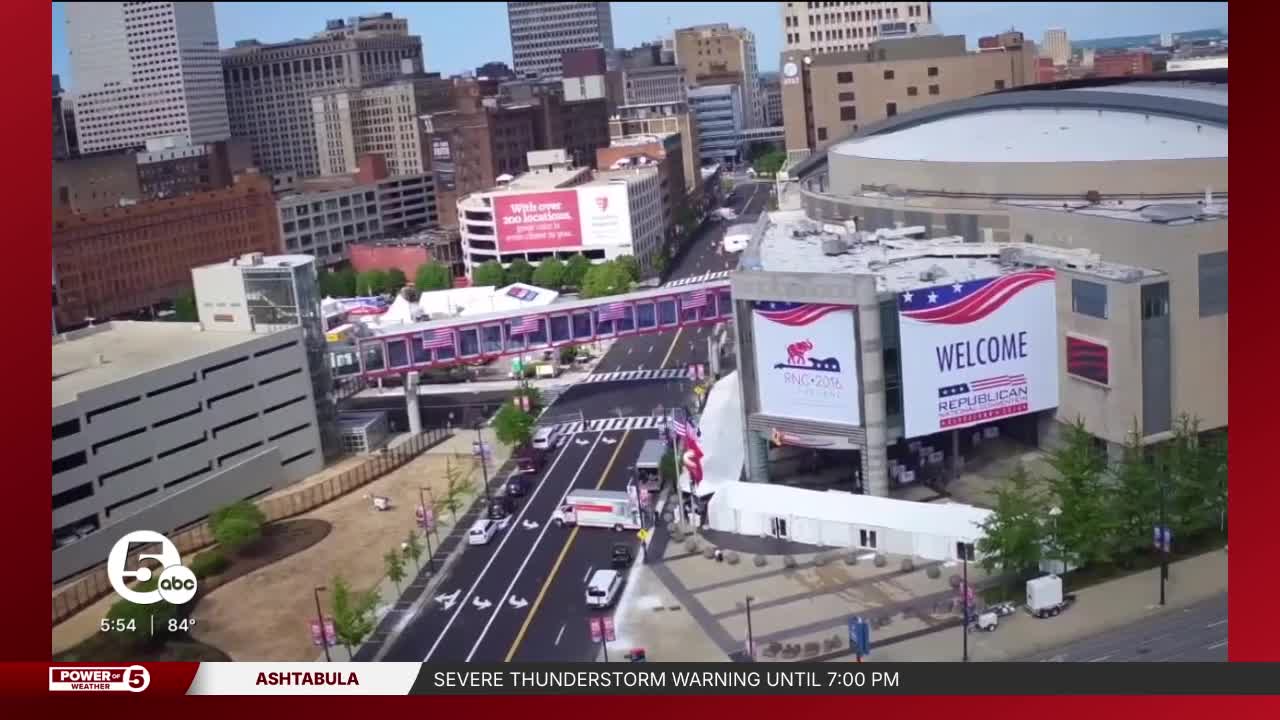


CLEVELAND — Ten years ago today, the Republican National Convention, the first in the city in 80 years, wrapped up its four-day run at what was then Quicken Loans Arena. The gathering brought in 48,000 people, including 15,000 media representatives from all over the world and nearly 2,500 delegates. Pulling it off without incident or the problems that had plagued previous conventions sent a message in the process.
"I think it sent a note to the outside world that sort of, honestly, Cleveland was back," said Destination Cleveland President and CEO David Gilbert, who also led the 2016 Cleveland Host Committee.
It showed Cleveland could play on the big stage and set the stage for the decade of events that followed, including the MLB and NBA All-Star Games, NFL Draft, NCAA Final Fours and the upcoming 2030 Special Olympics USA.
That success literally came out of failure, for it was 20 years ago in the summer of 2006 that Cleveland lost a bid for the 2008 RNC, coming in a distant second to Minneapolis-St. Paul.
"That effort we really were never primed to get," recalled Gilbert. "We didn't have the infrastructure."
But in rejecting Cleveland, the RNC encouraged the city to regroup and come back, recalled former Cleveland Mayor Frank Jackson.
"When we came in second, they actually critiqued us, so we remembered where we fell short, and we made sure that they knew that we had improved over Cleveland 2006."
Between 2006 and 2014 the city would see a total of $4 billion in economic investment downtown including the building of a new convention center, a new public square and the addition of enough hotel rooms to pull off an event of this size. Investments, especially in hotels that served us well over the last decade, but that was a decade ago, said Gilbert.
"Our peers around us, Detroit, Columbus, Cincinnati, Louisville, Milwaukee and others are all building more," he said. "We're now hearing from some, 'As much as I like Cleveland, I can do it [in] another city three hours away, four hours away, five hours away to be in three hotels — I have to be in eight hotels in Cleveland.'"
While Cleveland remains very competitive in this market, he thinks it's time for the city to start thinking big again.
"Right now, we have a beautiful convention center, it's doing really well; it's pretty small. We have decent hotel inventory but quite frankly compared to our peer set it's pretty low in terms of total number of rooms, in terms of number of larger full scale convention-type hotels," Gilbert said, adding he believes the city needs one, if not two, more larger convention-sized hotels. He believes they can fill them, pointing to the recent expansion of the convention center into the old Global Center for Health Innovation space.
"That is already more than paying for itself because of new meetings and conventions that are here specifically because of what was added, and we think of adding exhibition space and more attached hotels, we will continue to fill it, which ultimately drives enormous, enormous dollars into this community," he said.
Hotel and Leisure Advisors founder David Sangree has studied the Cleveland hotel market for years.
"Year to date for 2026, the market is up nearly 9% in occupancy, and the average rate is up 8%," he said. "So 2026 is looking like a very strong year for the city. When you have the market doing that well, it indicates maybe there is a potential for a new hotel supply in the market."
He and Gilbert believe it would likely be some sort of public-private partnership.
"It typically needs some kind of government help," Sangree said. "In my mind, you could have a private developer who has government assistance vs the government doing it all, like with the Hilton. But with that, you'd have to have a developer that comes forward and expresses interest."
"This is where we kind of specialize in doing feasibility work for these types of projects. You have to verify that there's sufficient demand so that if a new hotel like this is built, it could achieve a 65-to-70% occupancy range over a long-term period," he said.
And while the new Browns Stadium in Brook Park will lure a new crop of events in the future and be, in the words of NFL Commissioner Roger Goodell "Super Bowl quality," that won't be quite enough to land the big game.
"We have hotel room needs of close to 50 if not 60,000," said Goodell at the stadium groundbreaking this spring. "You have the stage now, we have to bring the facilities around it."
Cleveland itself may be at half of that, but Sangree said he would hope the NFL would be willing to take a wider look.
"If you look at a Super Bowl in Los Angeles, people are driving an hour drive to stay overnight, they're not all staying within 10 minutes. So when you add up the rooms from Sandusky, Akron, Ashtabula County and Cleveland, all which would be within an hour drive, your room count gets to the 35-to-40,000 rooms," he said. "If you add up those rooms, you realize our numbers are very similar to Indianapolis, and they're just a little bit less than Detroit's."
