

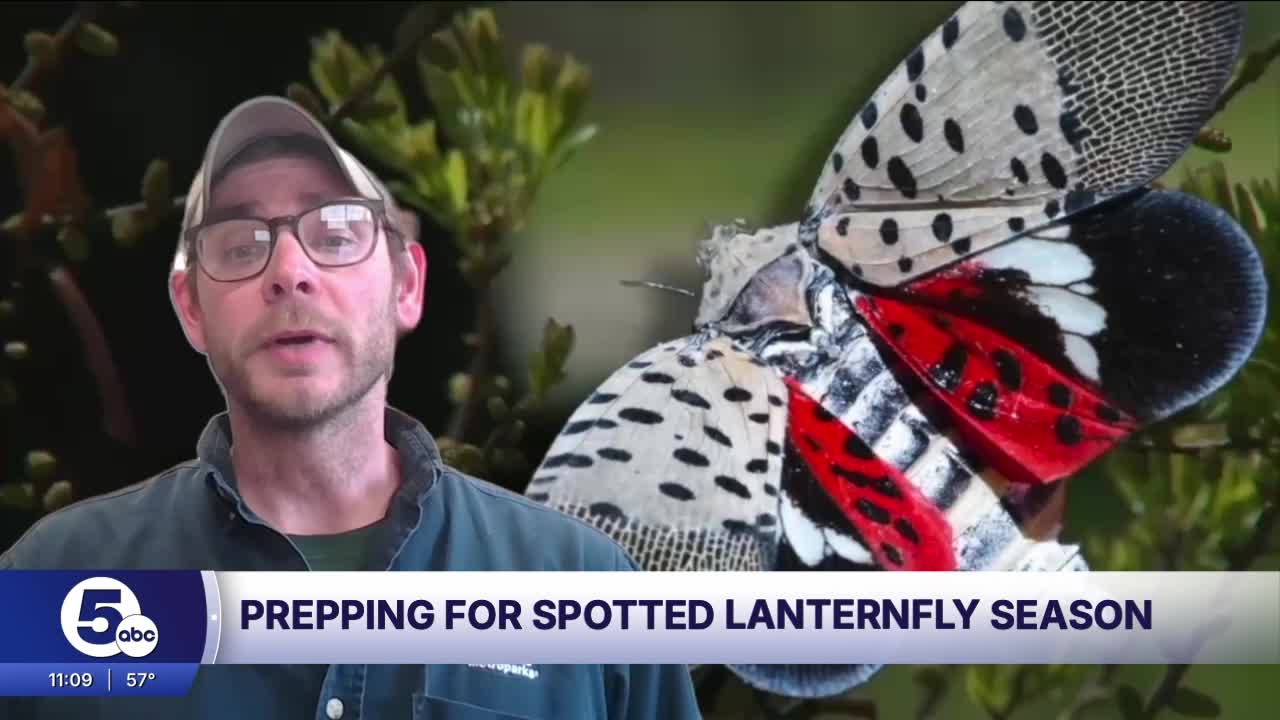



CLEVELAND — Spotted lanternflies will soon return to Northeast Ohio this summer.
Lanternflies were accidentally introduced to the U.S. from Asia. The invasive species causes serious damage to plants and can also make a mess in your yard by leaving behind a sticky substance that produces black sooty mold.
"They’re a big nuisance, they're landing on you, they’re hatching, and they’re catching rides home with you,” said Clevelander Brian Hurd.
That’s why Cleveland Metroparks is stepping in to help reduce the number of lanternflies.
"A lot of what we've done has been regular surveys to control populations that we know are large in areas. We control them using low-tech tools like paint scrapers, fly swatters and shop vacs. We're also doing a lot of surveys in areas for early detection, so areas where we don't necessarily know we have them but want to make sure we can respond quickly and keep those populations down,” said Climate Resilient Forest Manager Adam Regula.
They also have dogs that are trained to sniff out egg masses during the winter and spring months.
"They help us to identify those egg masses, and then we can scrape and destroy the egg masses, which is effective. Within any given egg mass, you can have 30 to 50 eggs, so we're getting a lot of bang for our buck when we're able to go out all winter and control and destroy those,” said Regula.
Their techniques don’t stop there; they’ve also been removing the bugs' preferred host, a non-native species called the Tree of Heaven.
"The Tree of Heaven are nonnative species from East Asia, and so those Tree of Heaven are very important to their life cycle, especially as adults, they congregate around those trees. Those trees are often found in urban areas that have been disturbed, so another effort we do is eliminate its preferred host,” said Regula.
Late last year, they rolled out a new technique called lampshade traps. Metroparks installed several traps on trees in the reservations and was able to collect around 660 egg masses.
"You basically wrap it around a tree, and it creates a sort of a lampshade effect that the adult females like to go in and lay their eggs. So, once they lay their eggs, then we can come back and destroy those relatively efficiently,” said Regula.
And soon, community members will be able to get one of their own. The Cleveland Metroparks plans to distribute 400 lampshades to the community. You can CLICK HERE for more information on lampshade traps.
