

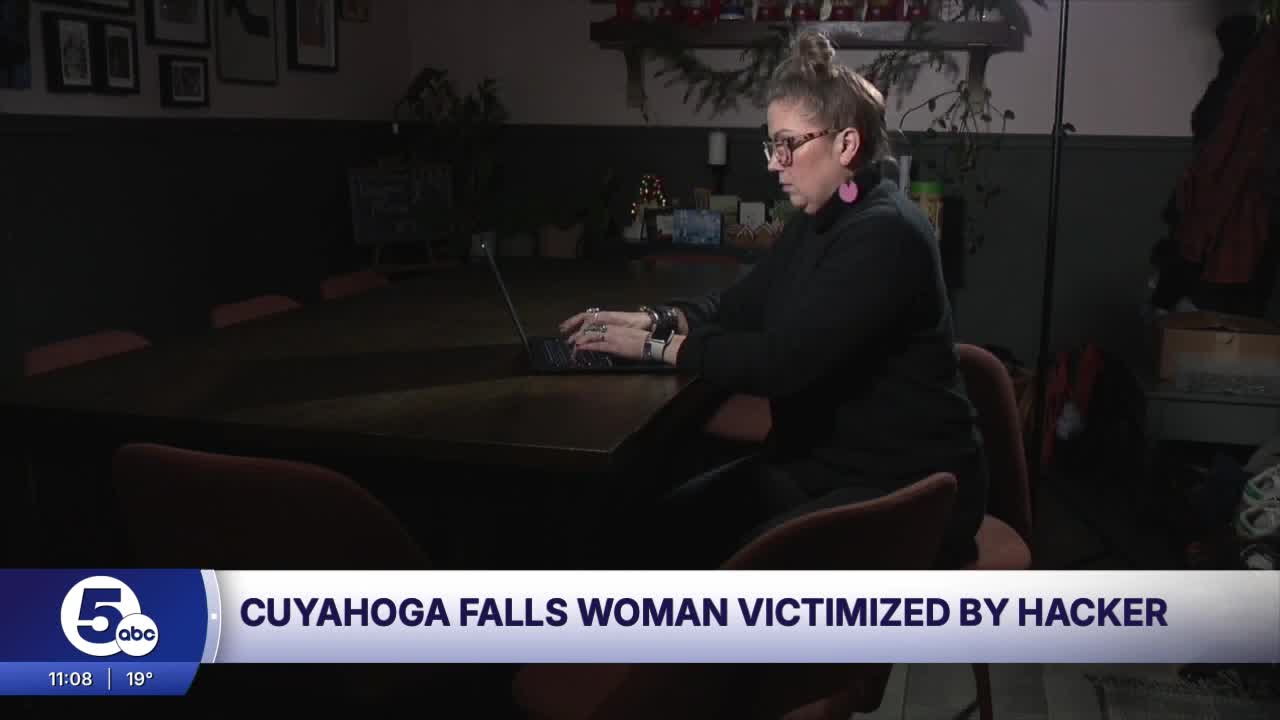


CUYAHOGA FALLS, Ohio — Marie Willis-Guarneri was recently elected Cuyahoga Falls Ward 7 Councilperson, so she should be celebrating.
Instead, she's battling Meta over losing several social media accounts on both Instagram and Facebook.
Willis-Guarneri tried logging on to her Facebook accounts on Dec. 17, but couldn't.
She told me she then started being bombarded with texts from friends and family alleging that her accounts may have been compromised.
"Probably 10, 15 people reached out in various ways: texting me, emailing me, calling me, saying 'I think you got hacked,'" Willis-Guarneri told me.
A fraudulent post was then shared on her profile claiming her uncle's health was declining, which is forcing her to sell his things.
Expensive items were listed for sale, such as a 2018 Toyota Highlander and a Rolex watch.
"A friend did think that they were reaching out to me and buying something for Christmas, and now they're out $750, and they've not gotten that money back," Willis-Guarneri said.
Willis-Guarneri said the impersonator is also buying advertisement space on Meta and has purchased profile verification.
Willis-Guarneri hopped on her Instagram to see if it had been compromised, too.
While she was able to log on, she found messages between Instagram's customer service and someone who was impersonating her.
The impersonator asked Instagram to reset the email and password associated with Willis-Guarneri's account.
In total, she lost her campaign page, two personal accounts, two business profiles, and one account for a nonprofit she was working on.
A police report has now been filed with the Cuyahoga Falls Police Department regarding her friend losing money.
"I feel terribly guilty because it's happening under my name," Willis-Guarneri said. "I have a lot of photos on there. I have 20 years of photos. It's not about creating a following or having influence. It was a scrapbook of my family, and that's gone now."
She told me she's had two conversations over the phone with Meta customer service in an attempt to recover her accounts, but that she was never offered a resolution.
"They just said, 'Sorry, I know you're really frustrated, but there's absolutely nothing we can do.' That's ridiculous. That's not an answer to me. That's not a solution," she said. "That's not OK that users are not safe using these platforms."
Willis-Guarneri said she had difficult passwords in place and different emails associated with her accounts, so she wants to know how this could have happened.
I reached out to Meta on Monday to figure that out.
A representative told me the situation is being investigated, but didn't provide further information.
Meta said it plans to reach out to Willis-Guarneri.
Advisory Solutions Director for TrustedSec, Alex Hamerstone, told me he believes this situation was targeted.
"If you're a scammer and want to scam other people, using a trusted account, you know, can really further those goals," Hamerstone said. "For any of us, if somebody we know and have been friends with for 10 years online reaches out to us, asking for money or needing something or offering a service, we're much more likely to, you know, go for that than somebody random."
Hamerstone said it's never the victim's fault, no matter how much it might feel that way.
He told me it's difficult to steer clear of intellectual crimes as such, but suggested extra layers of protection, like a multi-factor authentication process.
"It's not infallible, but I would say it's a seat belt. It won't save your life every time, but you still would never leave home without wearing it. A lot of these things aren't perfect, but it's helpful," Hamerstone said.
He also recommends complex passwords and setting up alerts for fraudulent activity.
"Something that you're not paying for and not subscribing to and kinda getting for free don't always have the best customer service, you know, or the most extensive," Hamerstone said. "That can be a little bit tough, but yeah, it really is unfortunate when you hear these stories fairly often where somebody loses access to their account."
Hamerstone recommends not giving in to ransom threats, as you may never know if they'll actually give back your social media account.
"These are professional scammers. They're very good at it, you know, so this is kind of their full-time occupation," Hamerstone said.
Willis-Guarneri said that whether or not she gets her accounts back, she wants to see something change within Meta to better protect users.
"There has to be a solution for everybody," she said.
Meta recently announced new ways to access account assistance on Facebook and Instagram.
I'll continue to check in with Meta regarding the outcome of its investigation.
If you have something you need me to look into, please email me at Kaylee.Olivas@WEWS.com.
