

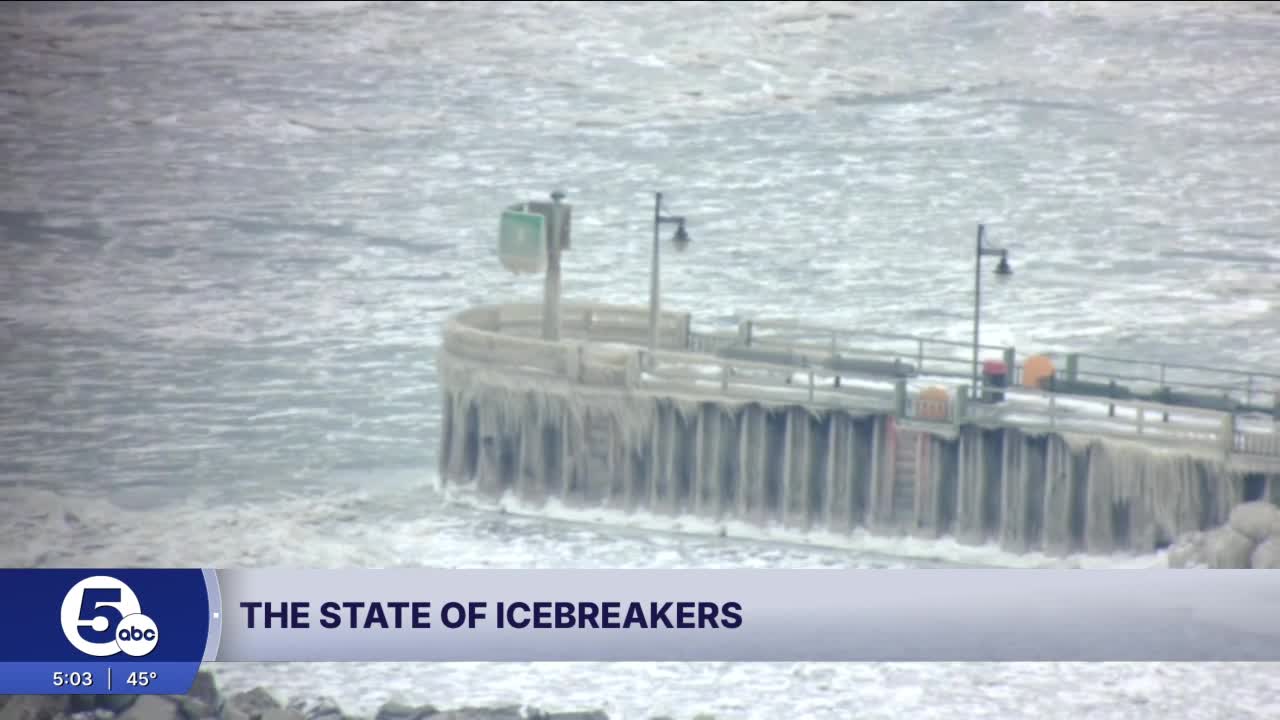


CLEVELAND — Ice on Lake Erie is a familiar sight most winters, but as we've been telling you, an exceptionally cold December brought the earliest appearance of ice on Lake Erie in 17 years. That early formation leading into early January is a pivotal time for shipping on the Great Lakes.
"These are critical days in the shipping industry. We need to make sure that our steel mills have enough supplies on the ground to get through the winter," said Jim Weakley, President of the Lake Carriers' Association, which represents the companies operating cargo vessels on the Great Lakes.
Operators that are heavily reliant on the ice-breaking services of the U.S. Coast Guard, especially in early January, in these few remaining days before the various locks and canals connecting the Great Lakes shut down.
"Remember it's a system that's connected, so even if the ice breakers are working on Lake Erie effectively, if they can't from Lake Superior through Lake Huron to Lake Erie, Cleveland Cliffs is going to be in a world of hurt," he said.
The early freeze is also impacting the Coast Guard's ability to tend to other annual issues, like removing navigational buoys.
"They have to transition from pulling buoys out of the water before the ice forms so that the systems, the ice doesn't drag the buoys off station," he said. "That happened in the St. Mary's River. They didn't get the buoys out quick enough, so the St. Mary's River that connects Lake Superior to Lake Huron was shut down for a day because the ice had moved the buoy in."
We first spoke with Weakley about the growing problems of dealing with ice on the Great Lakes in 2022.
"We are just ice breaker poor," he said at the time. "In 1979, the U.S. Coast Guard had nearly 20 ice breakers between the Canadian and the American Ice Breaker fleet; now we're down to 11."
So, three and a half years later, has the problem improved?
"No, in fact, it's gone downhill. We're still at 11, but those 11 we have are less reliable," he said. "The U.S. Coast Guard has had some engineering casualties, so currently two of their vessels are done for the season and earlier in the year, they had another one, the Mackinaw, their only heavy icebreaker, that had some engineering casualties as well. Fortunately, the Mackinaw's in the fight. We've been advocating for years that we need a second heavy ice breaker like the Mackinaw. It's been authorized, and we were close in the reconciliation bill, but it was the only type of ice breaker in the entire U.S. Coast Guard that wasn't funded."
Weakley doesn't blame the U.S. Coast Guard for the ice issues currently facing freighters, saying they're inadequately funded with an updated fleet badly needed. He did, however, take issue with our Canadian counterparts.
"The Canadians aren't doing their fair share, I'll just be characteristically blunt. They have done absolutely nothing, zero, zero since the 15th of December when ice breaking started on the Great Lakes," he said. "It drives us crazy, it's literally us subsidizing the Canadian taxpayer, us subsidizing the Canadian industry. Like I say, if you have a snowblower and you always do your neighbor's yard. They're never going to buy a snowblower."
"They're supposed to have two icebreakers on the Great Lakes; they've had one of them has been broken, it's done nothing except sit at the pier all year. The second one, they actually took out of the Great Lakes and sent it up the seaway rather than taking a Canadian icebreaker from the east coast and work the seaway. They stole one of the two Canadian icebreakers and sent it up the seaway, and it's not due back until the 17th of January. That puts more pressure on the Americans to not only work in our waters but also work in the Canadian waters."
Several years ago, the Lake Carriers' Association commissioned a study of the previous three winters and found there was $2 billion in lost economic activity as a result of ice on the lakes.
"And jobs," Weakley said. "I think we calculated 20,000 jobs lost because of the opportunity cost of that, you know, billions of dollars that wasn't made from the steel that wasn't created from the iron ore that wasn't moved because the ships were stuck in the ice. It's just like our nautical highway. Could you imagine the outcry if we didn't keep our highways plowed? Think of the economic impact when one of our ships in a single load can carry the same amount of cargo as 2,800 dump trucks."
With the Soo Locks set to close for the season on Jan. 15, he said some ships delayed by ice will be cutting it close.
"Absolutely, we will cancel loads because we don't have enough shipping season left," he said. "So as the Soo Locks close on Jan. 15, you've already got your layup dock selected. So you need to be on the correct side of that lock when it closes, and that may mean that you're going to have to cancel your last cargo of the year and sometimes your last two cargoes of the year."
That, as he mentioned, could impact mills like Cleveland Cliffs. The iron ore they take in from the upper Great Lakes flows through the Port of Cleveland's bulk terminal. They remain hopeful that the impact in these final days will be minimal.
"We're seeing a bit of delay," said the Port of Cleveland's Dave Gutheil. "I'm not aware of any vessels that have been outright cancelled because of ice conditions up in the upper Great Lakes; it's just taking a little longer," he said. "I haven't seen anything thus far that would necessitate an emergency situation, so to speak."
News 5 reached out to Cleveland Cliffs but did not hear back.
For its part, the U.S. Coast Guard said in a statement:
“The Maritime Transportation System is vital to the economic security of the Great Lakes Region, and the U.S. Coast Guard works closely with our Canadian and industry partners to ensure the safe and timely movement of goods and people on our federal waterways."
