

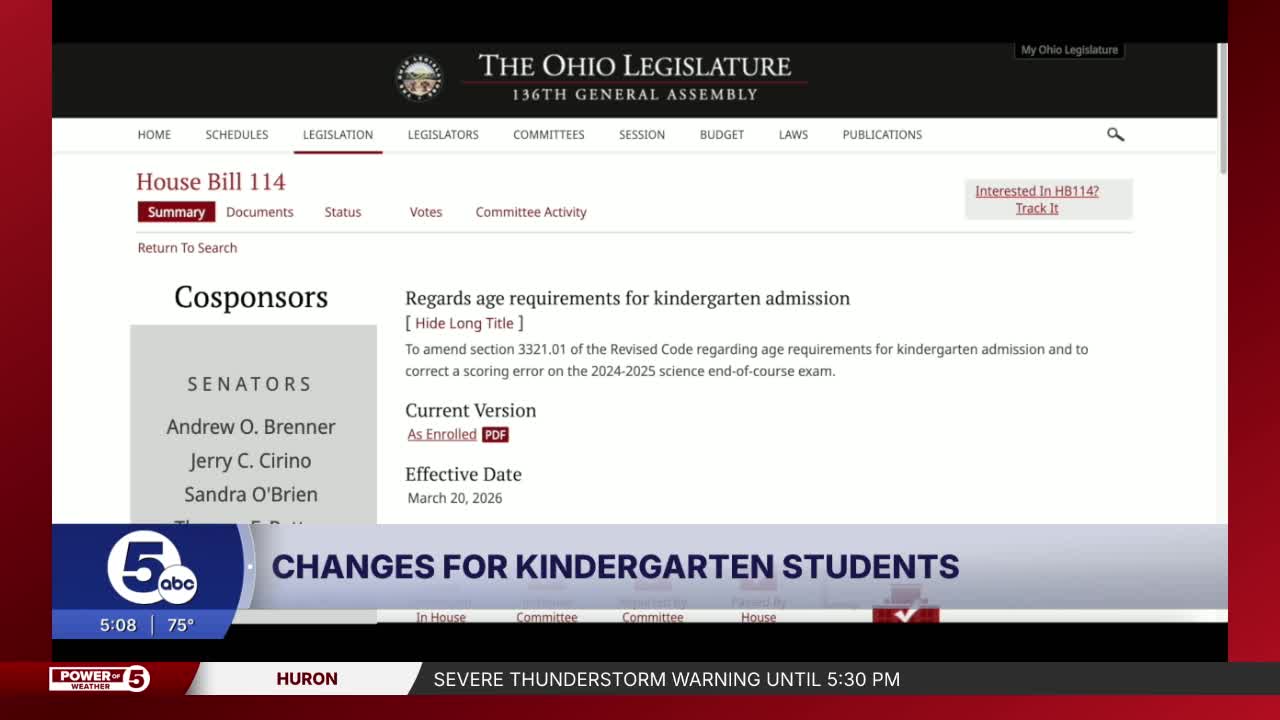


In mid-March, a new law went into effect requiring children across the state to be 5 years old by the first day of school in order to start kindergarten.
Kindergarten is a major milestone for both children and parents, but now a child’s birthday plays an even bigger role in determining when they can enroll.
That’s because late last year, Gov. Mike DeWine signed House Bill 114 into law. The legislation requires children to turn 5 on or before the first day of school. Previously, districts could choose between an Aug. 1 or Sept. 30 cutoff.
“We want everybody that starts kindergarten to already be five, not going to be five,” said Senator Tom Patton, who co-sponsored the bill.
Patton says age is critical for a child’s development and early learning.
“We think this gives our younger children the best opportunity to get off to a running start, and by the time they do get to third grade, they'll be able to successfully pass that third grade reading guarantee,” said Patton.
He added that for children who may need to wait an extra year, the long-term benefits outweigh the delay.
"Studies have shown significantly that children who go to preschool it establishes a stronger base. They're more social, and they hit the ground running," said Patton.
Schools have already begun notifying parents, including in Lakewood, where the first day of school is August 27. However, other districts, like Cuyahoga Falls, have raised concerns about confusion over what qualifies as the “first day,” since it can vary from year to year.
In a statement, the district said:
"House Bill 114 raises important practical questions for our district and the families we serve. While we are carefully reviewing the legislation and its implications, we have identified two areas of concern that we believe warrant further clarification.
First, the bill ties kindergarten eligibility to the first day of instruction, a date that shifts from year to year and varies by district. This lack of consistency makes it difficult for families to plan ahead and know when their child is eligible to register for kindergarten.
Second, the bill does not define what constitutes the "first day of instruction." For example, it is unclear whether this refers to the first day kindergarteners enter the building, even if only for screening or assessments, or the day formal instruction actually begins. That distinction has real consequences for how eligibility is determined.
We are committed to ensuring a smooth and equitable transition to kindergarten for all families, and we hope to see these questions addressed as the legislation moves forward."
We reached out to parents on social media and in person, and they have mixed reactions to the change.
“It's hard for parents who are working and figuring out a half-day school, full-day school, and so I think it's a mix,” said Elaine Hagan, a grandparent of a child heading to kindergarten.
“When they start kindergarten. To me, it doesn't feel like that big of a deal. It's one of those life parameters that you just deal with, and you move on, and you make do,” said Laura Hunter, a parent of a child heading into kindergarten.
The law still allows for early admission in certain cases, such as when a child turns 5 by Jan. 1 and passes an evaluation, or through a district’s acceleration policy.
