



HIGHLAND HEIGHTS, Ohio — Imagine having so much to say—but no way to say it.
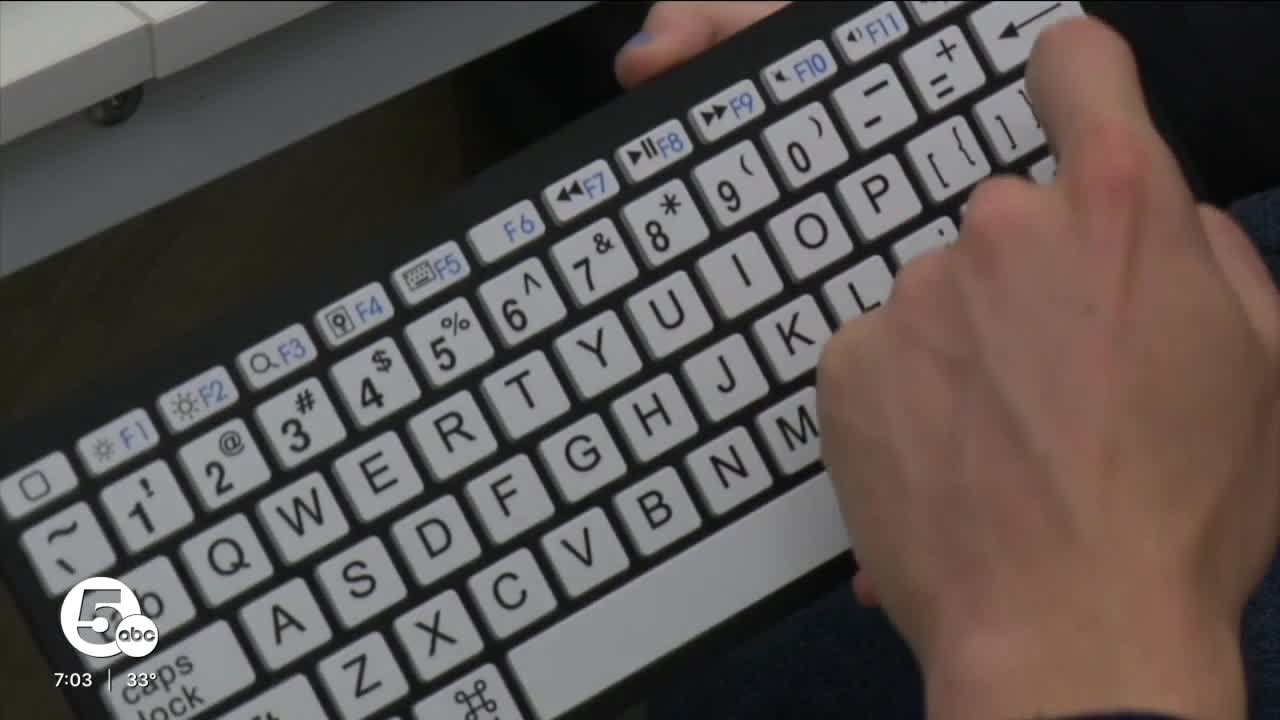
That was life for one man, until things started changing, one letter at a time. Now, with a simple keyboard, he and other non-speakers are able to share their thoughts, personality and voice through spelling to communicate.
Each letter becomes a word, and each word can open up a whole new world.
“I knew that he was smart. I didn't know he was as smart as he really is,” said Megan Velotta
Meet Charlie Velotta and his mom, Megan.

It was early in Charlie’s childhood when Megan learned her son was autistic and non-speaking.
“Charlie was walking and talking, and having a normal development until about 16 months, and he slowly started to lose his words. We call it regressive autism,” said Megan.
For nearly two decades, they relied on tools like TouchChat—an app that uses customizable pictures and words to help with communication.
“It had simple language—‘I’m hungry,’ ‘I need to go to the bathroom,’ ‘I want water,’” Megan said. “It worked functionally, but those weren’t really his words.”
Then, three years ago, everything changed when Charlie began spelling to communicate.
“Once they're using the spelling to communicate, they can actually have an open conversation,” said Megan.
LeeAnn Ditomaso and Samantha Paros founded Access S2C to teach non-speaking individuals how to use letters to spell the words they’re thinking.
“We're working on a gross motor skill to point to letters on a letter board, and then eventually, if they wish to use a keyboard with an iPad that will speak for them,” said Ditomaso.
Since opening three years ago, they’ve worked with about 100 families. Ditomaso said spelling doesn’t just give people a voice—it unlocks what’s already inside.
“We're not testing their knowledge on it. The knowledge is there. This is a way to get the knowledge out,” said Ditomaso.
State Sen. Casey Weinstein has seen the impact firsthand.
“I think any technique or tool that helps people have a voice and feel heard is valuable,” Weinstein said.
Under his new AAC coverage bill, those tools could soon be more accessible.
“These devices are expensive, and insurance often rejects coverage for them, so this bill would mandate coverage for those devices, whatever device the individual needs to to be able to communicate and the associated services,” said Weinstien.
We also reached out to the American Speech-Language-Hearing Association, or ASHA. While they say they aren’t opposed to spelling methods, they do raise concerns.
“You can’t tell whether the words being spelled out belong to the autistic child—or to their aide. The aide holding the alphabet board may move the board unintentionally in the direction of the letter that they think the child should select next,” ASHA wrote.
That’s something Megan doesn’t agree with, especially after seeing the impact on her son.
“You go to a restaurant and for so many years, you just order what you think he wants.” Megan continued, “Now he’s like, ‘No, I’d like a hamburger with french fries,’ or 'I don’t want that. Mom, today I’d like some pasta marinara with a meatball, please.'"
While we were there, Charlie had a lot to say, typing by himself, with his mom and Paros.
“He doesn't want any of his friends or peers or people like him, to go without a voice. He wants to give every single person that doesn't have a voice a voice. It would be like keeping Braille away from a blind person,” said Megan.
We asked Charlie how spelling has changed his life.
“I dreamed of an opportunity like this one and it would have never been possible without the life changing method of spelling to communicate,” Charlie typed.
We also talked about sports, food, and even his favorite books. He was excited to spell—but more importantly, to be heard.
“Thank you for believing in non-speakers,” Charlie typed.
To learn more about S2C click here.
Nadeen Abusada is a Cuyahoga County and immigration reporter at News 5 Cleveland. Follow her on Instagram NadeenAbusada or email her at Nadeen.Abusada@wews.com.
