

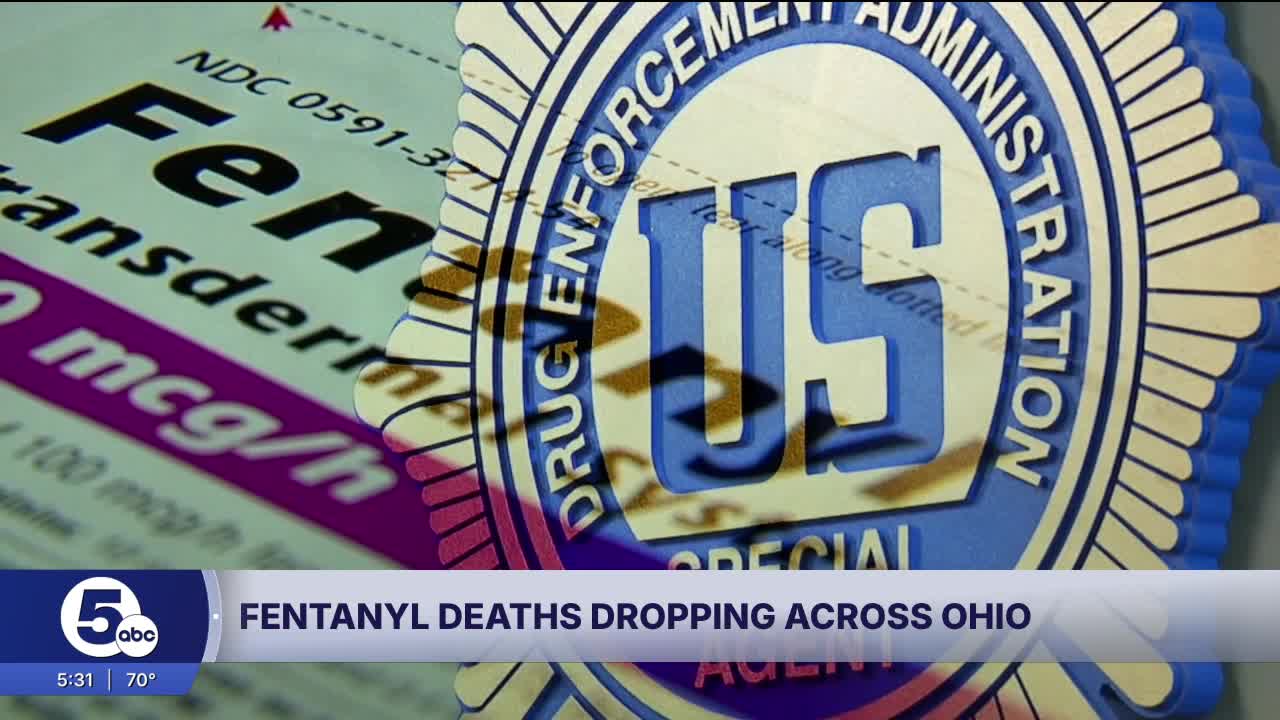


KENT, Ohio — During his State of the State address, Governor Mike DeWine touted as a major accomplishment a decrease in the number of accidental overdose deaths in Ohio.
"For the third year in a row, unintentional drug overdoses have decreased -- this time by an astounding 34%," he said.
It comes as the Drug Enforcement Administration launched an initiative last year intended to attack the opioid epidemic, and specifically, fentanyl.
Joseph Dixon, special agent in charge of the DEA's Detroit Field Division, told News 5 the agency is committed to stopping the drug's spread.
"Fentanyl is one of the worst drugs we've seen in this country — one of the deadliest drugs, but we will not stop until we cut off the head of the snake," Dixon said.
It takes just two milligrams of fentanyl — smaller than the tip of a pencil — to kill a person.
What does battling fentanyl look like in Ohio?
Last year in Ohio, the DEA seized 42 kilograms of fentanyl, enough to kill every man, woman and child in New York City... twice.
Data from the Ohio Department of Health shows a steady decline in unintentional overdose deaths since 2021.

Karyn Kravetz, associate director of the Mental Health & Recovery Board of Portage County, said they're seeing users do their best to shift away from fentanyl to other less-deadly drugs.
"The drug landscape is always changing, and that's true for decades," Kravetz said.
While the shift away and the increased enforcement by the DEA have impacted the supply of fentanyl in Ohio, Kravetz credits much of the recent decline to improved access to naloxone, the overdose-reversing drug also known as Narcan.

"There used to be a little more barriers to having naloxone or Narcan," she said. "People would have to take a class or come in person. I think a lot of people were afraid to do that. Now you can get it out of a vending machine, and we have several throughout the county."
One of those free Narcan vending machines was installed last year in the lobby of Townhall II in Kent, available to anyone who needs it.
For Chris Leonard, the opioid crisis is personal.
"I've struggled with it personally in my family," Leonard said.
Leonard serves as the chief clinical officer at Townhall II, the Kent-based behavioral health organization that helps those with mental health and addiction conditions.
"It hurts the individual, it hurts the family, it hurts the community," Leonard said.
For Leonard, the path forward in the fight against fentanyl is rooted in empathy.
"When someone is struggling, you meet them with compassion and you meet them where they're at," Leonard said.
Clay LePard is the Ashtabula, Geauga and Portage counties reporter at News 5 Cleveland. Follow him on X @ClayLePard, on Facebook ClayLePardTV or email him at Clay.LePard@wews.com.
