

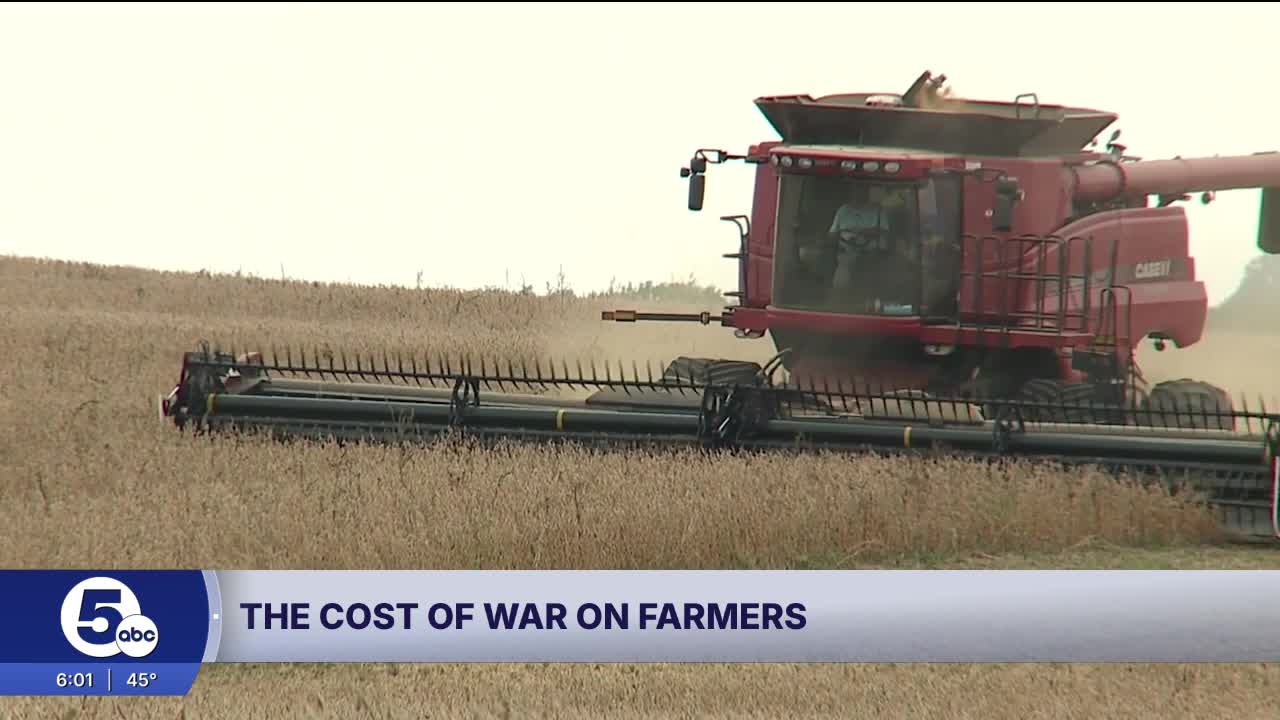


MANTUA, Ohio — Farmers around Ohio are half a world away from the military conflict in Iran, but what's playing out there is having a direct impact on their ability to grow crops here, as they feel the same pain at the pump, if not worse than what drivers are seeing.
"We call it off-road fuel," said Portage County farmer Chuck Sayre. "Tractors burn a different type of diesel fuel than regular trucks. It's moved almost $2 gallon right now."
During the spring planting season, Sayre said he'll burn through about 10,000 gallons. "That 10,000 gallons is an extra $20,000 for us to plant our crops this spring, and we're a small farm."
Diesel is just part of the impact. The other is fertilizer; a lot of the world's key fertilizer ingredients that end up in Ohio fields originate in the Persian Gulf and flow through the Strait of Hormuz.
"Fertilizer follows fuel, and it also follows world politics, so when we upset other nations, they get upset, the prices go up," Sayre said, with some nitrogen products up 40-70%. "So to plant our corn, it's twice as expensive now to plant corn."
Portage County Dairy Farmer Jared Phillip feels it as well, "Between fertilizer and fuel, it's going to put people in the negative real quick."
Phillip raises cattle and some crops for feed he too is seeing the impact.
"We still have the same input costs, and we still have the same feed costs to feed those cattle. Whether the price goes up or down, it is going to be a huge impact with the price of fuel and fertilizer this year."
That's something the Ohio Farm Bureau says only adds to the uncertainty that farmers already have enough of.
"With the uncertainty of fertilizer prices going up and how long they'll be there, as well as how long will diesel fuel be at $5 or more a gallon, it's definitely a stressful situation," said Brad Bales, senior director of state and national policy for the Farm Bureau.
"When it comes to fertilizer and fuel, especially as we're starting our planting season, this is timed very poorly for us because we already have very high input costs," he said.
It comes at a time when farmers are struggling to at most to break even on the crops they plant.
"Nationally, we have 15,000 fewer farms than we did in 2024. When it comes to farm bankruptcies, they increased 46 percent in 2025," Bales said. "This is just going to be another added difficulty."
Sayre has seen it firsthand in his community, "Last week, for instance, I just went to a farm where he was in business for 60 years, and he sold out. We're seeing a lot of that."
It's a pain that consumers will share, if not immediately, said Sayre.
"The crops that we're planting this spring won't be harvested until fall, won't go to the market til winter, you know it takes time," he said.
In Washington on Thurday, News 5 asked Sen. Bernie Moreno what his message would be to those farmers and, in turn, the consumers who would see higher prices as a result.
"We had to take action. We had to take action against a hostile regime that for 47 years has wished horrible pain and suffering on America," he said. "I'm hoping and praying that our soldiers are there safe, that we don't have any further casualties, and that this conflict ends very very quickly."
So too are farmers like Sayre. "It's difficult. It's putting farmers in (a) really difficult place," he said.
