

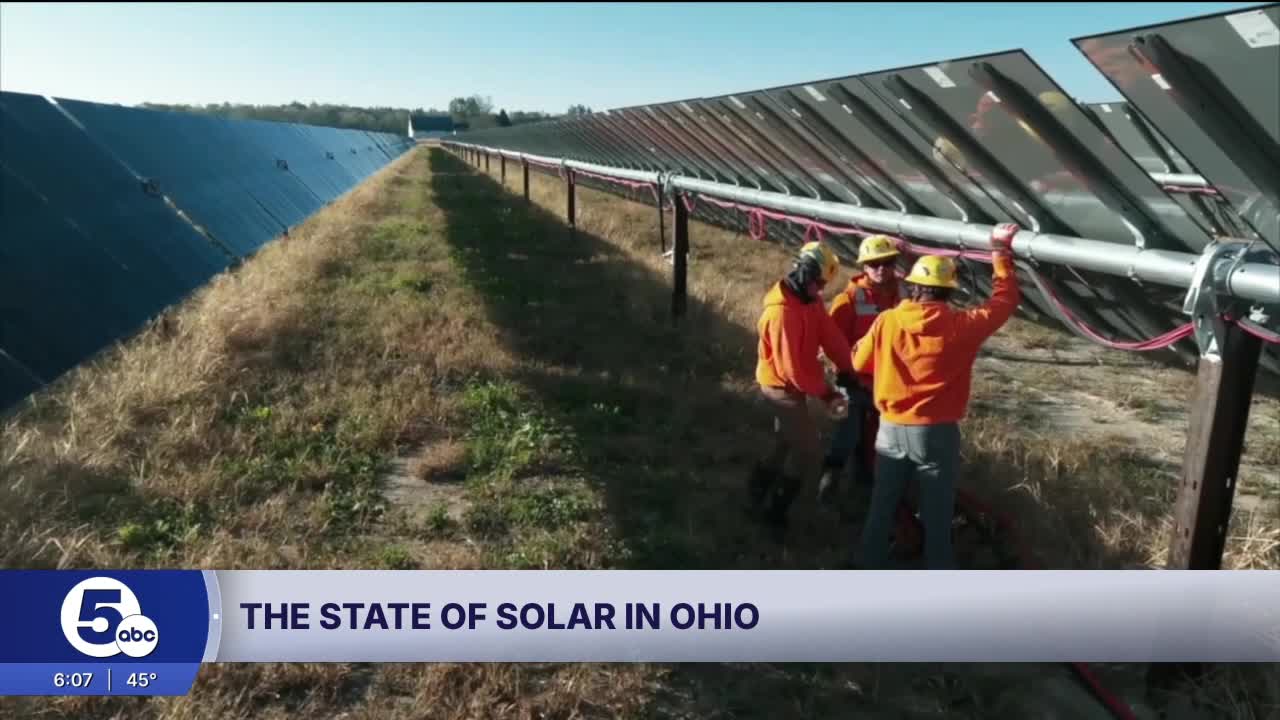



RICHLAND COUNTY — It’s getting hard to build wind and solar farms across Ohio, including in the unincorporated parts of Richland County. Senate Bill 52 gave county commissioners the choice to decide if they would allow solar farms in their unincorporated townships.
Richland County Commissioner Darrell Banks said they sent out a letter to all 18 townships asking if they wanted to ban solar farms in their township. In July 2025, 11 out of the 18 replied yes. The 11 townships are: Monroe, Blooming Grove, Jackson, Franklin, Mifflin, Jefferson, Sharon, Monroe, Troy, Plymouth, and Weller.
But local groups and International Brotherhood of Electrical Workers Local 688 are working to get that changed in the upcoming election.
Brian McPeak from IBEW and advocates of the "No ban on Property Rights" have been campaigning and hosting town halls to inform voters on why they should vote to make industrial solar projects legal throughout Richland County in May.
“We just want everybody to make an educated decision,” said McPeak.
McPeak claims that by 2030, the demand for power in Ohio could double.
“At this point we're not doing anything to get more production online. So, this is just another path that we can take, and coal fire and nuclear power plants can take 15 to 20 years. However, to build a solar field you're looking at probably 24 months on average from start to finish,” said McPeak.
McPeak is worried about the continued increase in power demand and fears the county could be headed for rolling brownouts and blackouts.
"The first people that are going to be kicked off the grid because of the demand and lack of supply are going to be individuals specifically in rural areas. They're going to pump power into the industrial areas, the data centers and manufacturing facilities first. Rural areas are going to be second on top of that and electric bills are going to go up,” said McPeak.
Banks says the 11 townships have made it clear they want to keep their farmland solar-free.
“They don't want to look at the solar fields across the way from their homes and we're hearing some of the things that are supposed to be coming true with solar farms in other areas are not,” said Banks.
Although Banks is against building on farmland, he is not against solar farms being built in city areas like Mansfield to help with the county’s electrical needs.
“We have a landfill we're no longer using in Mansfield, and we want to use that land. They are thinking of putting a solar farm there which makes perfect sense to me to put it on land we can't use as a farm or anything,” said Banks.
McPeak said it’s not just about renewable energy; solar farms can provide hundreds of jobs to areas that desperately need them, attract other businesses and bring money into the local economy.
“Instead of solar farms paying property taxes they pay directly to the taxing jurisdictions of the county. That money goes directly to the townships, to the schools, the fire departments and so forth,” said McPeak.
If the referendum does NOT pass on the May 2026 primary election ballot, industrial solar would be legal throughout the entire county, but McPeak says there will still be a process the companies must go through, and not every solar farm project will be accepted.
To learn more about solar farms, the next town hall meeting is on March 28 in Madison Township.
EDITOR'S NOTE: A previous version of the story said that if the referendum does pass, industrial solar would be legal.
