

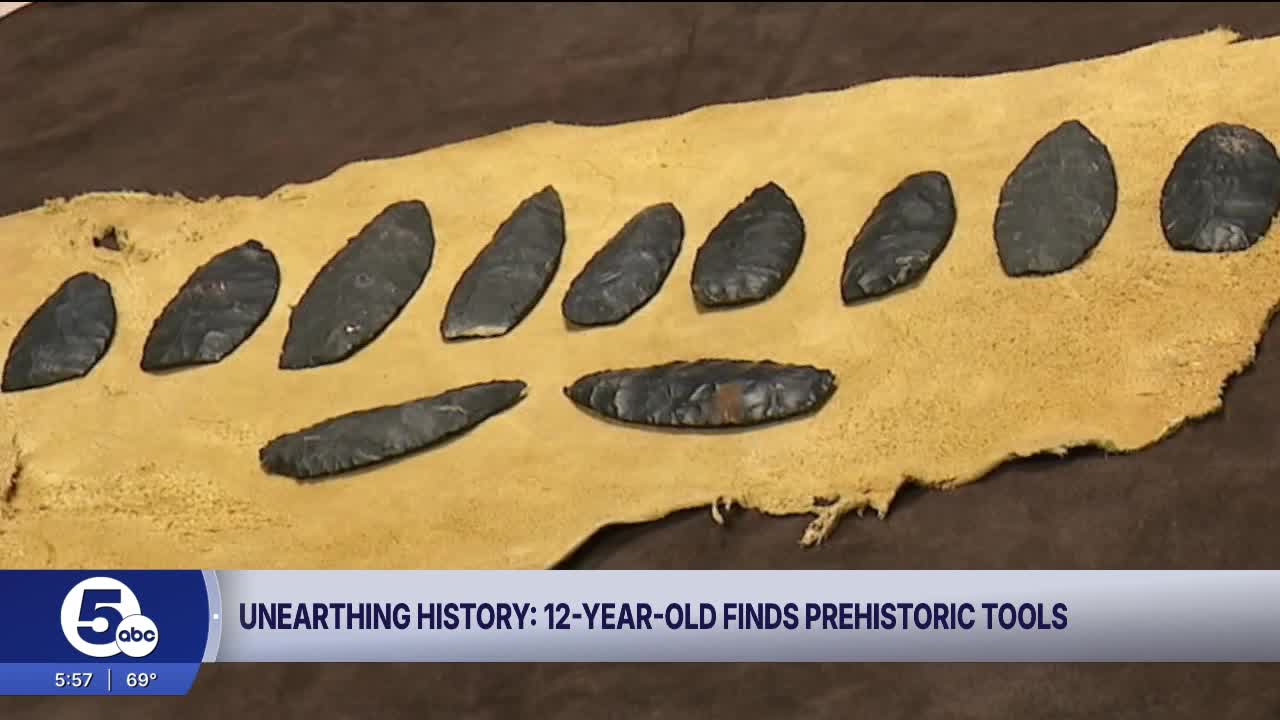


SUGARCREEK, Ohio — A Norton teenager made a discovery at the age of 12 while on a trip that would surprise scientists in the years to come.
Joshua Fetter, 17, was on a family getaway in Sugarcreek in 2021 when he started exploring an open field and a section of land that was under excavation.
He never imagined the science spotlight would be shining so brightly on him because of what he found.
"I'm like holding this big thing, and it's exciting, and then it's like, there are more, ya know? So, I started digging them up," Fetter said.
Archaeologists said he uncovered nine prehistoric stone tools that look like arrowheads and could be about 2,000 years old.

"I mean, the first time I saw them, I honestly was a little creeped out by it. I thought it was like some weird plant," Fetter said.

Scientists went back to the site and found two more.
"Some of the most significant archaeological finds are made by members of the public who may not exactly know what they found," said Kent State Professor of Archaeology Metin Eren.
Eren said extensive testing was done on the artifacts over five years.
Conclusion? The artifacts Joshua stumbled upon are likely connected to prehistoric Adena Indian culture.
"And it's one of the earliest complex societies in North America," Eren said.
Fetter finds it "really cool" that he made the discovery.
"I definitely enjoy telling new friends and people I know. It's definitely an interesting story to tell," he said.
While these appear to be prehistoric stone tools, archaeologists don't believe they were used as tools at all, but were more likely buried as some kind of ritual to the Earth or to the gods.
"This is a lot of work to make these artifacts just to bury them and never use them again," Eren said.
Because of the unusual find, Joshua is listed as one of several authors on a paper about the artifacts that will be published in the Journal of Archaeological Science Reports.

"It's not something that everybody gets to experience, so it's a special thing, but being in a paper is pretty exciting," Fetter said.
In addition, the stone tools will now live at the Cleveland Museum of Natural History.
"Scientists around the world, archaeologists, scientists can study and learn from Joshua's discovery," Eren said.
