

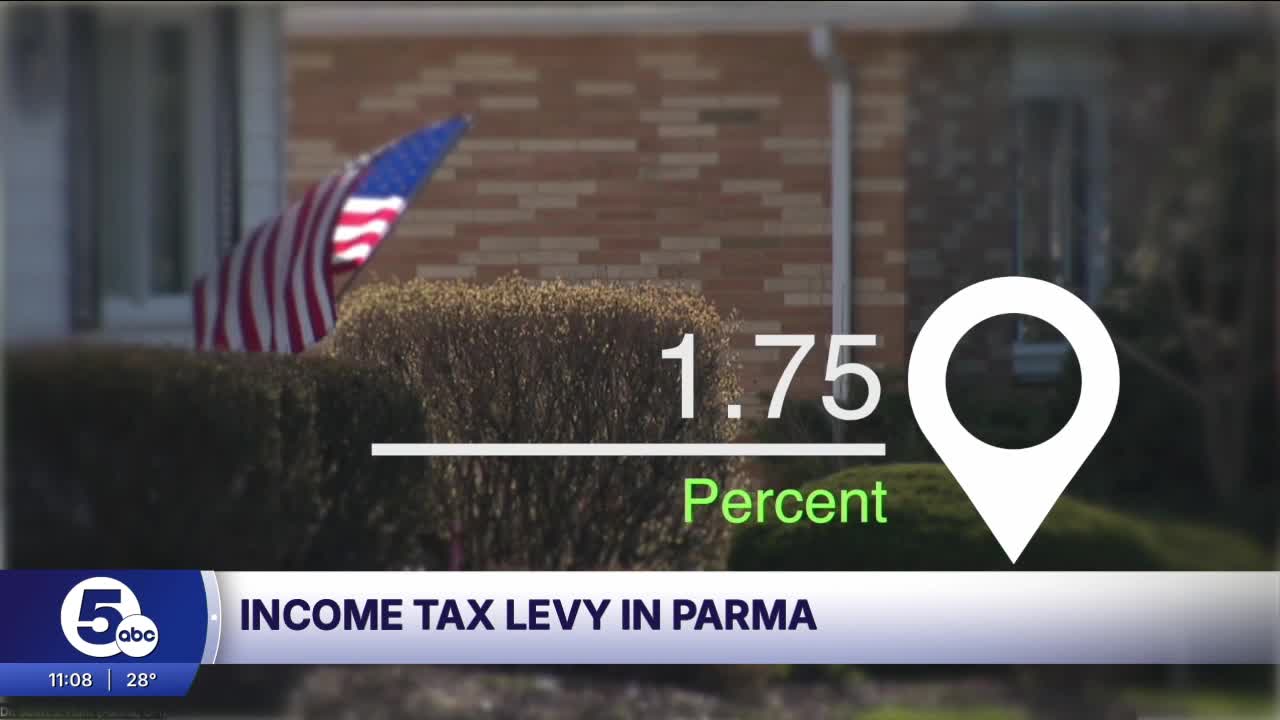


PARMA, Ohio — For the first time in Parma City School District history, the board is offering to eliminate three property tax levies, but only if voters say yes to a 1.75% earned income tax.
If the income tax were to be approved by voters, the Parma district school board has passed a resolution as of mid-March that essentially promises to stop collecting on property tax levies set to expire in 2030, 2031, and 2034.
The collection of those property tax levies would cease in January 2028.
The income tax would begin collection in January 2027.
The earned income tax would only apply to wages, salaries, and self-employment income.
"What we're attempting to do is shift our reliance on property tax to generate revenue for us and pivot to this earned income tax. This is a different request," Parma City Schools Superintendent Scott Hunt told News 5.
The average $100,000 district homeowner in Parma, Parma Heights and Seven Hills would annually save $500 in property taxes with the elimination of these levies.
"We're also looking at making reductions district-wide over the next three years. It was part of that resolution; $9 million over three years. Our commitment is to remain financially transparent, to do the things that we need to do to be fiscally responsible," Hunt said.
Parma City Schools last passed a new-money operating levy in 2011. The most recent attempt at a levy failed in November 2025.
Hunt said the board had discussed a larger levy request this go-round, but ultimately concluded that anything beyond a 1.75% earned-income levy would fail by a wide margin.
With the 1.75%, Hunt said the district would collect $50.3 million in exchange for the $40.5 million that the three property levies do.
"That net increase doesn't sound like a lot, but because it's an earned income tax, our hope is that people's income grows each year, and this helps sustain what we would collect in the future, and it would be more than just that flat property tax collection that we get," Hunt said. "We're in a position where we don't get help from the state in terms of the budgeting process or fair school funding, and we're in a situation now where we have to find a way to generate revenue. We know we can't invest in Bitcoin, and we know we're not winning the lottery, and so, this is how we have to attempt to do this."
On March 24, I asked a Parma Facebook group chat whether they'd vote yes on this exchange. The overwhelming majority said no.
"I've been here long enough to see plenty of levies. I've supported some and not supported others. I'm a hard no on this one. It's an income tax, and we're already paying a pretty good chunk of money into our income tax system for the city, and then just to add another 1.75% — it's a lot to ask for," Jeff Uzl said.
Uzl has lived in Parma for 30 years.
He said an income tax is far from the answer and needs to be evaluated by the school district.
"I've done the math on it. The median household income in Parma at $69,000. That means that half the households are going to face at least a $1,200 a year tax increase, and the levies are based on old property values, so they're not going to outpace the current proposed tax rate," Uzl explained.
Uzl said there's not much that would force him to reconsider his vote. Not even Hunt's statement that if this tax levy fails, it will result in program and staffing cuts.
"I don't think an income tax levy is the way to go at all. It's permanent. It doesn't change anything for me because that's always the threat you hear from everyone; it's always about cutting people. Nobody looks at where other monies are going to and where it's being spent at or how it's being spent, and I don't feel like the school board's been as transparent as they can be with budgeting and where the money is going. If we need to cut people, then we have to be judicious about it and cut where it needs to be cut. We see it done in private industry all the time," Uzl said.
Hunt said 83% of the district's budget goes towards staff.
Leonard Jeffko, another Parma resident planning to vote no, wants to know how much of that percentage is comprised of administrative staff.
"How much of that staffing is administrative staff that's been growing and growing and growing while the enrollment has been lowering and lowering and lowering?" Jeffko asked.
While Jeffko said he would benefit from this tax levy exchange, he is inclined to vote no because of a lack of transparency from the district on this proposal.
"Levies can be good things, necessary things, but they push it with little real information. They're not really showing any plans to make things better for the students, to make education actually better," Jeffko said. "It sounds like more of the fluff that I voted no on for other levies because it didn't add up."
He doesn't want to see staff cuts. He said he'd rather see how the district is spending its money, dollar for dollar, to ensure it's being spent responsibly.
"I'm all for more money if you can truly need it, but don't tell me you need it while you're hiring administrators," Jeffko said. "You've got to meet with the people with dollars and cents in your hand with proof with where the numbers are gonna be."
There will be an informational meeting on this income tax levy proposal on April 28 at 6 p.m. at Valley Forge High School.
If this levy doesn't pass in May, Hunt said the district will try again in November.
"After that, we will be in dire straits. The reductions that we're talking about right now will likely increase more significantly, and Parma City schools will look vastly different. We are a people business, and we have to have teachers in front of kids to deliver high-quality programming. Ultimately, it does boil down to people and programs that we have to eliminate to make sure that we can keep a budget in the black," Hunt said.
I'll continue to Follow Through as this issue heads to the polling booth on May 5.
