

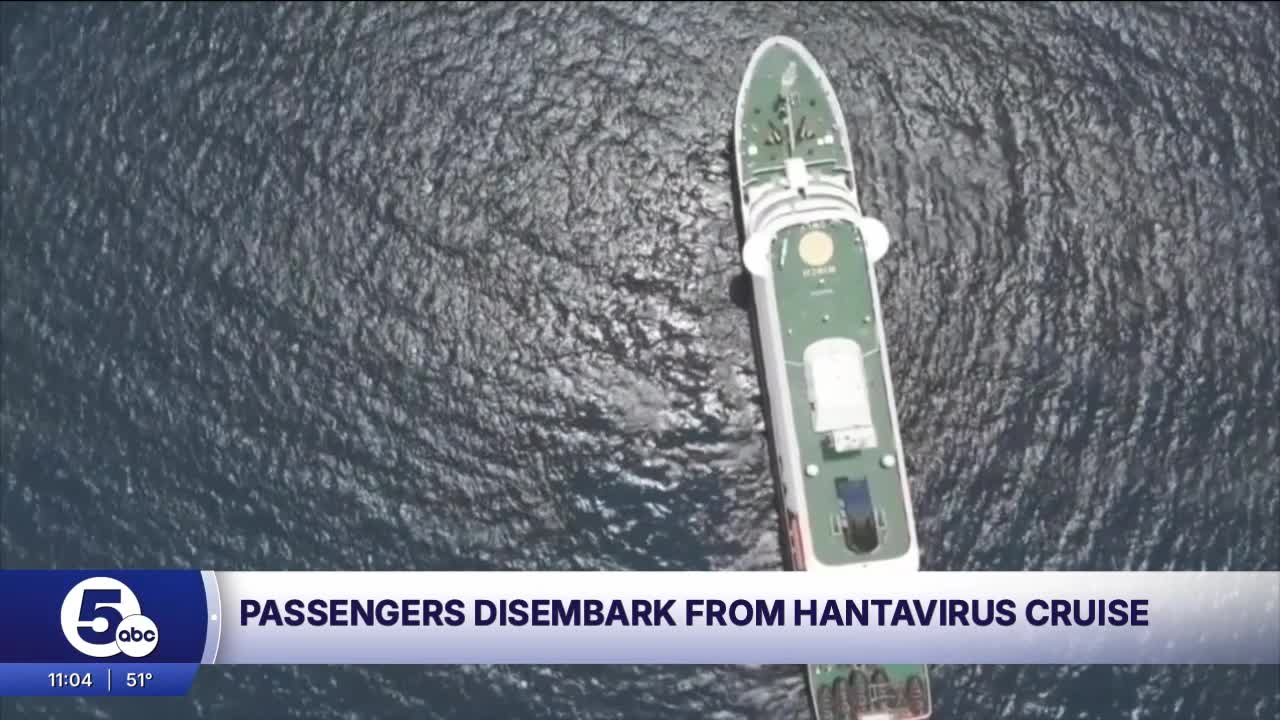


The 147 passengers aboard a Hantavirus-stricken cruise ship began disembarking on Sunday.
According to the World Health Organization (WHO), disembarkation operations began at 7:30 a.m. on Sunday in Tenerife in the Canary Islands.
WHO Health Operations Lead, Dr. Diana Rojas Alvarez, said in a press conference that those allowed to disembark first were Spanish crew and passengers.
"We were all looking at the ship and seeing how the passengers were coming, and their happiness of being finally on land was really a moment to celebrate," Rojas Alvarez said.
From there, the order of those escorted off the ship depended on their nationality.
Passengers from France, Canada, and the Netherlands were among some of the first to disembark following the Spanish.
According to ABC News, Americans who evacuated the Dutch ship are airbound, heading to the United States as of just before 8 p.m. on Sunday. Their flight is scheduled to arrive Monday morning.
None of the flights MV Hondius passengers are on are commercial.
The 17 Americans coming back home are heading straight to Omaha, Nebraska, where the National Quarantine Unit is located.
From there, the passengers will be evaluated by CDC specialists. If cleared, they'll be allowed to go home and self-monitor for symptoms.
WHO Department of Epidemic and Pandemic Threat Management Director Maria Van Kerkhove said the recommended incubation period for anyone who was onboard is 42 days.
Thirty MV Hondius crew members will remain on the ship as it heads back to the Netherlands, according to WHO.
Van Kerkhove said the ship will undergo a full disinfection.
With passengers returning to their home countries, many people are asking about the possibility of a further outbreak.
"While the risk is low to the general public, there’s a lot of people that are scared because a lot of people are thinking this is the next Covid. It is not the next Covid," Van Kerkhove said during Sunday's press conference.
Those aboard the cruise ship haven't seen land since the beginning of April.
According to ABC News, the total number of confirmed and probable cases of Hantavirus onboard the ship is eight, including two people confirmed to have died from the virus and one person who remains suspected to have died from the virus.
RELATED: Hantavirus live updates: Americans aboard MV Hondius depart from Spain
What is Hantavirus?
According to the CDC, Hantaviruses are a family of viruses that can cause serious illnesses and death.
Cleveland Clinic Infectious Disease Physician for Akron General, Dr. Donald Dumford, said this strain of the Hantavirus is called Andes.
This particular strain originated in South America, first identified in 1995, according to local doctors.
Dumford said Hantaviruses are typically passed through animals. The only strain that can go from person to person is Andes.
"Initially, you've got a flu-like illness, and then after that flu-like illness, because the body's response to the virus, you actually start to see inflammation in the lungs, and also, a patient can go into cardiogenic shock, where their heart isn't pumping as well. Patients get really, really sick related to that," he said.
University Hospitals Pediatric Disease Specialist, Dr. Amy Edwards, added, "It's a virus, so fever, headache, muscle aches, it's GI (gastrointestinal), there's some GI symptoms. You wouldn't know that's what it was. It doesn't become clear until they get sick, until they start to develop the cardiopulmonary compromise."
According to the CDC, Andes virus can spread:
- Through contact with infected rodents or their urine, saliva or feces
- By touching an object or surface with the virus on it, then touching your mouth, nose or eyes
- Through close contact with a person who is sick with Andes virus
"Andes virus, this tends to then kind of replicate and then it can be found in the salivary glands, so in our saliva and also in like respiratory droplets," Dumford said.
Dumford said Andes virus does not spread easily, though.
"It's not a very efficient transmitter compared to a lot of other viruses we see," he said.
Edwards said the virus is not something to worry about in North America.
"There's probably about 40 to 50 cases of Hantavirus pulmonary syndrome every year in the U.S., and that's it," she said. "I think the R0 has to be like 0.5, and that's why the outbreaks die so quickly, because most of them are 40 people, 30 people. So even if it is transmissible, the R0 has to be less than one because they quickly die out. It doesn't normally involve this many people, and so that's kind of why it's caught people's attention, but things like this actually happen in the world constantly."
Dumford echoed the same in that despite the 17 Americans flying back to the U.S., there's nothing to worry about.
"I would say definitely do not panic. I think that this is something where it's good to be aware that there's, you know, a Hantavirus out there, but I think that we're gonna see that this current outbreak is going to fizzle very quickly and really be limited to where it's at now," Dumford said. "There's a bunch of other infections that are much more common and much more likely that I'd be thinking of for people in Northeast Ohio."
