

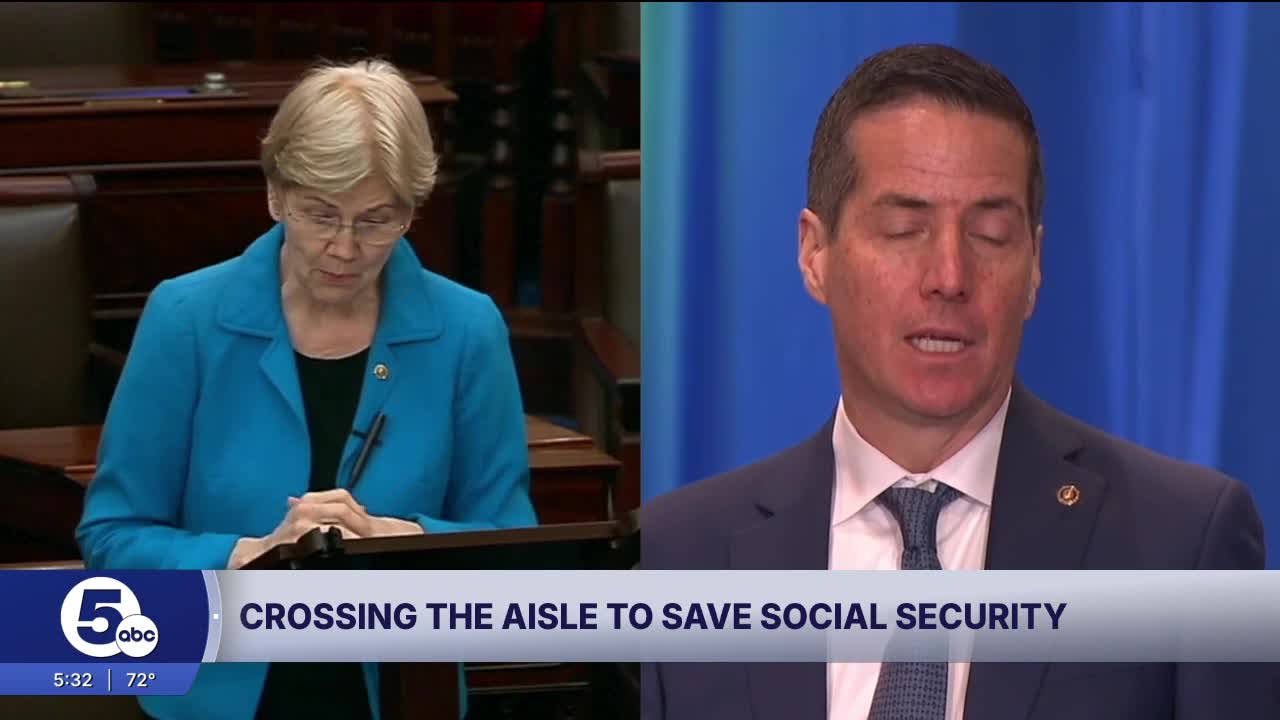


CLEVELAND — In a rare show of bipartisanship, Senators Bernie Moreno (R-OH) and Elizabeth Warren (D-MA) co-authored a piece in the New York Times on Tuesday, announcing their mutual support for an effort to save Social Security.
"We don’t agree on everything, but here’s one thing we do agree on: Congress must act now to save Social Security for generations of Americans to come," they wrote.
This comes after the Social Security Administration's Board of Trustees announced earlier this month that, unless action is taken, the fund would become insolvent in late 2032, resulting in a more than 20% cut in benefits.
More than one in five Ohio residents — 2.5 million people — receive Social Security payments — an average of $1,923 a month, which could be cut by nearly $500.
"Congress has to roll up their sleeves, they have to get to work, they have to address the long-term solvency of Social Security," said Jenny Carlson, the Ohio State Director for AARP.
Dennis Kucler of Westlake is one of those 2.5 million Ohioans.
"It's a serious concern," the retiree said. "I do taxes for seniors," he said of his volunteer work. "So I see an awful lot of seniors' finances, if you will, and it will be just more than a little issue if it happened. It would be serious."
Under the current system, the maximum Social Security withholding for one worker is $22,878, or 12.4% of the current cap of $184,500.
"Since the vast majority of Americans make less than that, most people are paying Social Security taxes on 100% of their earnings while the highest earners are paying on only part of theirs," the senators wrote. "Why should a middle-class nurse pay a larger share of her paycheck than a wealthy corporate lawyer?"
"That would inject $3 trillion into the Social Security System, and so that would close the gap, and so it's very, very promising," said the AARP's Carlson.
It would buy Social Security time, no doubt, says the Roosevelt Institute's Director of Stratification Economics, Stephen Nunez, who has studied the issue, but he says it won't entirely fix the problem.
"If we had eliminated [the cap] about 10 to 15 years ago, it would have gotten us through to 2063 on its own," said Nunez. "I think it's a large contribution to closing the gap, but because we've waited so long to really do anything about it, it means that it's not enough, and we will also have to consider other things like, for example, taxing other forms of income or dealing with the payroll tax or the benefits formula itself."
Whatever is done, cuts to benefits should not be an option, said Kucler.
"You count on those being there, that's kind of the commitment that's been made our whole working life," he said. "If you disrupt that, you basically disrupt the entire financial plan most of us have for our retirement."
That's why he's happy at the prospect of any movement in Washington, and, so too, he joked, are his children.
"Probably the most terrified are my kids cause it's like if we lose Social Security, 'Oh my god, are they gonna move in with us?' And they don't want that to happen," he said, laughing.
