



LAKEWOOD, Ohio — How bad is Southeast Asia's plant, kratom? Allegedly, harmful enough that the state is considering making it a Schedule One Substance, which is the same category heroin and methamphetamine are a part of.
RELATED: Should kratom be illegal or regulated? State leaders are discussing.
For months, state leaders have been weighing the pros and cons of kratom.
Kratom is not approved by the U.S. Food and Drug Administration (FDA) for consumption or medical use.
According to preliminary data from the Ohio Department of Health, kratom was found to be the cause of death in more than 200 unintentional overdose deaths in Ohio from 2019 to 2024.
"These modified kratom products, sold online and in stores, are essentially legal, over-the-counter opiates that anyone – including kids – can buy with just a few bucks,” Gov. DeWine previously said. “There is no accepted medical use for kratom in Ohio, and it is an imminent public health risk."
Earlier this month, the Ohio Board of Pharmacy voted to begin the rule-making process to ban all kratom products in the state.
The vote followed an emergency order, signed by Gov. DeWine, to outlaw the kratom compound 7-hydroxymitragynine (7-OH), which is synthetic.
At this point, the rule to ban all kratom products has just been proposed.
"In reviewing this issue over the past few weeks, national experts, including the FDA, agree that synthetic kratom compounds should be scheduled as illegal,” said Gov. DeWine in December. “However, while there is a clear path to take action on synthetic kratom, I still have deep concerns about natural kratom, given the harms, including fatalities, attributed to it. Pursuing the regular rule process for a ban on natural kratom will allow for hearings, testimony, and a deliberative process."
I reached out to the governor's office for an updated comment, but was referred back to his December press release on kratom.
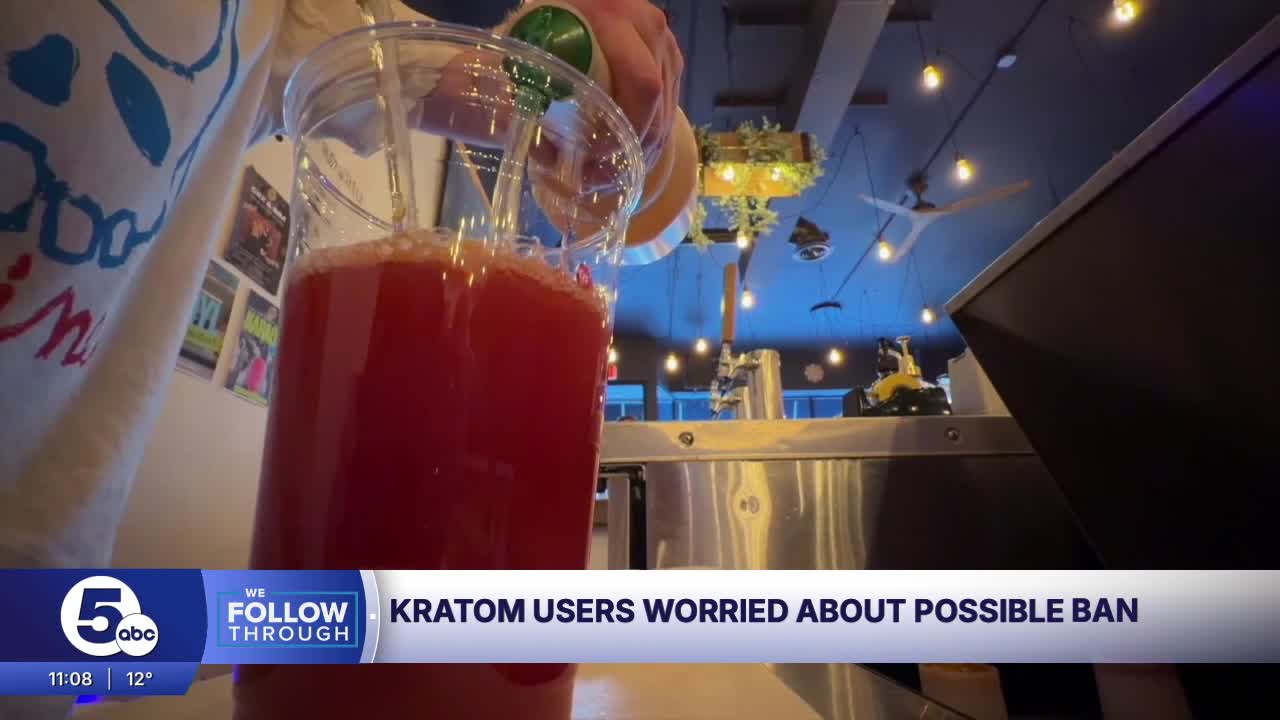
I stopped by Sacred Waters Kava Bar in Lakewood on Tuesday to sit down with the owners and customers, getting their reaction to the ongoing process for potential prohibition.
Sacred Waters co-owners, Michael Young and Chris Nunnari, told me they felt blindsided by the governor's push to ban natural kratom.
"A lot of customers and myself included, we kind of talk about how dumb it is that they're gonna do this," Young said. "To have a government agency make a determination like this, seemingly against what's happening in the legislature, I think it's more important that elected officials would make a decision like this rather than a government agency."
There are two pieces of legislation moving through the State Capitol right now: SB-299 and HB-587.
Both bills advocate that natural kratom be regulated in Ohio, which Sacred Waters is in support of.
"With the regulation, it would make consumers have proper labeling and testing products, and just informing and educating the public, you know, what it is and what it can do, how it can be used safely," Nunnari told me. "We're for the regulation, not the ban. It being a Schedule One would make everyone criminals here and, you know, thousands of consumers all over the state criminals overnight."
Jane Kalinowski is a kratom user who often hangs out at Sacred Waters.
"I'm 23. I don't drink. It's very hard to find community and spaces where you can hang out with people, not spend a whole bunch of money and still be able to spend time with people, get to know people, find community in your local area, but not have to base it around like going to get a beer or getting a cocktail," she said.
To hear the fate of kratom is in limbo frustrates her.
Kalinowski said she believes the conversation around it stems from politics and a lack of education on it.
"There's a stigma around kratom because of the bad substances that are going around, but there is a very large difference between natural kratom and synthetics. I think that needs to be more common knowledge, especially when considering all-out bans like this," Kalinowski said.
Megan Nesposito is also a frequent customer of Sacred Waters and has been since it first opened in 2022.
"I have fibromyalgia, so the strain that I use from kratom helps me with energy. There are different strains, but the strain that I use helps me with energy, and it also helps me with my pain that I feel. Kratom is really a natural way to help me with what I struggle with," Nesposito said.
Kratom is biologically related to the coffee plant as both belong to the Rubiaceae family.
According to Sacred Waters, it produces caffeine-like stimulation.
At low doses, it can be stimulating.
At high doses, it can be "calming," according to Sacred Waters.
Sara Williams and Paul Marshall, customers at Sacred Waters, told me there are real benefits to kratom.
"It's anti-inflammatory, anti-fever, anti-pain. It doesn't mess with your stomach like aspirin does," Marshall said. "The idea of making real kratom a class one, you know, narcotic, it just doesn’t make sense."
Williams said the negative conversation happening around kratom saddens her because she sees so much opportunity for growth in the community it brings.
"I think the possibilities of what places like this can do are endless," Williams said. "When something is new, and people don't know, it can be scary, but come and hang out with us."
For Williams, she appreciates the ceremonial value of kratom and the connections it brings.
Marshall said he appreciates the subtle boost of energy it gives him.
"I don't like the feeling of being high at all or being out of control like that," Marshall said. "Kratom is just a plus. It's a supplement. Think of it as a cup of coffee. I think that's like a really, really great way to describe it, you know, you're having that little jolt in the morning to get you moving. It becomes, you know, part of our daily routine."
All four Sacred Waters customers I talked to on Tuesday are hopeful the state will hear their stories and decide against the ban.
"I guess we'll just have to take it day by day, but hopefully, if we can get our voices out there and our stories told, and people can get an idea of who hangs out here, you know, hopefully I'd love to see more of this," Williams said.
Sacred Waters said it is continuing to reach out to state legislators, as a decision has not been finalized yet.
"Talk to more people that use kratom and learn their experiences, their positive experiences, rather than just listening to negative experiences. There's a lot of biased research out there. There's new research every day, so go and look it up and inform yourself," Nunnari said.
The Pharmacy Board is accepting public comments on the proposed rule until Jan. 28.
Following this rule comment process, the board will review the comments and determine the next steps.
If it decides to move forward in the process, it will then file the rules with the Joint Committee on Agency Rule Review (JCARR).
During this process, the public will have two additional options to provide comment before the legislature determines if the rule is appropriate to move forward.
The JCARR process from start to finish takes 76 days.
More information, including how to comment, can be accessed HERE.
Sacred Waters is asking for support.
If you're interested in learning more about their movement, scan the QR code below.

