

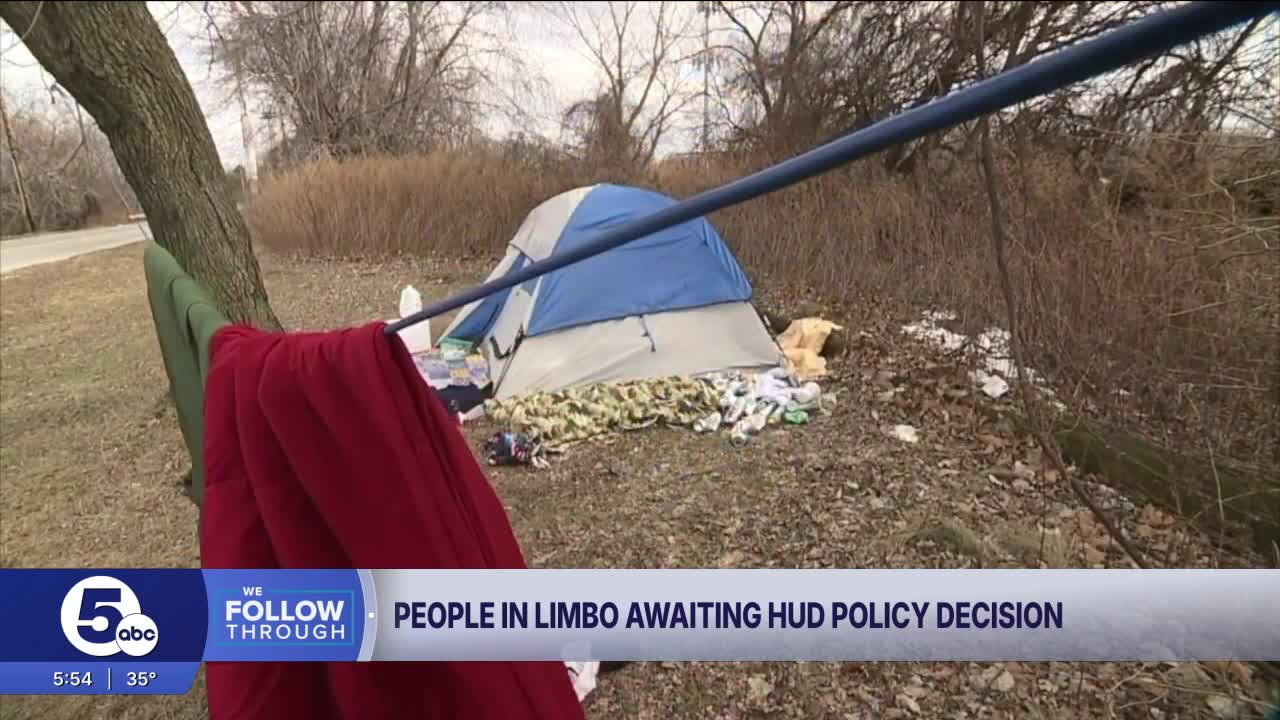


KENT, Ohio — After the Department of Housing and Urban Development announced a cap on funding for permanent housing — a move advocates say could put thousands on the street — the agency has now paused that change following two court cases challenging it. The decision leaves many in limbo, unclear about what’s to come.
For seven years, Jerry Ingram has covered his rent with the help of government assistance.
"I have in-state COPD, I just got over lung cancer, two bouts of COVID with the shots too. Just my physical health is just getting down,” said Ingram.
But now he’s concerned after getting a letter stating that his assistance could end.
"Basically, HUD funding has been cut for them, or it's going to be cut briefly here in the future. They're unaware when the cuts are going to happen and how they're going to work,” said Ingram.
The letter stems from a policy change announced last month by the Department of Housing and Urban Development — a 30% cap on funding for the Continuum of Care Program, which connects people with permanent housing.
RELATED: What HUD’s new housing cap means for homeless services in Cuyahoga County
Amy Riegel with the coalition on homelessness and housing in Ohio says this change could put people back on the street.
“So in the state of Ohio, we receive a little bit north 125 million. So, it puts 80 million at risk for the state of Ohio," Riegel continued, “The overall system supports about 14,000 individuals within permanent housing. So, it would be 10,000 who would have to figure out another way to support their unit.”
We reached out to HUD about the change. They say the money will be reallocated to transitional housing and supportive services instead, writing the following:
“Setting aside 30% of funding for permanent housing rather than the historical 90% will restore a true continuum to the CoC program. In this new Notice of Funding Opportunity (NOFO), HUD is making a historic investment in transitional housing and supportive services to help give homeless Americans the tools and resources to recover and live a life of self-sufficiency and dignity. These long-overdue reforms will promote independence, connect Americans with the help they need, and make our cities and towns beautiful and safe," the statement read.
Riegel disagrees and raises concerns about how the change could impact people’s lives.
"These are individuals who are in crisis and in sometimes the greatest crisis within our community, and they found a place to call home. They are stable in their units. They have finally found a sense of security, and it's going to be taken away from them. We would never think that this could happen, and it's just terrible,” said Riegel.
But then Monday — just before two court hearings challenging the policy change — HUD temporarily pulled the policy back, leaving many organizations in the dark.
"We don’t know when it comes back, retooled, does it come back and is responsive to what has been pointed out as the devastating impact. Does it come back and create more devastating impact?” said Riegel.
She says they’re having conversations with those who could be affected, but the uncertainty is troubling.
"These are the type of communications that can really cause people to destabilize and to have episodes or to have moments where they struggle once again. We don't want to do that to anyone. We don't want to put people into a state of panic that is unnecessary, but we do have to start talking to people what the reality of what it could be, and try to have them work with us to think about what options are available,” said Riegel.
As for Ingram — if the funding isn’t restored, he fears the worst.
"Part of me says, 'Yeah, I could be homeless very easily,'” Ingram continued. “It's frightening. It's, you know, I can't even put it into words or anything. Like I haven’t slept for a couple of days now.”
