

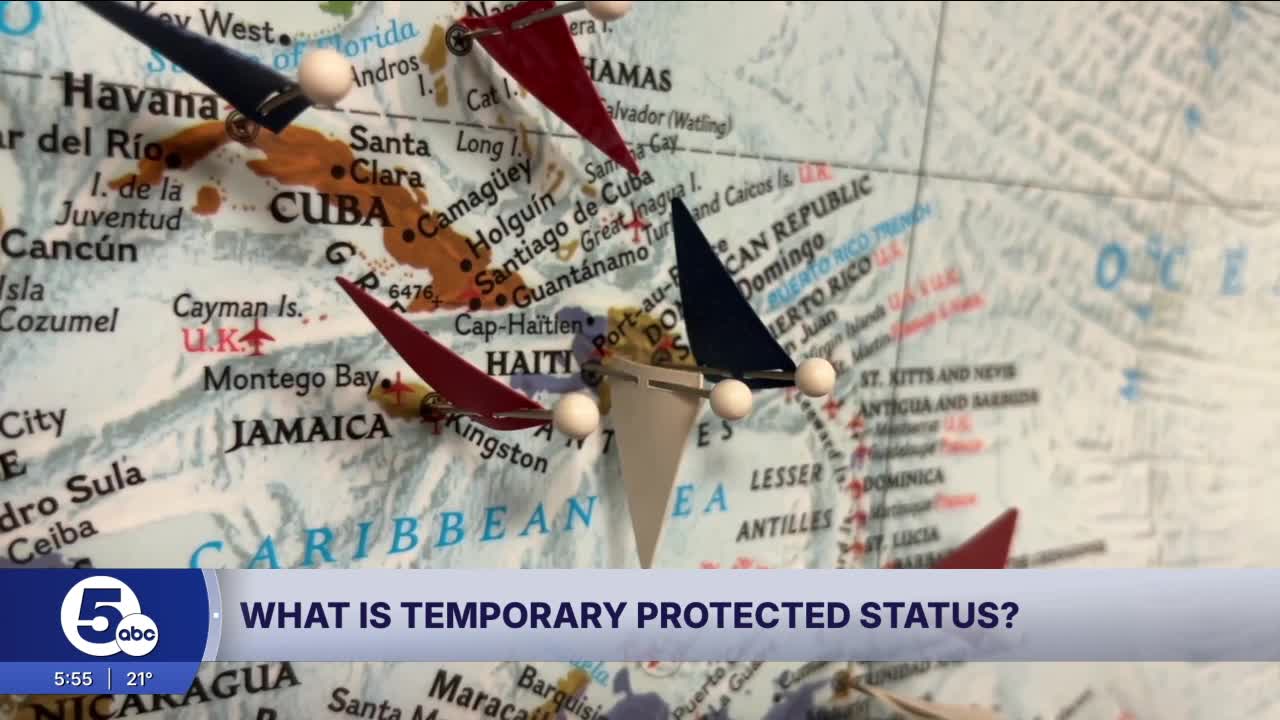


CLEVELAND — Springfield has drawn national attention because of its large Haitian community. Now, a major change from Homeland Security is raising new questions. Temporary Protected Status for Haitians is set to end, making them the latest group affected by the administration’s decision.
This update was posted on the Homeland Security website:
“Temporary Protected Status for Haiti and TPS benefits will no longer be in effect starting at 11:59 p.m. on Feb. 3, 2026.”
Before the Haitian community was impacted, TPS protections were ended for people from Somalia, Afghanistan, Venezuela, Syria and others. To better understand what TPS is, we spoke with immigration attorney Stacey Cozart Martin.
"Temporary protective status is issued by the government to protect a certain group of individuals, and basically, it could be because of an environmental concern in their country, like the earthquake. It could be because of a governmental concern in their country, or it could because their country is at war,” said Martin.
With TPS, individuals are allowed to remain in the U.S. and apply for work authorization. However, the length of protection varies by country.
"Every country is different,” Martin said. “Some countries, it’s been 20 years. Some countries, it’s been a year and a half.”
Martin says those who lose their status must leave unless they qualify for another form of legal protection, noting she has seen the same situation play out with Venezuelans.
"You're going to leave if you don't have any other status, or you're going to stay here undocumented,” Martin continued. “It happened with a lot of Venezuelans, which is the same problem. It ended very quickly, and then everyone had to sell their homes and quit their jobs and go back to Venezuela.”
The Haitian community has been at the center of political debate now and nearly a decade ago, according to former Ohio Congressman Jim Renacci.
"The first word is temporary, and of course, it started under the Obama administration because of the Haitian issue and the earthquake, and it was supposed to be temporary, and President Trump even in 2017 tried to eliminate it,” said Renacci.
Renacci supports ending TPS, saying he believes the Haitian population is causing issues in Springfield.
"I think it's a problem because again, we have so many programs to try and help other countries, but we don't have programs that just allow people to be here on a temporary basis permanent. I mean that's the real key here now,” said Renacci.
Renacci says TPS recipients should self-deport and that the immigration process needs to be reevaluated.
"I think in the end it is good because we do have American workers that need to have jobs, and at the same time, we do need an immigration process that's legal,” said Renacci.
Martin disagrees, saying she has seen firsthand the consequences when protected status is canceled. She says the impact won’t just be felt by individuals, but by the local economy as well.
"I will tell you that there is a large influx of Haitian population in Springfield because those jobs were available before they got here. Those were not jobs they took away from a U.S. citizen. So, employers are going to shut down because they don't have the wherewithal to keep operating when most of your staff is going to be leaving you,” said Martin.
