


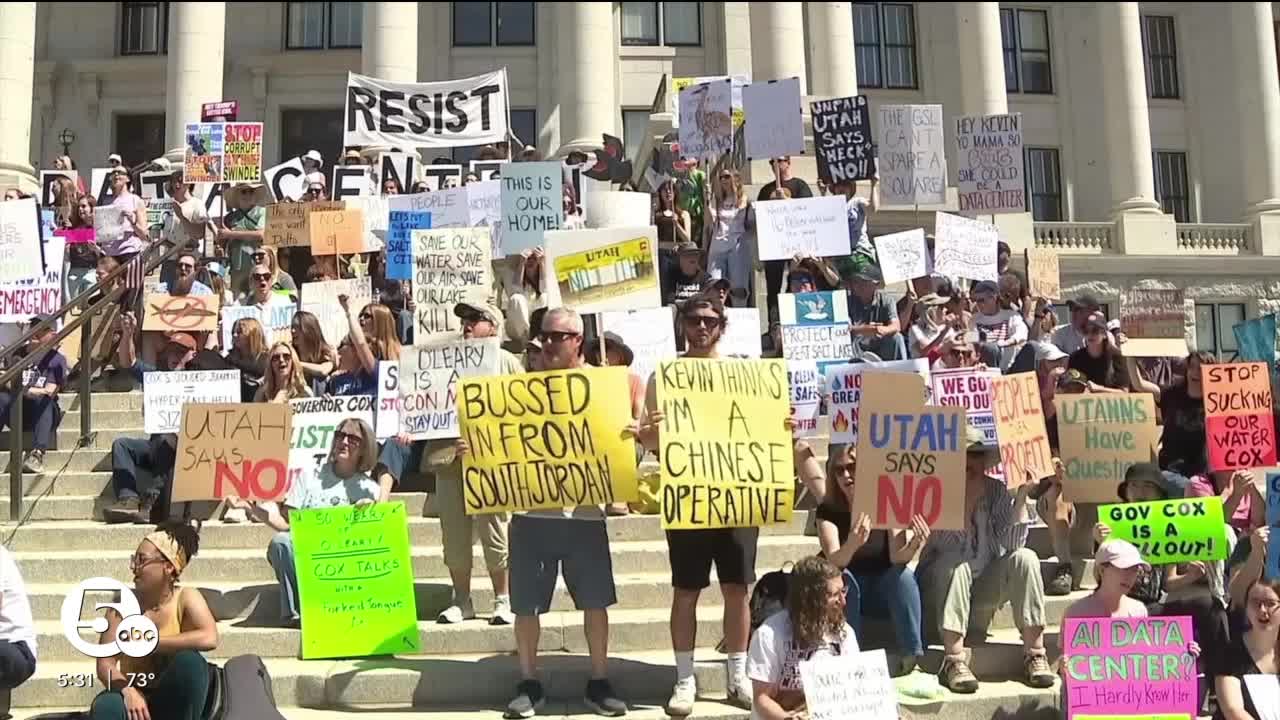



COLUMBUS, Ohio — The frontrunners for Ohio governor both want to regulate data centers but have different plans for how to address growing concerns.
It's one of the most controversial topics this year: data centers and their rapid expansion in Ohio.
RELATED: A developer wants to turn three Lorain County industrial buildings into a data center campus
"I think we need a leader who just doesn't say, 'Hey, open it up, and it's a free-for-all,' or a leader who says that they ban it because 'I don't understand it,'" Republican nominee for governor Vivek Ramaswamy said in a town hall event in Strongsville last week.
Ramaswamy explained that the state needs more data centers in order to store and process data. Previously, Ramaswamy said a total ban would be bad for the economy. During recent events in Northeast Ohio over the past week, Ramaswamy laid out his plan for regulating the tech hubs.
"Attract and use and require the use of the best technology that requires only two restaurants' worth of water rather than 3% of the water supply of a city," he said after an attendee asked about data centers polluting water.
He emphasized that he wanted to protect agriculture and the water supply.
RELATED: Ohio farmers fear new proposal would allow data centers to take property
Much of the criticism against data centers is mainly due to environmental and energy usage concerns, which Ramaswamy said he understands.
"If you're going to use a whole bunch of energy as a demand user, a hyperscaler, you should bring at least the energy that you're using," the Republican said.
Democratic candidates Amy Acton and her running mate, David Pepper, went further into detail, taking a hard-line position on data center energy usage.
"Nobody should have to pay a dollar more on anything because the data centers are moving in," Pepper said in an interview. "That should be an absolute baseline, red line of guardrail by the state of Ohio for any future developments."
He said that energy costs, infrastructure, or any tax costs associated with the tech hubs should not fall to Ohioans. On Thursday, the Trump administration announced a voluntary pledge for data centers to pay their own way.
RELATED: Is a data center a blessing or a curse? It depends on the community.
On day one, Pepper said he and Acton will work to put in place major changes, addressing concerns over transparency and safety, as companies frequently ask public officials to sign non-disclosure agreements.
"No more NDAs, no more secrecy, no draining the water tank table, no polluting," the Democrat said.
Recently, there was bipartisan outrage over the Ohio EPA's plan to allow data centers to discharge wastewater into some bodies of water.
"Ohio families shouldn't have to worry about the quality of their air, their water or the health of their communities because a billion-dollar company wants fewer rules," Acton said in a post on X.
Also fueling data center opposition are reports that tax breaks handed out by the state have reached $1.6 billion.
"They need to be reined in as well," Pepper said.
Ramaswamy said tax incentives shouldn't be given to companies using outdated technology.
"We should not be given state incentives to bring something here that guzzles water and drives up electric bills," he said. "The modern versions of that are actually being built today take less water."
Lawmakers attempted to pass legislation reducing those tax breaks, but weren't able to get it across the finish line before summer recess.
RELATED: Ohio lawmakers unveil data center regulations
Libertarian candidate Don Kissick is "against data centers," his website says.
"Data centers are not just warehouses for computers — they are becoming part of a growing surveillance infrastructure that concentrates unprecedented amounts of personal data and power in the hands of government agencies and large corporations," Kissick said on his campaign website.
He wants to have more transparency in the process as a whole.
"These facilities consume massive amounts of electricity and water, contribute to environmental concerns through energy use and electronic waste, and are increasingly being built on productive farmland that should remain available for food production and local communities," he wrote.
RELATED: Tax expert critical of Ohio governor candidates' property tax relief proposals
Follow Statehouse and Columbus bureau reporter Morgan Trau on X, Instagram and Facebook. Email her at Morgan.Trau@wews.com.
