

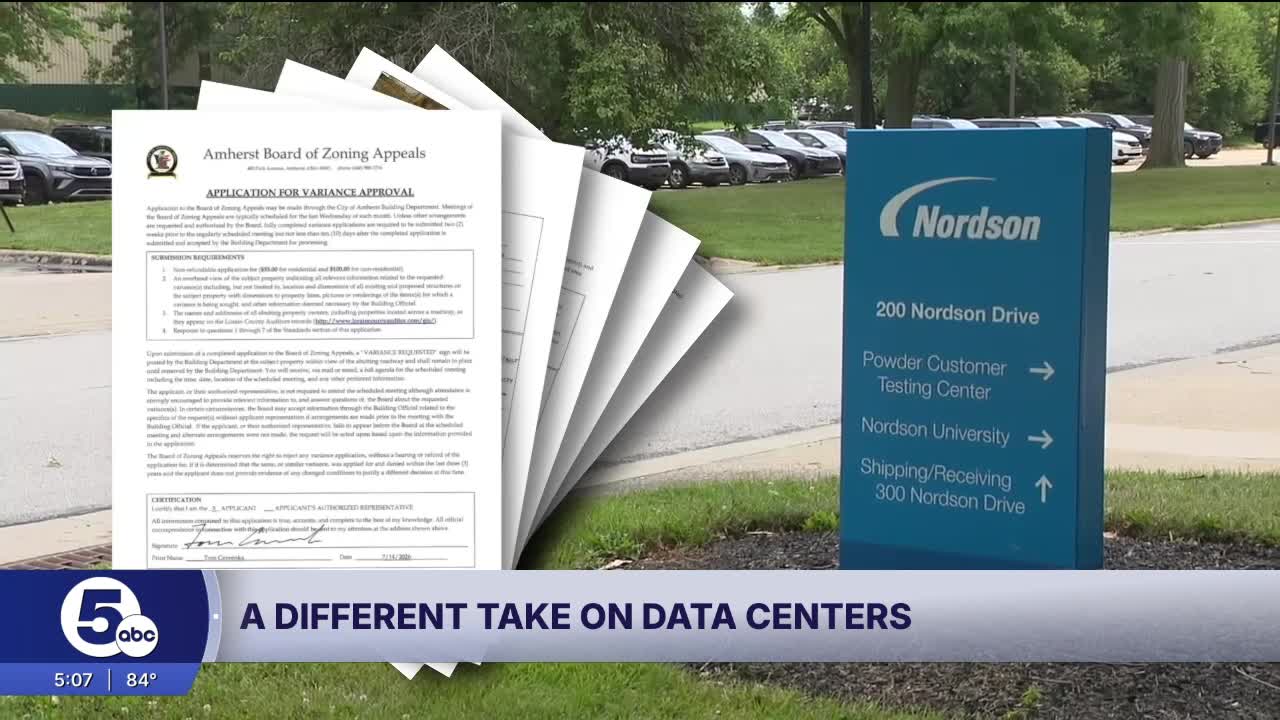



AMHERST, Ohio — As Nordson Corporation empties out its longtime campus in Amherst, a potential buyer hopes to transform three of the buildings into a data center.
Cervenka Development Partners LLC, based in Illinois, is seeking a zoning use variance for the project from the Amherst Board of Zoning Appeals. In a request filed with the city on July 14, the company says it’s pursuing the properties at 100, 200 and 300 Nordson Drive.
But this isn’t a done deal. Amherst’s mayor stresses that the variance discussion is just the start of a public process. And the initial hurdle won’t necessarily be easy to jump.
“In our industrial codes right now, a data center is not allowed. So they’re asking for a use variance, doing their due diligence,” Mayor Mark Costilow said Tuesday.

Ohio is seeing a wave of data center development spurred by available land, access to power and tax breaks (though the state recently pressed pause on considering sales-tax exemptions for new projects). Across the state, neighbors are pushing back, raising concerns about soaring electricity bills, the changing landscape and the rise of artificial intelligence.
Public officials, meanwhile, are weighing the risks and rewards of riding the boom.
RELATED: Is a data center a blessing or a curse? It depends on the community.
Costilow never expected to see a data center proposal in Amherst, a Lorain County city of about 13,000 people. He learned about the developer’s plans last week, when the variance request arrived. Now he’s reading everything he can about data centers.
"This is my first experience asking about these facilities,” he said.
The mayor said he’s had one brief conversation with Tom Cervenka, a principal with the development company. During that discussion, Costilow learned that the data center would be a mid-sized facility, with a potential power capacity of 45 megawatts.
The redevelopment proposal spans about 240,000 square feet of buildings — a mix of office, warehouse and lab space at the northern end of the Nordson campus. The property, served by Ohio Edison, is equipped for heavy power use and includes a power substation, according to marketing materials from the Colliers real estate brokerage.
Nordson has already moved out of a cluster of old manufacturing buildings at the southern end of the campus. Those buildings will be demolished, and the city’s talking with the publicly traded company about the future of that portion of the site.
"Nordson’s been a great partner,” Costilow said of the business, which was born in Amherst in 1954 but is now based in Westlake.
Citing the landlocked nature of the Amherst campus, which is flanked by homes and railroad tracks, the company moved its manufacturing operations to South Carolina in late 2024. Now Nordson is consolidating office jobs in Westlake.
"As part of the normal sale process, interested parties are conducting due diligence and evaluating potential future uses of the site,” Lara Mahoney, a Nordson spokeswoman, wrote in an email about the Amherst properties. “No transaction has been finalized.”
Cervenka did not respond to interview requests. The company’s zoning application touts that a data-center conversion would repurpose existing buildings, limit exterior construction and bring investment without creating much traffic or straining city services.

The application says the project would involve “minimal water and sewer demand,” without getting into specifics.
Costilow, who has been hearing from people on both sides of the data center debate, said there will be plenty of time to talk about the details — if the project moves forward.
But the zoning board, which is set to hear testimony during its July 29 meeting, isn’t focused on those issues. The five-member board and the city’s law department will have to decide if there’s a compelling case to make an exception to the city’s rules around what’s allowed in an industrial area.
Amherst’s planning and zoning code — like the codes in many Northeast Ohio cities — does not mention data centers. The city’s stance is that if a specific use isn’t mentioned on the list of permitted activities, then it requires a variance.
“This isn’t a conversation about ‘How noisy is this? How much electric is it gonna use? Is it gonna ruin my neighborhood? Are my property values gonna go down?’” Costilow said of the zoning board discussion. “This is only ‘Does it fit in this zone?’ … There’ll be a lot more meetings and a lot more opportunities to express those concerns.”
The zoning board won’t decide on the variance request at next week’s meeting. After hearing testimony, the board can take up to two weeks to issue a verdict. If the variance request gets rejected, the developer will have opportunities to appeal.
At this point, Costilow isn’t taking a position on the proposal.
“I really don’t know where I’m gonna be until I learn more about it. … I want to do a lot more,” he said. “I’d like to take a visit and see some of these things.”
Michelle Jarboe is the business growth and development reporter at News 5 Cleveland. Follow her on X @MJarboe or email her at Michelle.Jarboe@wews.com.
