


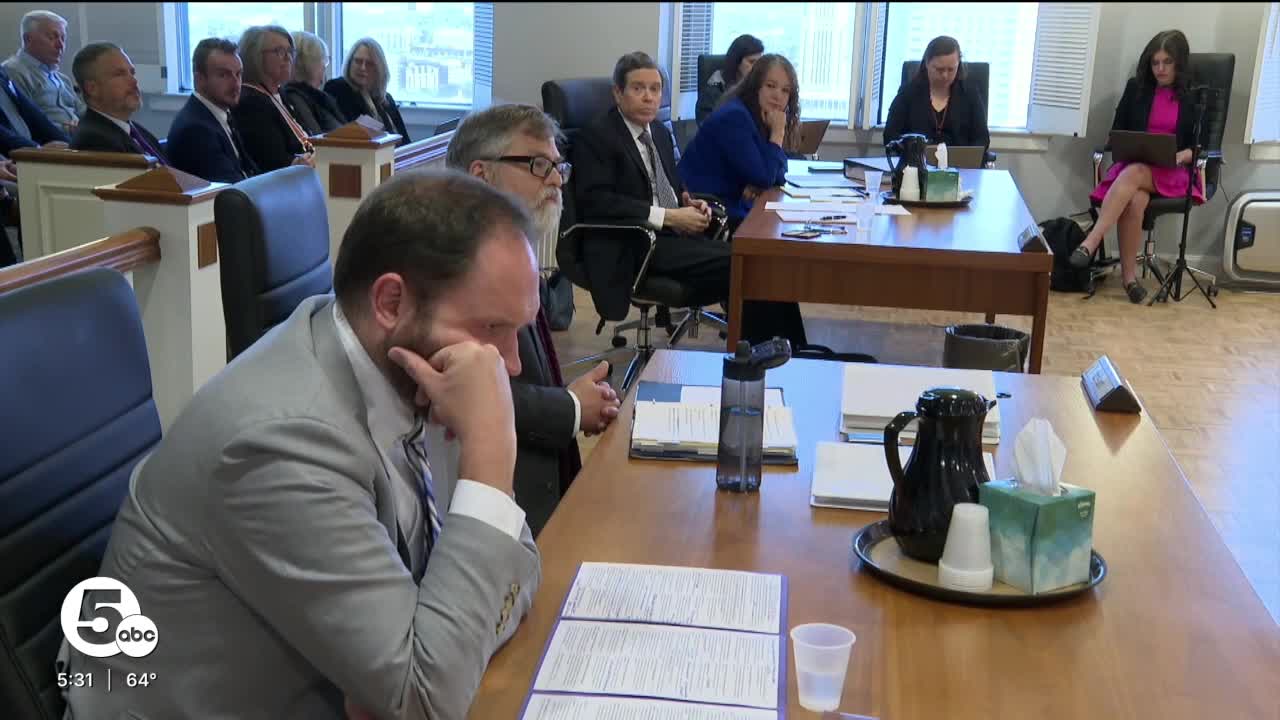


COLUMBUS, Ohio — A panel of Ohio judges questioned the state's attorneys about why taxpayers are footing the bill for private school tuition.
Leaders of public schools, including Cleveland Heights-University Heights, headed to Columbus for an early morning hearing before the 10th District Court of Appeals.
More than 300 public school districts are suing over the state's private school voucher program, also known as EdChoice. It allows any family, regardless of income level, to get taxpayer dollars to attend nonpublic schools.
A trial judge ruled last summer that the program was unconstitutional. The state appealed the majority of the ruling, while the schools are pushing back against the one charge that was decided against them. The school complains that the voucher program creates “segregation” in schools, but the judge said there was no evidence of that.
"The damage that's being done to Ohio's amazing public schools is undeniable," Cleveland Heights-University Heights school board member Dan Heintz said.
RELATED: Why Ohio ballots are packed with school levies — and how we got here
Schools are now experiencing cuts to jobs, classes and athletics. Some, like Heintz's still don't have air conditioning. Public schools deserve more money, he and Cleveland-based attorney Miriam Fair said.
"The General Assembly has abdicated its constitutional obligation to public school students and instead prioritizes private education," Fair said while speaking to the court.
Nonpartisan research group Policy Matters Ohio found that K-12 schools are being underfunded by nearly $3 billion over the next two years.
In the fiscal year 2025, more than $1 billion of taxpayer dollars went to private schools. They are set to get more than $2 billion over the next two years.
RELATED: Where the gubernatorial candidates stand on education
Some proponents of EdChoice argue that schools are wasting money, some of which they said they need, on the lawsuit.
"When they come begging for more taxes, ask them why they spent the money you already gave them on losing lawsuits," Attorney General Dave Yost said, in response to my post on X about the hearing beginning.
Heintz said each participating school has spent $2 per student for the past four years. Based on that number, the coalition has spent $1.7 million on legal fees. This is a drop in the bucket compared to the $3 billion they say they were underfunded.
RELATED: Lawmaker reverses course on bill to restrict money for schools that sue EdChoice voucher program
Judges David Leland, Kristin Boggs and Shawn Dingus will be deciding whether or not they completely agree with Franklin County Common Pleas Judge Jaiza Page in her ruling.
But the state and a coalition of families that use vouchers are fighting back, arguing that the education funding isn't coming from the same pool of money.
"There's no inherent connection between the EdChoice funding and the public school funding," Deputy Solicitor General Stephen Carney said.
Carney is joined by Keith Neely of the Institute of Justice, who is representing a group of private school families.
There is no way to say that if EdChoice went away, the money would go to public schools, he said. It could go to other priorities like Medicaid. Conversely, money could also be given to public education by canceling the handout that the lawmakers gave to the Cleveland Browns for their new stadium, Carney said.
"Just to add some more controversy to today," he said.
The judges seemed to agree with this sentiment, repeatedly asking the attorneys for the school coalition, called Vouchers Hurt Ohio, how ending EdChoice would help them.
Attorney Mark Wallach responded that there is a "laundry list" of other ways that the program "erodes" public education, such as violating the Equal Protection Clause.
But it's the lawmakers' right to fund both public and private education, Neely said.
"[Families are] going to be forced to send their children to a public school environment that might not have worked for them," he said.
The judges continually interrupted the state’s team.
Data shows the majority of people using vouchers were already sending their kids to nonpublic schools.
"What's the purpose, counselor, of having an admission policy where students who can afford private tuition to private schools are nonetheless subsidized by EdChoice vouchers?" Judge Leland asked. "What is the governmental purpose of that?"
"Well, it's to provide choice to parents," Carney said.
"Why are we subsidizing wealthy students who can afford to go to private school? Why are we paying for their tuition with tax dollars?"
Carney tried to explain that EdChoice was not just for the wealthy, but also was started for lower-income families and students with disabilities. Allowing for choice is the crux of the issue, Neely said.
Judge Dingus asked the state how this is a choice for "parents" when really, it's the school deciding who they let in. He offered a hypothetical of an LGBTQ+ child not being let into a private school. Carney conceded that the "choice" is being able to apply.
"The argument this morning, I think, went well for us," Neely said after the hearing.
"You genuinely thought it went well?" I asked him.
"I do think that the argument went well on some of the claims…" he said. "Ultimately, I think we all recognize that this case is going to go to the Ohio Supreme Court one way or the other."
The appellate court judges will eventually rule on the case, but Neely expects the panel, all of them Democrats, to side with the schools.
He believes eventually, the Republican-dominated Ohio Supreme Court will rule in his favor.
"From that perspective, I think today's argument is a success," Neely said. "It moves us closer to that goal, and we're excited to have that opportunity when the day comes."
Heintz still holds out hope for victory.
"When the Supreme Court eliminates the EdChoice vouchers, the money will be there, and the statewide expectation will be there, that Ohio's public schools will be funded to the promise of the Constitution," he said.
The voucher program remains in effect as litigation continues.
Follow WEWS statehouse reporter Morgan Trau on Twitter and Facebook.
