


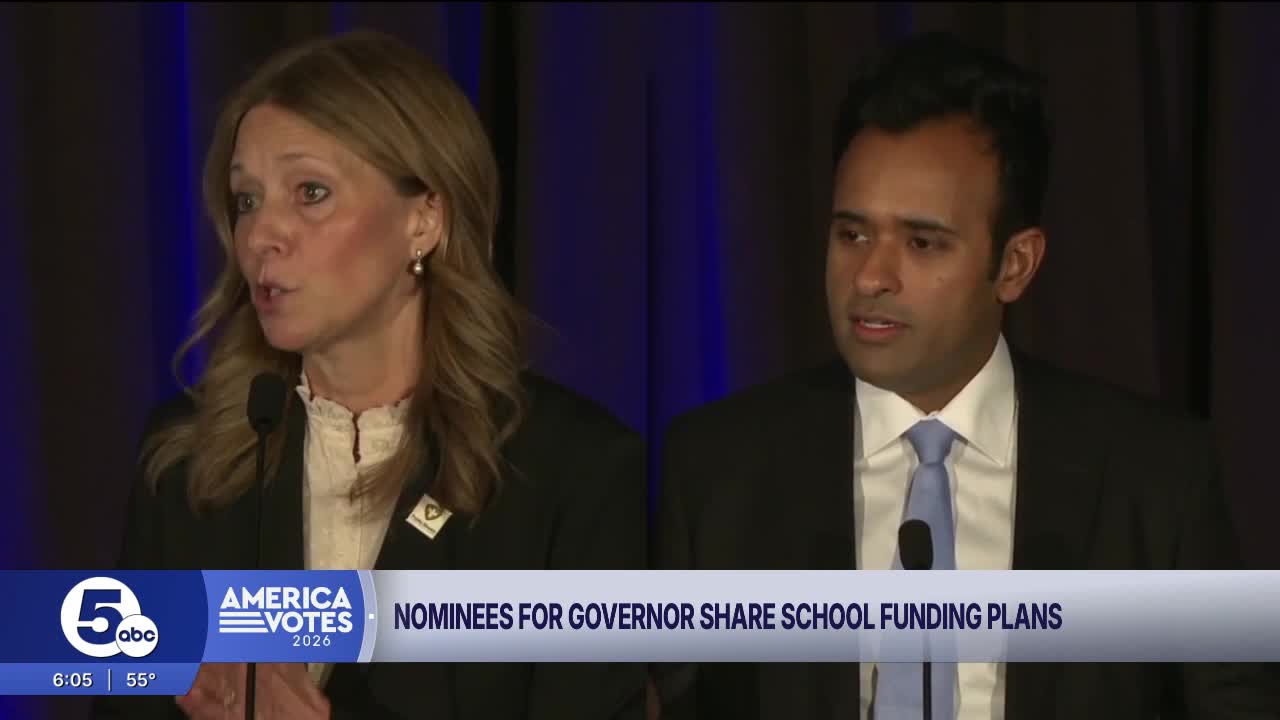



COLUMBUS, Ohio — The future of public education in Ohio looks different depending on who wins the governor's race. While Democrat Dr. Amy Acton wants to fully fund education so districts can improve, Republican Vivek Ramaswamy said schools need to deliver results first.
On May 5, schools asked voters for more money. Across the board, the majority of tax increase levies failed. Those districts face hard decisions.
"Kids having access to a really high-quality education that meets their needs — that is something we must be putting our taxpayer dollars to," Acton said.
RELATED: Game on: Ramaswamy, Acton race to become Ohio governor
Schools are underfunded by nearly $3 billion over the next two years, according to the nonpartisan research group Policy Matters Ohio. Current school budgets are now experiencing cuts to jobs, classes and athletics.
Some Republicans say that schools need to prove they deserve more money.
"We need to see an improvement of academic outcomes," Ramaswamy said.
Ramaswamy proposed adding literacy requirements but wouldn't answer our direct questions about school districts' concerns over funding.
"How is the funding situation going to be rectified?" News 5 asked.
"Well, I want to talk about outcomes, and then what we need to get those outcomes, we'll talk about for funding," Ramaswamy said. "But it's a school debate, school policy debate — [it] should not be an accounting debate."
RELATED: Why Ohio ballots are packed with school levies — and how we got here
Schools argue that it's a catch-22 — when districts get less funding, they will perform worse and have less to offer. Lower-performing schools say they can’t get better without funding.
Ramaswamy then brought up an alternative.
"Somebody should not be trapped in a failing school district in the inner city of Cleveland if there's a better option," he said.
Ramaswamy has cheered the private school voucher program, known as EdChoice, which allows families to use taxpayer dollars to send their kids to nonpublic schools. Lawmakers gave $2.5 billion for vouchers in the budget.
"Almost all of the vouchers have gone to kids already in private school," Acton said.
Our investigations have shown, for years, that the vast majority of voucher-using families have always sent their kids to those schools.
Ohio law allows any family, no matter their income level, to get money.
We asked each candidate the same question — and had to ask multiple times — in order to get answers.
"Should millionaires be able to get a private school voucher?" I asked Acton.
"We've got to get our head around what is happening with these vouchers," she said, noting that there needs to be increased transparency and accountability. "We would certainly be looking at what would a reasonable income be to get extra support."
Ramaswamy also avoided the question.
"I think that educational choice is important, and I'm not going to be responsive to slapstick kind of questions that are one-off gotchas," he said.
Right now, hundreds of schools are in a legal battle with the state, arguing that EdChoice is unconstitutional and taking money from them.
RELATED: Lawmaker reverses course on bill to restrict money for schools that sue EdChoice voucher program
Follow WEWS statehouse reporter Morgan Trau on Twitter and Facebook.
