


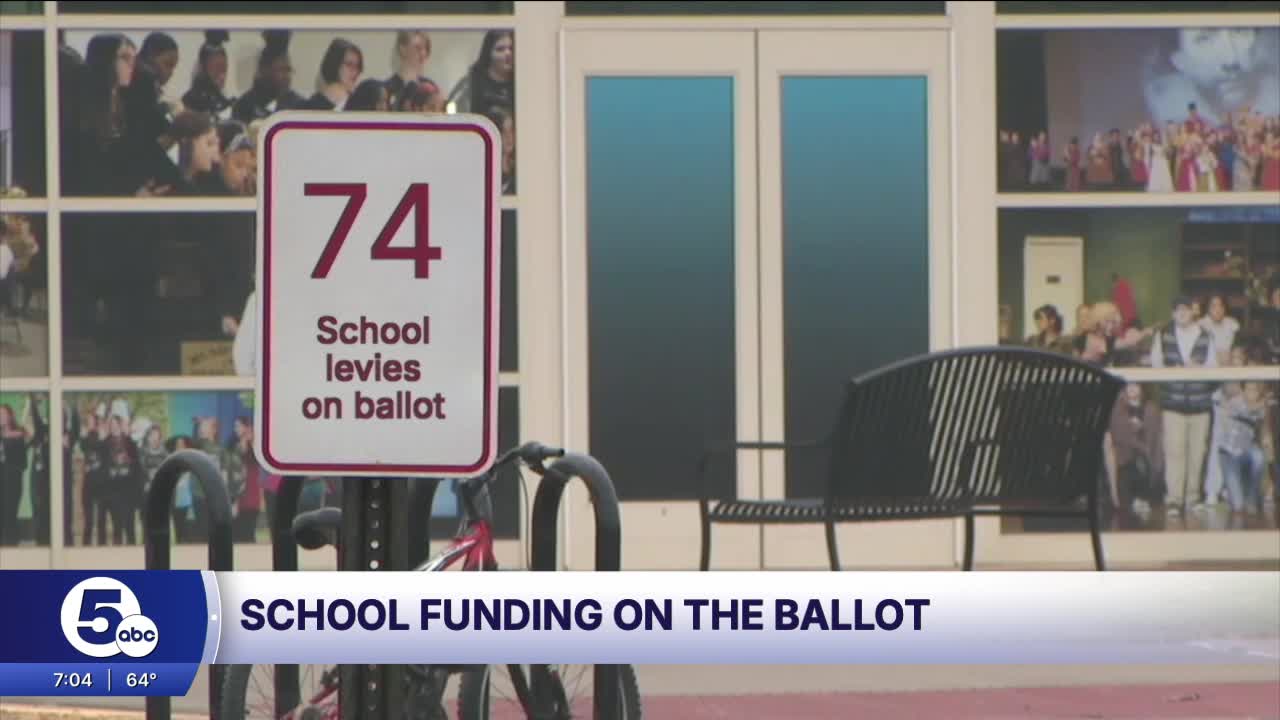



COLUMBUS, Ohio — There are more than 70 school levies on Ohio's May primary ballot, with districts saying that their proposed tax increases are due to state lawmakers slashing their expected budgets.
Schools around the state have been cutting jobs and programs.
"We're not just colleagues; this is family," Lorain Education Association president Julie Garcia said. "And so to see your family lose their job and go through this, it's really devastating."
More than 100 Lorain City Schools teachers received word in April that their positions are being eliminated. As the district faces more financial uncertainty ahead, some families worry about what else could be cut. The District had already cut 60 other positions.
They needed to make up $18 million, which meant also eliminating some programs like dance, choir and health. They also had to change the configuration of their elementary schools.
But to stop the purge, the district and 73 others put levies on the ballot.
"Eighty percent of our budget is staffing. And so, when it comes to a levy, that is where the majority of the finances you ask from your community will go,” said Maggie Niedzwiecki, superintendent of Lakewood City Schools.
RELATED: Lakewood City Schools asks voters to approve levy as property tax concerns split residents
Schools say the reason why there are so many levies on the ballot is due to a cut in funding from the state.
How we got here
The Ohio Supreme Court ruled in 1997 in DeRolph v. State that the way the state funds schools is unconstitutional, relying too much on property taxes.
Throughout the next three decades, lawmakers went back and forth on policy in an attempt to fix the unconstitutionality. The Ohio Education Association, as well as lawmakers on each side of the aisle, have deemed it unconstitutional until the early 2020s. However, some Republicans argue that because they are no longer using the struck-down policy, and since nothing else has been deemed "unconstitutional" in court, they argue that, by definition, it can't be considered unconstitutional.
Now, a nonpartisan research group, Policy Matters Ohio, found that K-12 schools are being underfunded by nearly $3 billion over the next two years.
Before the 2025 budget, Ohio had been following the Cupp-Patterson Fair School Funding Plan since 2021.
The rollout of the plan was supposed to take six years and is meant to change how public dollars are provided to K-12 schools. It would give additional support to local districts so they can rely less on property taxes.
The first two years were partially funded, and the second two years were fully funded. Lawmakers fought for months about the FSFP, with House leadership adamantly against it. In the end, the plan was partially funded for the final two years, but with massive cuts to the expected funding.
Huffman called the formula "unsustainable."
RELATED: Ohio's public schools end 2025 feeling bruised. The governor doesn't see it that way.
"It's about holding individuals responsible for the jobs they are paid to do," House Speaker Matt Huffman (R-Lima) said.
He and other Republican leaders have argued that schools need to be better at managing the money they already get.
"Stop complaining to the state every time they can't pay for the staff that they've hired or the pension pickups on the public side that they've chosen to pay," House Finance Chair Brian Stewart (R-Ashville) said.
There are cases of clear administrator bloat, lawmakers said. We found that the Cleveland Metropolitan School District (CMSD) may fit that claim.
To address serious financial issues, CMSD is consolidating schools and closing buildings. In April, 150 teachers and approximately 120 paraprofessionals were laid off.
However, Cleveland employs 177 principals and vice-principals and 25 executive directors, and a nine-person leadership team.
Our investigation revealed that the leadership team alone makes approximately $1.9 million, including CEO Dr. Warren Morgan, who will earn $299,250 during the 2025-26 school year.
RELATED: Cleveland schools spent $272K on an HR consultant to plan layoffs, reassignments
One district that has many administrators is the exception, not the norm, teachers argue.
Other lawmakers say that another reason why the budget is being cut is that they shouldn’t be rewarding lower-performing districts.
"We need to ensure that the money they are getting is tied to, in some ways, making sure they’re delivering at least improvement," Senate President Rob McColley (R-Napoleon) said.
Schools argue that it's a catch-22 — when districts get less funding, they will perform worse and have less to offer. Lower-performing schools complain they can’t get better without funding.
Huffman has repeatedly recommended private schools as an option, putting more than $2 billion in the voucher program over the two-year budget.
RELATED: Lawmaker reverses course on bill to restrict money for schools that sue EdChoice voucher program
"School choice helps that a lot, if you're in a place that has available schools that folks can go to: a better atmosphere, a better school, maybe it's for security or other reasons," Huffman said.
And now, Republicans are clamping down on another way schools can get money.
Property taxes have been spiking year after year, and to help provide relief, they have restricted the types of levies allowed.
Both schools and property tax relief advocates were unimpressed by the lawmakers' efforts, ones that both groups say won't actually give legitimate relief.
RELATED: Why schools and homeowners are frustrated by Ohio's property tax bills
If the ballot issues fail, schools will be forced to make difficult decisions.
"If we’re unsuccessful and if we have to attempt to balance the budget through cuts alone, that’s going to be the closure of a school," Painesville City Local Schools Superintendent Josh Englehart said.
Of the 74 school levies, 36 districts have a property tax levy, 33 have an income tax levy, four have bonds, and one has a combination proposal.
"We would have to look at our academic programming and our staffing,” Niedzwiecki said if her levy fails.
Some AP courses and STEM programming could be on the chopping block, she added.
“We'd have to raise our class sizes,” Niedzwiecki said.
Some Republican leaders have suggested that school districts consolidate, but no actual proposal has been made yet.
Follow WEWS statehouse reporter Morgan Trau on Twitter and Facebook.
