

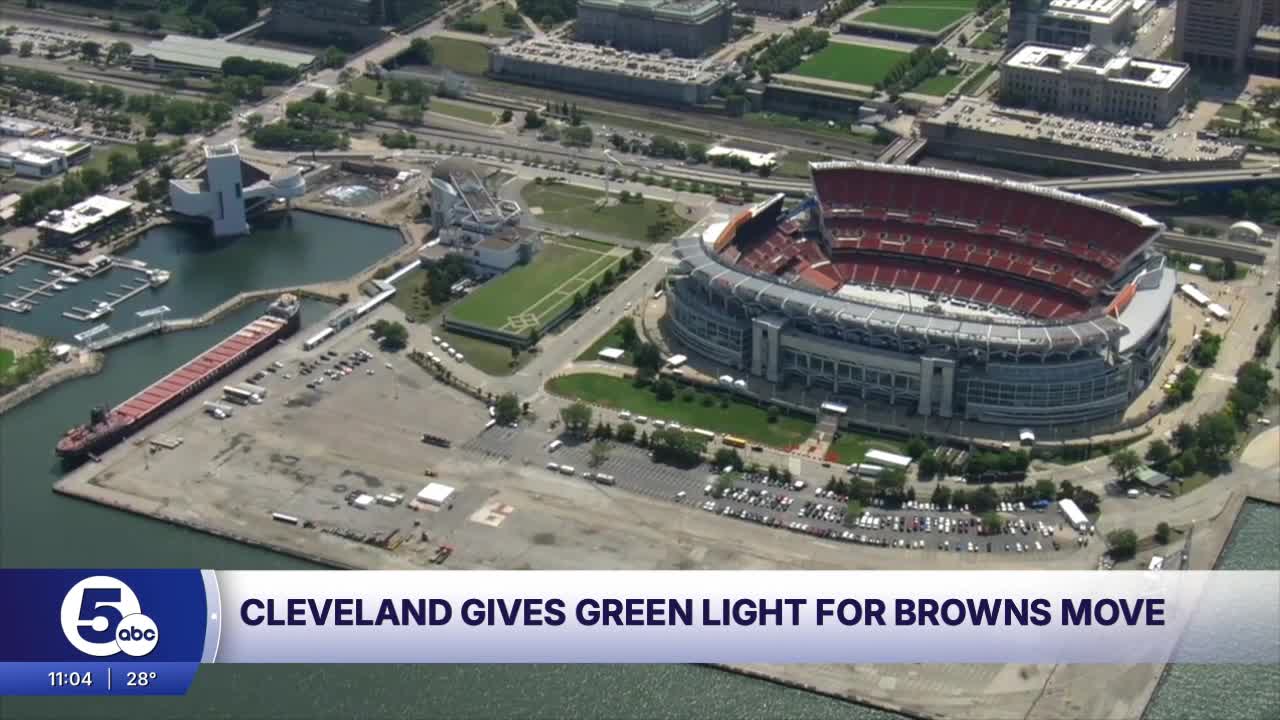



CLEVELAND — Cleveland City Council voted Monday night to approve an exit deal with the Browns – with some notable tweaks to the agreement, but no major changes.
After weeks of debate, council agreed to move forward on a roughly $100 million settlement to end a legal battle over the NFL team’s planned move to Brook Park. The revised deal changes how and where some of that money gets spent. It also raises the cost if the Browns need more time to make their move.
The Browns will get a smoother road to their new, suburban stadium. They’ll also get the option to extend their lease at the existing, city-owned stadium Downtown by a year or two if the Brook Park project runs behind schedule.
In exchange, the city will get money to develop the Downtown lakefront and invest in neighborhoods. And Browns owner Haslam Sports Group will pay to demolish the lakefront stadium and prepare the land underneath it for new uses.
Council members ultimately voted 13-2 to approve legislation tied to the deal, deciding it’s a settlement they don’t have to love – but one they can live with.
"Getting money to tear down a stadium we will no longer need is an exchange that I can at least sleep with at night," councilman Kris Harsh said during a long afternoon committee hearing.
The only dissenting votes came from Mike Polensek and Brian Kazy, two of the fiercest critics of reaching a truce with the Browns. "We should have gone after the NFL like dogs in heat," Polensek said. "That's what we should have done."
Council members Stephanie Howse-Jones and Joe Jones were not present for the vote.
Council President Blaine Griffin said he agonized over the decision but ultimately didn't want to punt the legislation to 2026, to a new council that will be seated in January.
"A lot of research went into this,” Griffin said near the end of the committee hearing. “A lot of conversations went into this. A lot of back-and-forth even today between the administration and myself. And I don’t negotiate in public, but what I am clear about is that there was some very, very intense discussions about how we move forward and why we should do this.”
Griffin said he and other members of council’s leadership team spent the weekend after Thanksgiving taking one last deep dive into the deal – and looking at where there might be room for movement by Mayor Justin Bibb’s administration and Haslam Sports Group.
Late Monday afternoon, the parties agreed on a few amendments to the deal. An updated term sheet outlining the revisions was posted online Monday evening. Here are the key changes:
Shifting money to neighborhood projects: The original plan earmarked $50 million for the lakefront and $20 million for “community benefits projects” across the city. The new agreement takes $5 million away from the lakefront and shifts it to neighborhoods.
That leaves $45 million for the lakefront and $25 million for neighborhood investments.
Costlier lease extensions: The initial agreement gave the Browns the option to add up to two years to their existing stadium lease if they need more time to move. The lease is currently scheduled to end in early 2029.
The revised deal preserves that option, but at a higher price.
If the Browns need one extra year, it will cost Haslam Sports Group an additional $1 million – money that would go toward neighborhood projects. If the Browns need the second lease extension, they’ll have to pay $2 million more – also for neighborhood investments.
Demolition project requirements: The city set minimum thresholds for local hiring and use of minority-owned and small businesses on the stadium demolition project, which the Browns will manage. Contractors on the job will have to pay workers prevailing wage – the rates paid on construction projects involving public money.
Clarity on wording: The agreement lays out what the Browns will have to do to get the cleared stadium site ready for redevelopment.
It clarifies that council will control how the $25 million for neighborhoods gets spent.
And the updated term sheet makes it clear that Cleveland will cooperate with the Browns to help the new stadium move forward – but the city won’t put any money into infrastructure for the suburban stadium district or throw its support behind the Brook Park project at the expense of city projects.
The view from council
News 5 asked Griffin if he believes the amended deal is a good one for Cleveland taxpayers.
"It's a deal," he said during an interview. "I think there's things that I would like to have seen better, things that I would like to have done, but sometimes you got to play the hand that you're dealt, and council was dealt this hand. Our lane in this was very limited, and it was not to renegotiate. Our lane was pretty much outlined for us, and I think we made the best out of a tough situation."
But Polensek thinks the settlement will put the city at a disadvantage.
"There's gotta be lead in the pipes here. Do not drink the water, because I continue to see bad decisions being made here at City Hall," he said during an interview. "When I walked in the door here, I learned how to count real quickly, and at the end of the day, we wind up in the red on this deal. I will not accept that, and that's why I voted no."
Griffin said the math is all over the place.
"One of the things that I've been concerned about is, are we gonna have a net positive or a net negative, gain or loss in this? I would tell you that meter moves oftentimes, and I don't think that there's a fixed thermometer," Griffin said.
He wishes the stadium had never been built on Cleveland's lakefront in the first place. Now the city is stuck with the consequences of decisions made in the 1990s, during horse-trading over the team between former officials and the NFL.
"I have such a disdain for what the NFL did," Griffin said. "The NFL put pressure on us and then had the audacity to go down to the state and lobby against us. Our vote today was not enabling the Browns to go. That was already a done deal when the state gave them $600 million. The state bailed the Browns out. It was 'How do we have a responsible decision for taxpayer dollars?' That's what we tried to focus on."
Polensek believes the deal moved too quickly.
"I enjoyed the two discussions I had with Jimmy Haslam on the phone," he said of the billionaire co-owner of the Browns. "I even said to him on the phone that we collectively don't talk enough to the team owners, and the team owners don't talk enough with us.
"They need to understand the issues we're confronted with. The poverty, despair, lack of opportunity, the infrastructure issues. We can brag that we are a major league city with three sports teams, but you can't have minor league neighborhoods, and that's what you have in this city."
Reactions to the deal
Dave Jenkins, Haslam Sports Group's president, applauded the resolution late Monday evening.
"We appreciate Cleveland City Council voting to approve our agreement," he said in a prepared statement, describing the deal as one that will advance the lakefront development while giving neighborhoods across the city a boost.
"As we've stated previously," he added, "we are extremely excited about the combination of a new, vibrant lakefront; the Bedrock riverfront project; our new, world-class enclosed Huntington Bank Field; and adjacent mixed-use development that supports Mayor Bibb's critical vision for a modernized Cleveland Hopkins (International) Airport. These projects all reinforce our belief that Northeast Ohioans should have it all. We are confident that, with continued collaboration, our region is set up for incredible growth and prosperity for generations to come."
In an emailed statement, Bibb also cheered the decision.
"From day one," he said, "I made it clear that any deal involving our city's assets must protect the city's general revenue fund and deliver real value for Cleveland. This agreement does exactly that. It resolves longstanding issues, safeguards the city's financial interests and positions us to move ahead with clarity and purpose."
A handful of civic and nonprofit organizations also chimed in, expressing their support for an end to the fight - and an attempt to move on.
Now the city and Haslam Sports Groups will put the finishing touches on their deal - and move to dismiss their dueling lawsuits over the existing stadium lease and a state law designed to give cities more power in battles to keep professional sports teams.
Cleveland stands to get an initial settlement payment of $25 million before the end of the year. That money is earmarked for the lakefront.
"We believe strongly that we have put the City of Cleveland in a position that it was not previously in," Bradford Davy, the mayor's chief of staff, told council members.
But councilwoman Jasmin Santana said that, in the future, there has to be better - and earlier - communication between the administration and lawmakers.
One of council's biggest complaints over the last six weeks was that members felt blindsided by the deal, which Bibb announced side-by-side with Jimmy and Dee Haslam on Oct. 13.
"We have to be partners," Santana said. "We all want what is best for our city. And working in silos is just not gonna move the needle."
Michelle Jarboe is the business growth and development reporter at News 5 Cleveland. Follow her on X @MJarboe or email her at Michelle.Jarboe@wews.com.

