



CLEVELAND — The American Cancer Society released its annual report, Cancer Statistics, 2026, on Tuesday, and while mortality rates have been declining through 2023, incident numbers are expected to increase for many common cancers, including breast, prostate, liver, melanoma, oral cavity, uterine corpus, and pancreatic cancer.
Pancreatic cancer is the third leading cause of cancer-related deaths, trailing behind lung cancer and colorectal cancer, a trend expected to continue in 2026.
The 2026 report estimates 2,390 new cases of pancreatic cancer in Ohio and 2,130 deaths. Last year's estimates were 2,500 cases and 1,980 deaths. According to the American Cancer Society, incident and mortality data lag 2 to 3 years due to the time required to collect and compile the data, ensure quality control, and disseminate them.
Part of what makes cancers like pancreatic cancer so deadly is that they are often not diagnosed until later stages, when the cancer has already begun to spread.
Dr. Jordan Winter, the director of Surgical Services at University Hospitals Seidman Cancer Center, says it is difficult to screen for pancreatic cancer because the pancreas cannot be seen endoscopically as easily as the cervix, colon, lungs, or breasts. The pancreas is located between the stomach and the spine.
"For pancreatic cancer, we don't have a really good test that can detect the cancer at a size that is less than 2 cm, and, once it gets to 2 cm, it generally has already spread microscopically," Winter said.
The earlier pancreatic cancer is detected, the more likely the patient is to survive. Winter said approximately 60,000 people per year develop pancreatic cancer in the United States.
"It's very hard to treat because it is so aggressive," Winter said. "It spreads earlier, early in the disease course, and it tends to be refractory or resistant to common therapies."
The Pancreatic Cancer Awareness Network, or PanCAN, said that pancreatic cancer is on track to become the second leading cause of cancer-related deaths before 2030, a rise in incident rates that Winter attributed in part to the aging population, but, as for why rates are rising among younger patients, he did not know.
He theorized it could be anything from obesity to the kinds of food we consume, but that it was "almost certainly" involving an environmental component.
"We don't know," Winter said, "but we are seeing a small uptick in the incident rates whereas, with many other cancers, the incident rates are actually declining."
A report published by the Ohio Department of Health in July 2024 found that an average of 1,899 Ohioans died of pancreatic cancer each year between 2017 and 2021. An average of 2,168 new cases were diagnosed annually during that time, and rates were higher among older adults (ages 65-74), males, and Black individuals. Fourty-five percent of cases were diagnosed at a late stage, and 11% of Ohioans diagnosed with pancreatic cancer in that period survived five years post-diagnosis.
Researchers are hopeful that survival rates can be improved through advances in treatment and more effective, earlier screening methods.
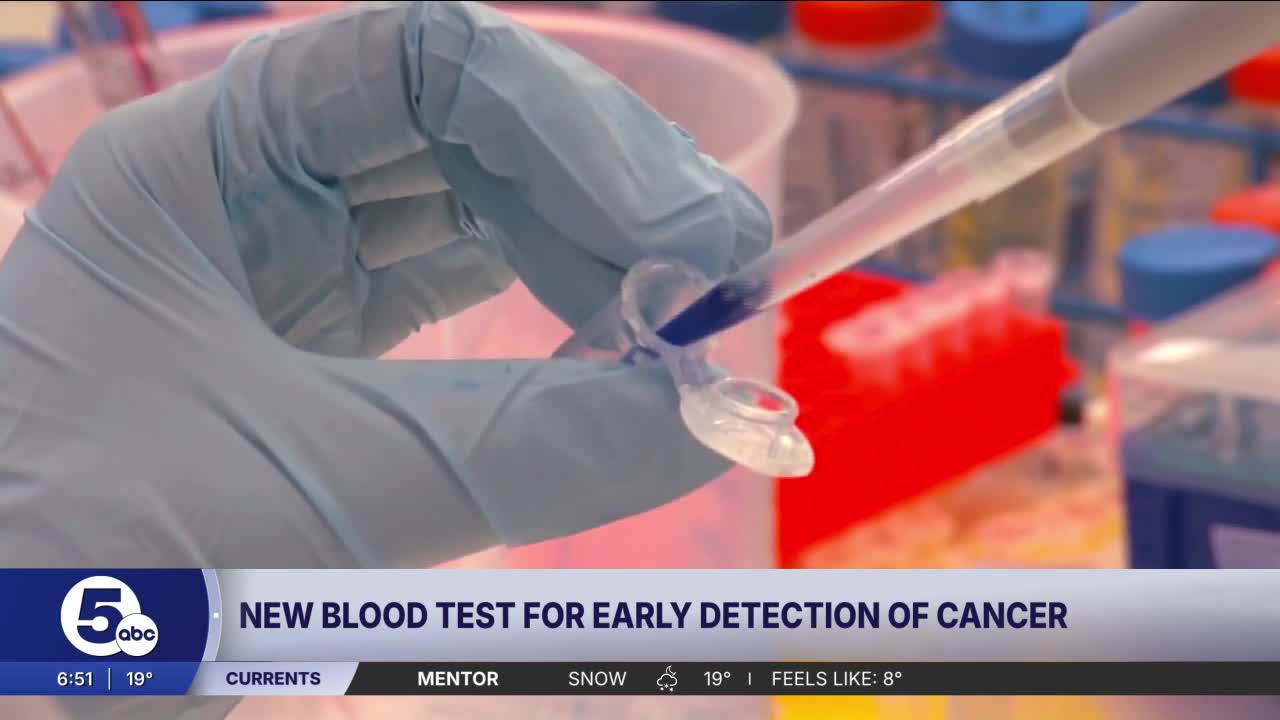
One of these screening methods is the GRAIL Galleri test, a blood test that can detect over 50 types of cancer.
We first told you about the GRAIL Galleri blood test in May 2024, when University Hospitals rolled it out to local fire departments. Firefighters have an elevated risk of cancer due to frequent exposure to smoke and other hazardous materials.
Watch:
RELATED: UH offers cancer-detecting blood test to local first responders
The GRAIL Galleri screens over 50 types of cancer. The test won't catch everything, but Winter estimated it will correctly indicate if a patient has cancer 50-60% of the time. The test involves drawing a vial of blood similar to any other blood work you get done, and results are typically expected in two to four weeks.
According to Winter, scientists look for blood molecules that reflect the type of cancer. Cancer cells shed fragments into the blood just as normal cells do, and each type has its own DNA sequence that can be analyzed to aid in a cancer diagnosis.
Unfortunately, the test is not yet widely covered by insurance, but Winter is hopeful that more carriers will cover it as the test's cost decreases and more data on survival rates become available.
"So we know that we can detect cancer earlier with the Galleri test and pancreatic cancer is just one of the 50 tests that it can detect," Winter said. "But does that change the trajectory in a clinically meaningful way such that survival's improved? That hasn't been proven yet, but the tests are underway to determine that."
The GRAIL Galleri test has FDA breakthrough device status, Winter said, meaning it has been vetted and proven to detect cancers earlier. Winter said similar blood tests are coming to market, such as Exact Sciences' Cancer Guard test, but that GRAIL Galleri is further along in its development.
For more information about the GRAIL Galleri test, CLICK HERE.
For more information on how UH is diagnosing and treating pancreatic cancer, CLICK HERE.
