

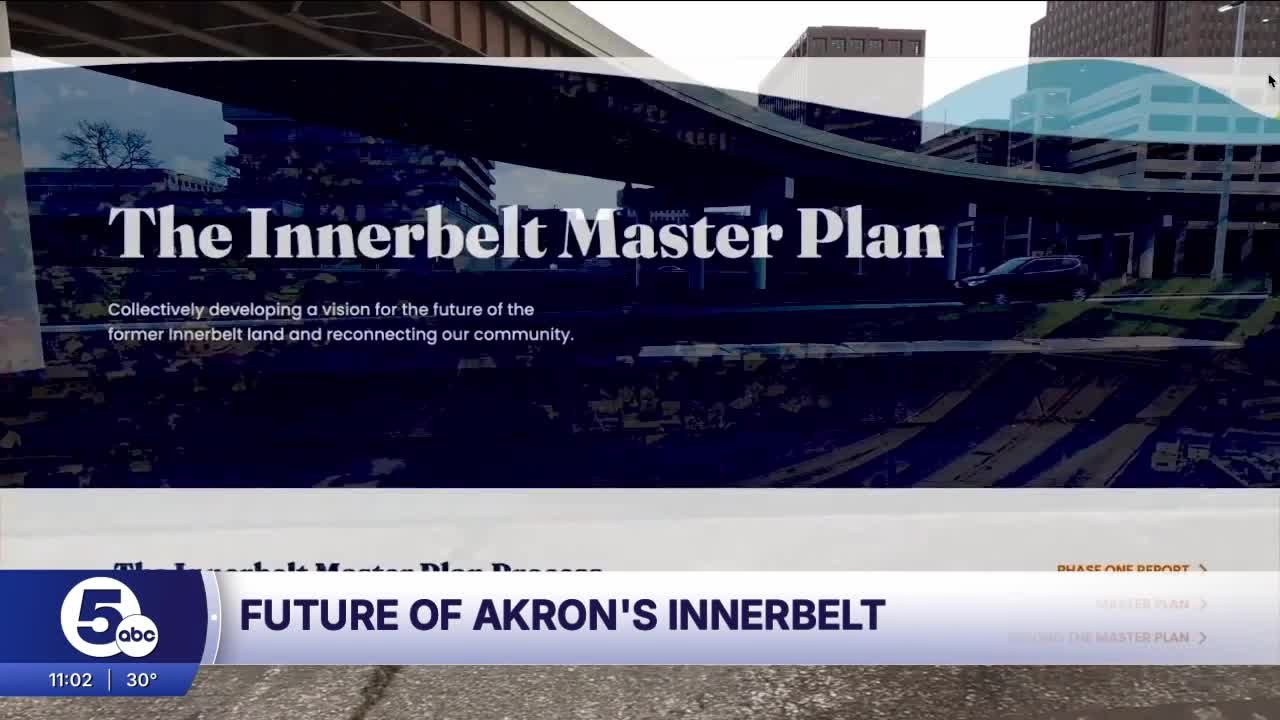


An abandoned stretch of land that was once the Akron Innerbelt will shape the future of Akron and serve new purposes, according to the final report of the Akron Innerbelt Master Plan released Monday morning.
The plan focuses on repairing the detrimental effects that came with the building of the Innerbelt, which involved the demolition of hundreds of homes and businesses in a thriving Black community in the 1970s and 80s.
“The completion of the Akron Innerbelt Master Plan marks an important step forward for our city,” Akron Mayor Shammas Malik said in a statement. “This community driven vision provides a clear path for reconnecting neighborhoods, supporting residents, and guiding future development in a way that strengthens Akron for generations to come.”
The Akron Innerbelt Master Plan outlines five strategies to develop the area that could create at least 20 new lots for businesses, 4,500 new homes, 11 new and/or improved street connections and six new connections to public spaces.
The strategies are as follows:
- Invest in the neighborhoods
- Strengthen East-West corridors
- Connect open spaces
- Activate Innerbelt adjacent assets
- Unlock land under the Innerbelt
Click here to read the full master plan.
Under these strategies, there are near- and long-term plans to redevelop and transform the Innerbelt area.
Near-term plan efforts
Within five years, the city plans to focus on infill housing development on vacant lots in the Oak Park Drive, Rhodes Triangle and Sherbondy Hill areas. Housing repair and anti-displacement tools will be deployed to ensure current residents will benefit from the revitalization efforts. Fresh food access initiatives will also begin in Sherbondy Hill, which is considered a “grocery desert,” according to the master plan.
Several streets will see improvements to crossings, restriping and traffic calming to aid pedestrian and cyclist safety.
Mill Street Bridge will be converted to a pedestrian bridge to enhance connections between the Glendale Neighborhood and Downtown. Vernon Odom Boulevard will see small-scale retail areas for small businesses.
Beautification efforts will take place, involving removing the eyesore that is the Innerbelt, with temporary planting on the Akron-owned northern section of the decommissioned highway. Additionally, a public art program will be implemented to commemorate the Innerbelt’s grim history and the steps being taken to rebuild the area.
Mixed-income housing and community spaces will be developed in areas near the Innerbelt, using publicly-owned parcels as development sites during the near-term phase. Also, during this time, the city will adopt a form-based code for future development efforts.
Within those five years, studies will be conducted to decommission and eventually remove the still-active portions of the Innerbelt owned by the Ohio Department of Transportation.
Long-term plans
Within the next 30 years or more, the city plans to see an increase in residents and investment in the infill housing developments that the master plan states will be built in the Oak Park Drive, Rhodes Triangle and Sherbondy Hill areas during the earlier phase.
Sidewalks, bike lanes and trees will be added to key streets in the area, and street repairs will be completed as part of the long-term efforts, supporting the revitalization of streets like Vernon Odom Boulevard and Exchange Street, which will serve as retail corridors.
The plan also allows for easier access to the Towpath and other public spaces along “green streets” like Bartges Street in West Akron.
Over time, redevelopment would take place in both public and privately owned areas near the Innerbelt, transforming them not only into mixed-income housing but also into employment and institutional sites. During this phase of development, Dart and Rand avenues will no longer serve as highway-like roads and instead will be urban-scaled streets, and new streets will be placed across the Innerbelt.
By the end of the long-term plan, the city envisions decommissioning, demolishing and redeveloping the still-active portions of the Innerbelt. However, those efforts are subject to market and funding conditions.
Redevelopment projects
The Akron Innerbelt Master Plan details over 20 place-based projects in the area to aid both physical and cultural development.
One site is Glendale Park, which the master plan describes as “hard-to-access and underutilized.”
Short-term goals for the area include using the park for community-centered activation, such as weekend markets or a food truck park, helping drive traffic to nearby businesses. While long-term efforts are to be explored, one idea is to construct mixed-income housing to frame the park.
According to the master plan, the city-owned site on Rhodes Avenue and Bartges Street could potentially serve as a community facility such as a Black Cultural Center.
This idea comes from the Legacy Building Project, a group that has been pushing to build a 25,000-square-foot African American Cultural Center and Museum.
Last month, News 5’s Bob Jones spoke with a member of the group, Terrence Shelton, who faced the damaging effects of the Innerbelt when his grandparents’ home was among those torn down. Shelton said that during discussions with the city, the mayor showed interest in developing the center.
RELATED: 'Repairing the harm': Group pushing for Black Museum & Center near Akron's Innerbelt
The master plan also proposes combining a site owned by AT&T with the land under the future decommissioned Innerbelt loop ramp near Dart Avenue and Opportunity Parkway, which is currently owned by ODOT.
Due to its size, the site has the potential for large-scale employment uses or large-scale, mixed-income housing development, according to the master plan. The buildings would memorialize the historic Wooster Avenue, which runs through the site.
What’s next
The Akron Innerbelt Master Plan will be presented at the April Planning Commission meeting for a recommendation and will then move to the Akron City Council for adoption, according to a press release from the city.
In this year’s capital budget, the city has budgeted $500,000 to implement the plan, focusing on short-term strategies such as updating the zoning code, beautification, infill housing development and resurfacing Vernon Odom Boulevard, the city said.
At this time, the city is awaiting further guidance from the U.S. Department of Transportation on a $10 million grant previously awarded to support the implementation of the plan, the city said.
“This funding is critical to turning this community vision into real, tangible change,” Malik said in a statement. “The Innerbelt has long represented both a challenge and an opportunity for our city, and with continued partnership from our state and federal leaders, we can unlock its full potential. We will continue to strongly advocate for these resources so we can deliver on what our residents helped design, including reconnecting neighborhoods, creating new opportunities, and building a more vibrant Akron.”
History behind the Akron Innerbelt
The idea for the Innerbelt emerged after Akron experienced a boom in the rubber industry, becoming the “Rubber Capital of the World,” attracting new residents and establishing a rapidly growing Black community, according to a historical timeline of the Innerbelt.
By 1967, the $47.4 million project began, and the city’s thriving Black communities became target areas for the projects.
Due to the Innerbelt construction, entire communities were wiped out, and many Black families were forced to move. More than 700 homes and 100 businesses were demolished to make way for construction. Residents continued to lose their land up until at least 1983.
The city relied on the growing population it saw to continue the construction of the Innerbelt, but when the rubber industry began to decline, population growth stalled. After years of construction delays, the Innerbelt never connected to Route 8 as originally intended.
News 5’s Clay LePard spoke with Akron’s Director of Planning Kyle Julien in 2024, who said the completed stretch of highway was meant to accommodate more than 100,000 cars a day, but, at its peak, it never saw more than 25,000.
RELATED: What's next for Akron's decommissioned Innerbelt? City looks for firm to help design for future
In 2017, city leaders decommissioned the Innerbelt, leaving the 30-acre stretch of land to sit abandoned to this day, with impacted communities remaining walled off from Downtown.
Efforts to heal the area from the damage done by the Innerbelt began in the early 2020s with the Reconnecting Our Community initiative, and a grant was awarded to help fund the master plan. In 2024, the city hired Sasaki, a global urban design and planning firm, which developed the master plan released on Monday.
Community reaction
Reverend Gregory Harrison, who was displaced by the Akron Innerbelt, said the Master Plan doesn’t make them whole and that there should be a greater focus on restoring a community that has been destroyed.
Harrison shared this information with News 5 during a phone call after we asked him for an interview, but he said he was unavailable.
In the meantime, Dr. N.J. Akbar, who participated in Akron Innerbelt community conversations on behalf of Akron Rites of Passage Institute, or AROPI, said the city’s plans are a step in the right direction.
"It’s not doing the same thing that was done previously with the harm, where those plans were made in some room, and then the construction and devastation happened, but the community has been at the center of this planning process,” said Akbar, the Administrative Lead of the Legacy Building Project.
Thanks to efforts made by AROPI, Akbar said the Legacy Building Project, a 25,000 square foot community-owned cultural center and museum complex, will be prioritized in the city’s plans to bring sustainable solutions and innovative processes.
"I think it really gives us an opportunity to repair harm and put a lot of the focus back on community-led, community-focused projects,” said Akbar.
News 5 asked Akbar if there’s anything more that needs to be done for the ‘children of the Innerbelt,’ those who were displaced and still have those haunting memories.
"That is a great question. I’m all for doing more than just symbolically acknowledging harm,” said Akbar.
