

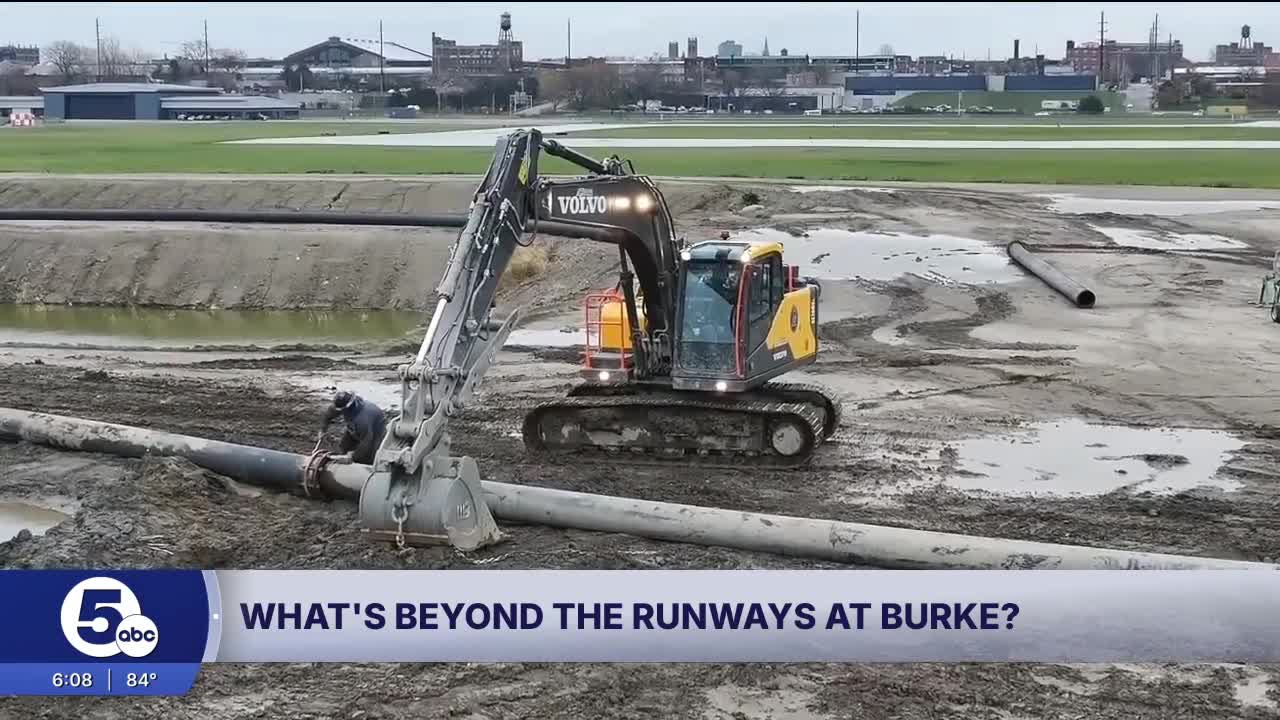



CLEVELAND — On a Friday morning in late May, Gabby Eisel hops into a truck behind a security gate off Marginal Road, near the Lakeside Yacht Club. She drives past excavators, dirt piles and a trio of sluiceways — a muddy, alien expanse at the northeastern edge of Burke Lakefront Airport.
Twice a year, in the spring and fall, those long channels get filled with sludge — water mixed with dirt dug up from the bottom of the Cuyahoga River.
And it’s that sludge, not the planes taking off behind us or the sweeping view of the city’s skyline, that we’re here to see.

Eisel works for the Port of Cleveland, which teamed up with a local landscaping and sediment management company in 2014 to open an unusual recycling facility on the Lake Erie shoreline. It’s where sand and silt pulled out of the river get turned into topsoil and fill dirt used on construction sites across Cuyahoga County.
This humble operation, which most Clevelanders can only glimpse from a distance, helps to keep the maritime economy afloat.
The U.S. Army Corps of Engineers dredges the Cuyahoga River to make sure heavy ore haulers can still navigate the shipping channel and reach the Cleveland Works steel mill just south of downtown.
“The Cuyahoga River has to be maintained at a depth of 23 feet,” said Eisel, the port's environmental and GIS specialist.
And the muck — the result of everyday erosion and runoff along the river — needs somewhere to go.
Some of it ends up in confined disposal facilities, permanent containment areas that the Army Corps and ports across the country have used for decades, creating new land.

But more than 60% of the sediment gets processed, trucked off and reused.
Port officials say that recycling operation, which would be tough to move and costly to rebuild, needs to stay put — even with the future of the 450-acre Burke property up in the air.
They believe the sediment-processing facility and a reimagined waterfront can coexist, with public trails and, perhaps, opportunities to teach people what dredging’s all about.
“The reality is that our dredge facility at Burke takes up a small fraction of the overall land mass,” Jeff Epstein, the port’s president and CEO, said during a recent interview.
'All this lakefront real estate'
Civic leaders are seeking congressional authorization to close Burke, a city-owned airport that mainly caters to private pilots, flight schools and hospitals. On Tuesday, Mayor Justin Bibb reiterated his commitment to shutting the airfield and freeing up the land.
“Call your senator. Help me close Burke,” he told a crowd of hundreds of people at the Rockefeller Foundation’s Big Bets for America event in downtown Cleveland.
“You know,” he added, “every time I drive past Burke, I get frustrated and very angry and very sad. … This is not about luxury townhomes and apartments and fancy restaurants. No. It’s about making sure that families can bring their kids down to fish in Lake Erie. It’s about having a youth sports complex where kids can play soccer or hockey. It’s about giving young people the ability to choose Cleveland as their home.”
Pilots and airport tenants, including the Cleveland National Air Show, are fighting to keep Burke open. On Thursday afternoon, a group called the Lakefront Airport Preservation Partnership urged Cleveland City Council to hold a hearing focused on the opposition soon.
Epstein, who was a member of Bibb’s cabinet before taking the helm at the port last year, is an advocate for shuttering the airport and rethinking roughly two miles of the shoreline.
“The potential is vast,” he said, recalling the first time he went out to the confined disposal facilities and stood there, looking back at the city.
“I think about how fortunate I am that I can get out and stand out there," he said. "And that other Clevelanders can’t. The fact that I’ve been living in Cleveland for most of my life — and have never been out there before. And all this lakefront real estate that we could do a lot more with.”
Turning trash into topsoil
The recycling facility at Burke spans about 40 acres.
It’s flanked by two active, traditional confined disposal facilities — one operated by the port, the other managed by the Army Corps of Engineers. Those storage areas, totaling about 122 acres, are expected to be full within the next few years.

Contractors hired by the Army Corps pull about 250,000 cubic yards of sediment out of the river each year. That’s enough to fill more than 15,000 dump trucks.
The recycling facility, operated by Kurtz Bros., can handle 80,000 cubic yards of the stuff, twice a year. Workers pull a barge filled with river silt and sand up to the shore. Then they mix the dirt with water and pump it through a thick hose into the sluiceways.
The sediment gradually settles to the bottom of those channels, and the water gets drained off. The whole process takes three to five weeks. Then Kurtz Bros. digs in, turning what’s left into products homeowners and construction contractors want to buy.
If you’ve purchased topsoil from Kurtz Bros. in Cuyahoga County in the last seven years or so, it probably contains some Cuyahoga River sediment, said Jason Ziss, the director of business development for the company, which is based in Independence.
“People all over the country have eyes on Cleveland and the state of Ohio because of this — and because it’s doing the right thing with a material that can be reused,” he said.
By recycling river dredgings, the port and Kurtz Bros. are cutting down on the need for new confined disposal facilities, which are expensive to build and tricky to locate. But that doesn’t totally eliminate the demand for storage.
That’s why the port and a slew of partners have been working to get buy-in from the Army Corps for a long-term project called CHEERS, which would use dredged sediment to soften the shoreline and protect Interstate 90 east of downtown by building green space, trails, a cove and fish habitats.

Preserving the nearby recycling operation is a key component of that plan.
The port says 13 million tons of cargo move through Cleveland’s harbor each year, supporting 23,000 jobs and generating billions of dollars in economic activity. Dredging is a critical piece of that puzzle, preserving access to 5.9 miles of federal shipping channel.
By pulling runoff out of the river, dredging also reduces the amount of phosphorus that makes its way into the lake from fertilizers and manure. Phosphorus overload leads to harmful algal blooms that can turn the water green and make people sick.
“There’s erosion happening. Trees falling down. Getting closer to roads,” Ziss said. “That is the material that is coming down and getting into our river system and needs to be dredged out. That’s the material we’re really getting out. Not material that’s running off an industrial property into the river.”

'They can work together'
Ziss has seen firsthand how a recycling facility can run side-by-side with lakefront trails and recreation. Kurtz Bros. owns and operates a similar sediment-management facility in Fairport Harbor, where a 10-foot-wide path runs along the shoreline.
Signs lining that path explain the process of dredging the nearby Grand River and repurposing the sand and silt.
“I do think they can work together,” Ziss said of sluiceways, dirt piles, earthmoving equipment and interactive nature exhibits.
Epstein believes something comparable is possible in Cleveland, if Burke closes.
“You could potentially walk around that dredging site or perhaps even … create a boardwalk where you can walk through and learn about that dredge material,” he said.
The neighboring confined disposal facilities, once they’re exhausted, could become parkland. That’s what happened just a few miles to the east in 2012, when the port opened an 88-acre nature preserve on a former dumping site.
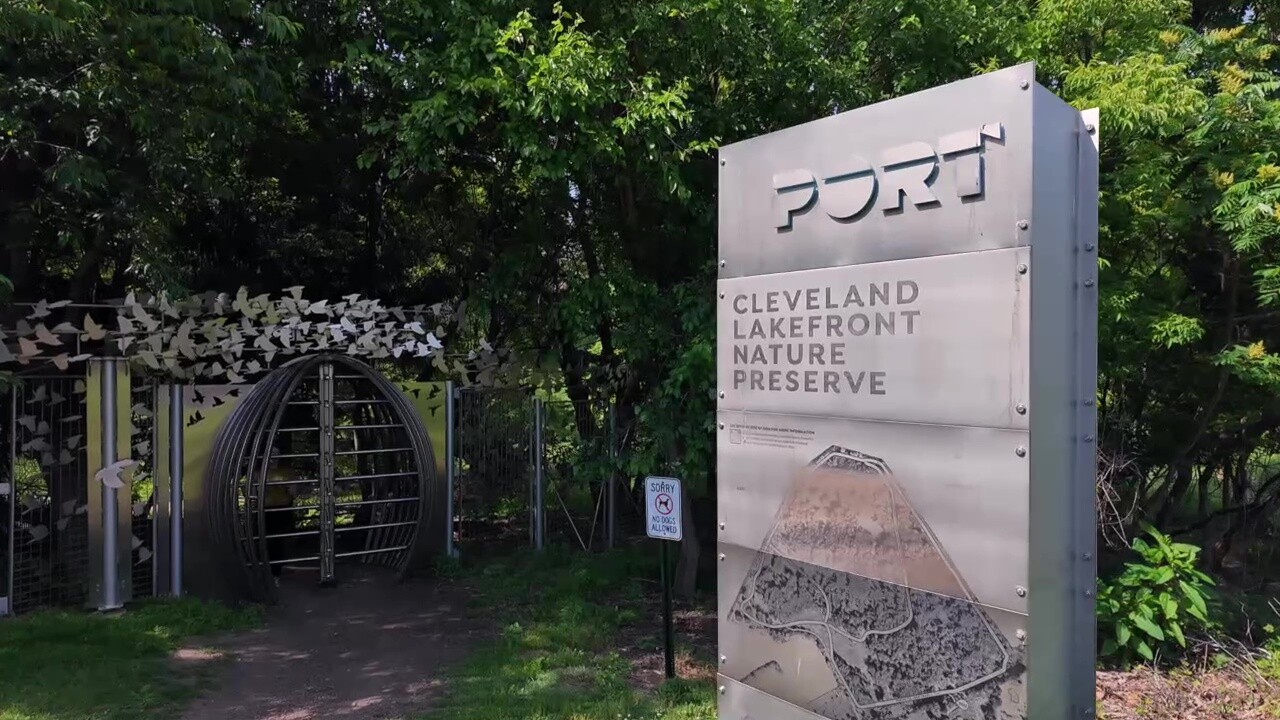
The Cleveland Lakefront Nature Preserve, off Lakeshore Boulevard just west of Bratenahl, was a repository for river dredgings from the 1970s to the late 1990s. Now it’s a haven for birdwatchers, a refuge filled with trees, native plants and 2.5 miles of hiking trails.
Thirty years ago, that land looked a lot like the sweep north of Burke — the property where Eisel can stand and watch private jets take off, with skyscrapers in the background.
Then nature crept in. And took over.
Michelle Jarboe is the business growth and development reporter at News 5 Cleveland. Follow her on X @MJarboe or email her at Michelle.Jarboe@wews.com.
