

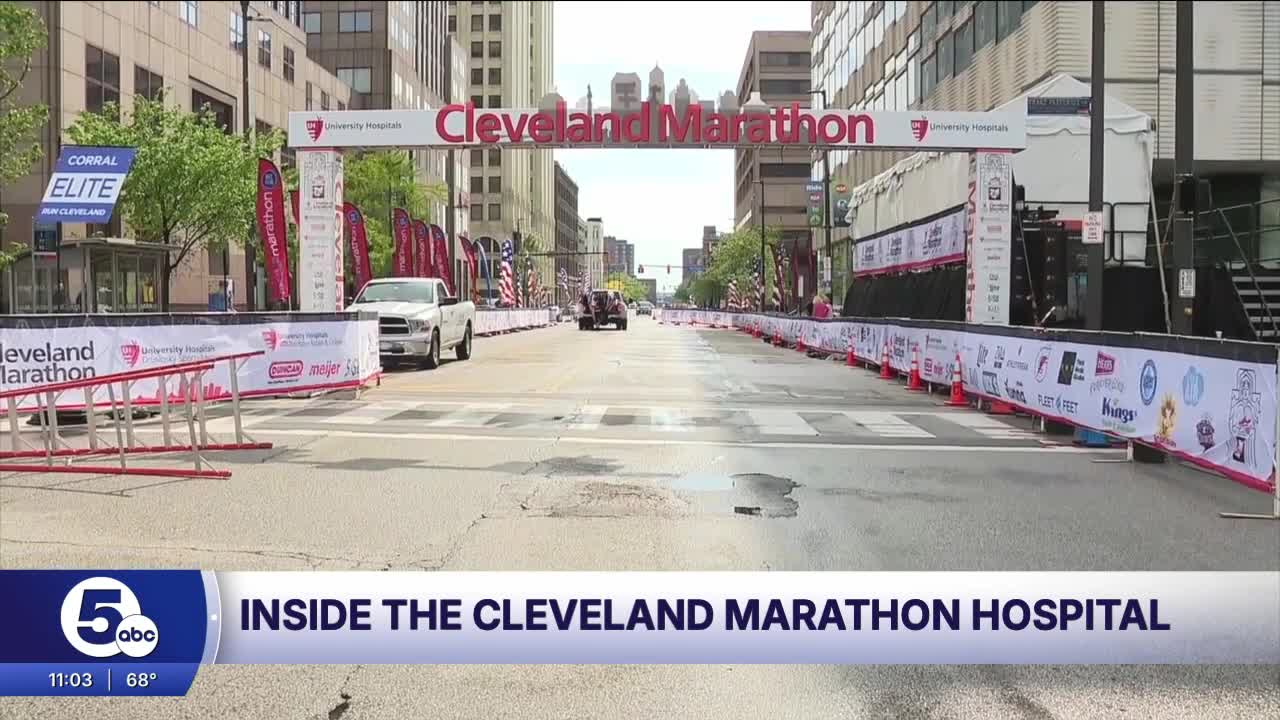


CLEVELAND — Thousands of runners and spectators have filled downtown Cleveland for the Cleveland Marathon, with a medical team of more than 100 providers standing by to handle everything from minor injuries to cardiac arrest.
The medical operation is led by University Hospitals Dr. Jeffrey Luk, who serves as medical director for the Cleveland Marathon. Luk and his team spend months preparing for the event, positioning medical staff at fixed locations and deploying mobile units throughout the course.
More than 100 medical providers of various levels are stationed at water stops and deployed on bicycles and gators along the route.
Luk said the most common medical issues fall into two categories.
"Some are traumatic injuries, like tripping over a curb or tripping over an obstacle. We see other medical issues related to heat illness, heat injury or dehydration," Luk said.
The medical tent is stocked with advanced equipment to handle serious emergencies.
"We have all the equipment that we would need to provide resuscitative care to somebody. So we have IV fluid, we have cardiac arrest medications, we have seizure medications, we have pain medications. Or if they need it in the airway, we have a mechanical CPR device, we have a portable ultrasound on site and we have a portable lab to give us quick numbers if we need it for those select patients. So, we're well equipped to provide the best care possible to the runners," Luk said.
Among the equipment on hand are ice bath dunk tanks used to treat heat-related emergencies.
"What we have behind me are dunk tanks that we have essentially ice baths that we submerge them in to rapidly cool them down to an acceptable temperature in order to preserve the neurological function right long term," Luk said.
The team has also responded to cardiac arrests at past marathons.
"We've had a few, and we've been able to deploy our assets very quickly because of how we've strategically deployed them,” said Luk.
With warm weather expected, Luk urged runners to take precautions and said the race would possibly begin under a yellow caution flag.
Runner Tim Dewald said the medical presence gives him confidence on race day.
"It just gives you that little bit of added security to know that if something would happen to you, you can feel good knowing that there's so many great trained medical professionals down here," Dewald said.
The medical team was ready to go on Sunday by 5 a.m.
