

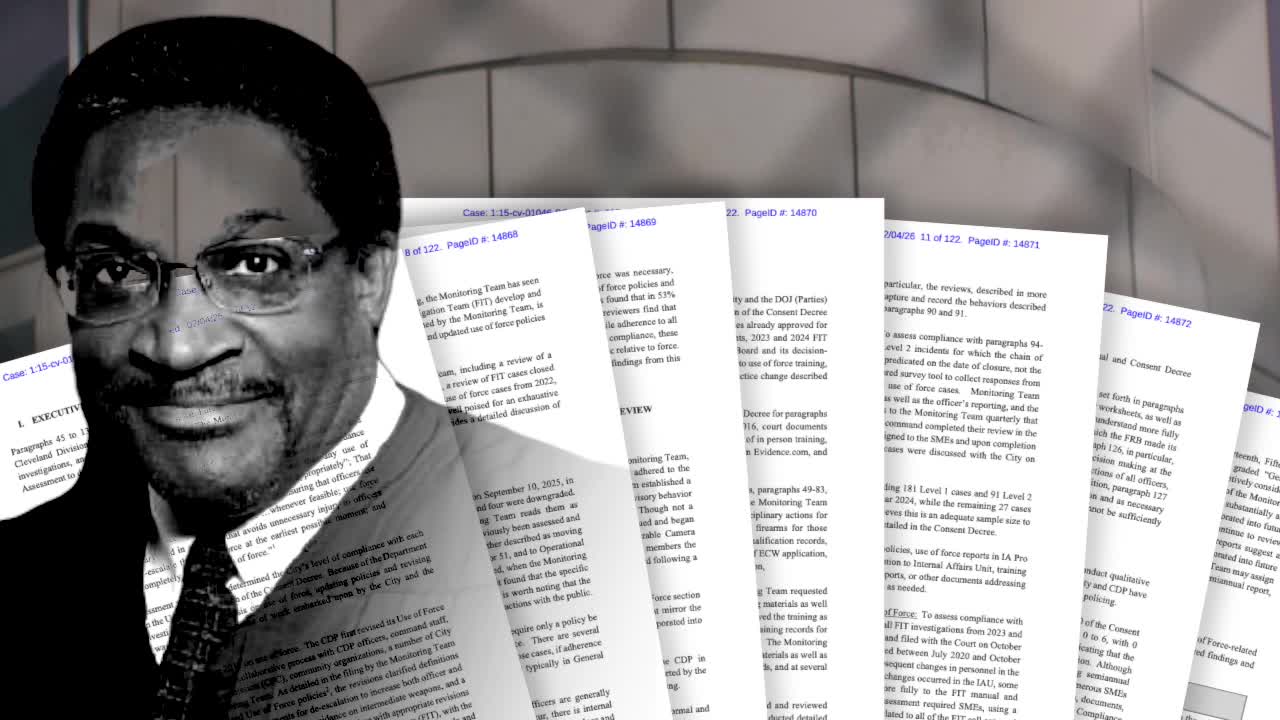


CLEVELAND — During a status hearing in federal court on Friday, Judge Solomon Oliver Jr. said he was surprised by the Bibb administration's news conference on Thursday regarding a recently filed motion to end the consent decree.
According to the judge, the City of Cleveland is not claiming it has met all the requirements to formally end the 10-year-old consent decree, but instead said it has met the most important ones.
Oliver said that the news conference yesterday came as a surprise, considering the work that must be done to meet the consent decree's requirements.
"I didn't have to have a heads up, but it would have been good," Oliver said Friday about Bibb's news conference.
According to federal monitor Christine Cole, the city has several additional assessments to complete that could extend the consent decree into 2027.
Yesterday, Case Western Reserve University law professor Ayesha Bell Hardaway, who spent years serving on the federal monitoring team overseeing Cleveland's progress, and as interim head monitor, noted there are eight other areas of reform in the consent decree that were not mentioned in the city's motion. Hardaway also noted the Trump Department of Justice has not been supportive of consent decrees.
"For them to file this motion in agreement with the Trump DOJ certainly does make for strange bedfellows at this time," she said.
During court on Friday, Deputy Assistant Attorney General R. Jonas Geissler said the joint motion to end the consent decree wasn't political but rather based on Cleveland's progress.
"The facts dictate its time," said Geissler, "Not who's in charge at DOJ."
The motion seeks to have Judge Oliver end the consent decree, which has been in effect since 2015, as the city has been in compliance with the mandated reforms.
RELATED: Cleveland files a joint motion with Trump DOJ to end police oversight, despite unmet goals
The Cleveland Division of Police has been under federal oversight since May 2015, after a U.S. Department of Justice investigation found the department engaged in a "pattern or practice" of excessive force and raised concerns about additional civil rights violations, including the deadly shooting of Timothy Russell and Malissa Williams, known as the 137 shots incident in 2012.
137 shots
On Nov. 29, 2012, a police chase involving 60 police cruisers through multiple cities in Northeast Ohio ended with 13 officers firing 137 shots into the car Russell and Williams were driving after dozens of CDP cars chased them from Downtown Cleveland to a parking lot at Heritage Middle School in East Cleveland. The pair was unarmed.
RELATED: Monitors: Cleveland earns 20 upgrades in consent decree report, but 'significant work remains'
