

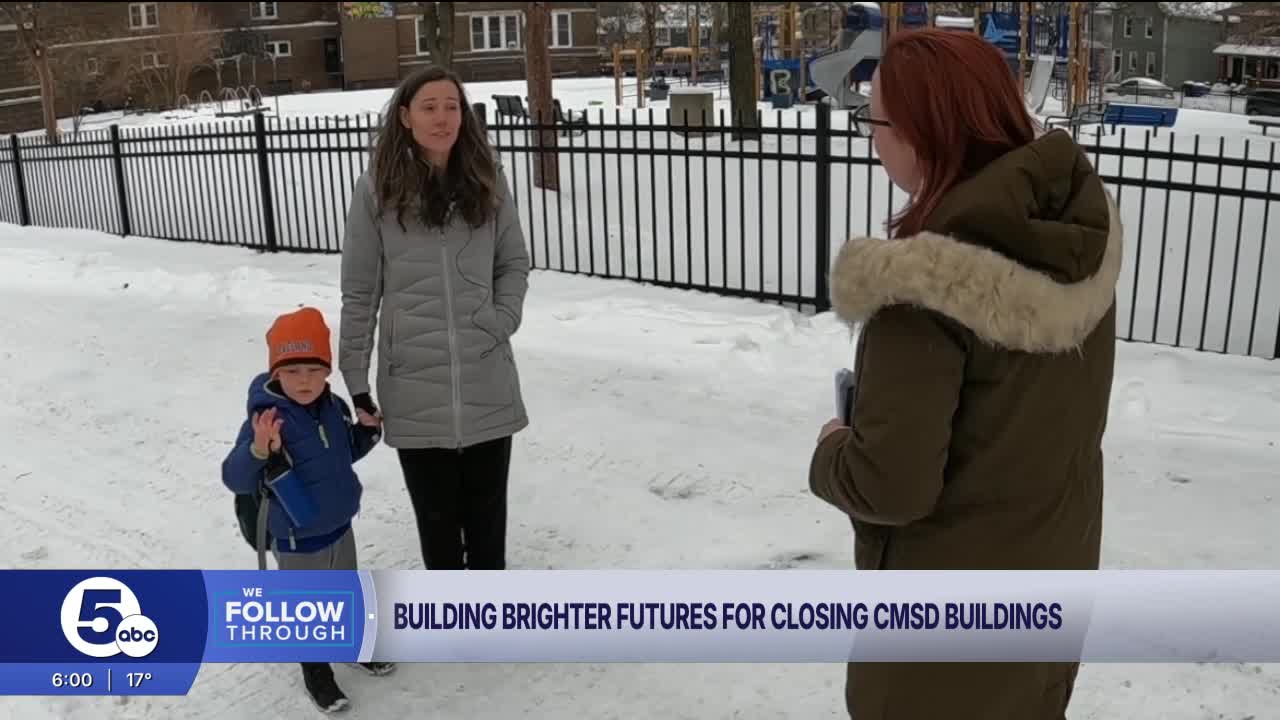



CLEVELAND — When the weather’s nice, Lynsie Osinsky rides a bike through Tremont to take her 4-year-old son, Camden, to preschool.
His school, Tremont Montessori, occupies a landmark brick building that opened in 1917. Now families are preparing to say goodbye at the end of the academic year. Tremont Montessori is one of 18 buildings the Cleveland Metropolitan School District plans to close as part of a sweeping cost-cutting and restructuring plan called Building Brighter Futures.
As a parent, Osinsky is disappointed.
“But I know that we have other options out there for school,” she said. “And my son is young enough that it really doesn’t disrupt too much.”
As someone who lives nearby, she’s more concerned. Because Tremont Montessori – like many Cleveland schools – sits in the heart of a neighborhood. And a building like that, a building in transition, can either be an opportunity or a liability.
“I definitely don’t want it to be an empty, unused building,” she said. “I would love for it to be something that everybody has access to.”
Now the city of Cleveland is asking neighbors what should happen to the 18 school buildings after students and teachers move on. Working with the district, city officials are holding a series of meetings this month and soliciting feedback through an online survey.
The first meeting will start at 5:30 p.m. Thursday at the Collinwood Neighborhood Resource and Recreation Center, at 16300 Lakeshore Blvd. It will focus on Collinwood High School and the Euclid Park and Hannah Gibbons elementary schools.

'As open-minded as possible'
“We’re not looking for developments that can be kind of plopped down anywhere, right?” said Trudy Andrzejewski, the city’s assistant director of development, said during a recent interview. “We know that a lot of these sites are tucked within neighborhoods … have played a very significant role in neighborhood fabric and identity for a long time.”
Matt Moss, a senior strategist in Mayor Justin Bibb’s office, echoed that.
“We want to emphasize that we’re not prioritizing any sort of outcome. … We don’t just want to put these sites out and develop them all into housing,” he said. “We want to be as open-minded as possible as to how these could be community assets.”
The buildings were constructed between 1917 and 2012. Several date to the 1970s, according to city records. Most of them are 60,000 to 75,000 square feet, though they range from 25,000 to roughly 300,000 square feet.
Moss said the school district might be able to repurpose some buildings for its own needs, like admissions or other student services. And the city’s considering whether any of the properties make sense for other public uses, like fire stations and police stations.
That means Cleveland won’t necessarily be looking for developers for all 18 sites.
“That would whittle down or limit what eventual sites might be put out in terms of a request for proposals or qualifications,” Moss said, referring to outreach to developers.
“That said, there are also opportunities where you might not need all the land that’s available at a particular site for a public use or for a city-government use,” he added. “And so, in that case, there still might be an opportunity to do something else with the balance.”
The school sites range from 1 acre to 7.5 acres.
Moss said it’s too early to talk about possible uses for individual buildings or sites. He and Andrzejewski want to hear neighbors’ ideas first. They see the potential, in some cases, for the city to play matchmaker between community groups and developers.
“We don’t want people to feel like ‘This is kind of crazy. It’s never gonna work. I won’t even bother trying,’” he said. “Reach out to us and let us know.”
After accounting for community feedback, the city and the school district could put out a formal request to developers in the spring. Moss said he hopes officials will be able to talk about specific uses for some of the properties by the end of this year.
It’s possible some buildings will be demolished. But former schools across the city have found new life as everything from apartments to nonprofit offices.
“We’ve seen a lot of great conversions of historic, really well-built properties that aren’t ever going to be able to be replaced,” said Andrzejewski, who has been working on school-redevelopment projects for the city since 2021.
RELATED: Cleveland plans to close 18 school buildings. Remaking them could be tricky.
State law requires districts to give charter schools, college-prep boarding schools and certain specialty schools first dibs on unused buildings. The state defines an unused building as one that’s been vacant for at least a year, or a school where less than 60% of the space was used for academic instruction during the previous school year.
The 18 buildings that CMSD is emptying out don’t fit that criteria yet.
Ohio also requires school districts to hold public auctions for unwanted properties that are worth more than $10,000. But districts can get around that requirement by selling real estate to another public entity or trading land and buildings with other owners.
“We’re exploring all our options in terms of how we follow the law and follow that process – again, to the best advantage of the residents,” Moss said.
Ultimately, decisions about the buildings rest with the Cleveland Board of Education.
“We really want to support the district's ability to focus on their bread and butter of educating our children - and staying focused on that,” Andrzejewski said. “So any support that we can provide, and really our development expertise, our planning expertise, is where we're trying to step in.”

'Those challenges are real'
In 2021, Cleveland and the school district solicited proposals from developers for 19 properties – a mix of vacant schools and vacant land. Most of those properties were on the East Side. Many of the former schools had been empty for a decade or longer.
Only one of the buildings, the former Hawthorne elementary school in the Jefferson neighborhood, has been fully reborn. It reopened as modestly priced apartments last year.
In 2024, a workforce development nonprofit called New Bridge Cleveland acquired the old Case elementary school on Superior Avenue. That building is set to become offices.
Three deals fell apart when the General Assembly changed state law in late 2022 to block developers from combining federal low-income housing tax credits and state historic preservation tax credits. That change, tucked into a spending bill, shocked the affordable-housing industry and threw at least one other school-redevelopment project, at the former Central school on East 40th Street, into limbo.
“Funding, of course, is always going to be a challenge,” Andrzejewski said.
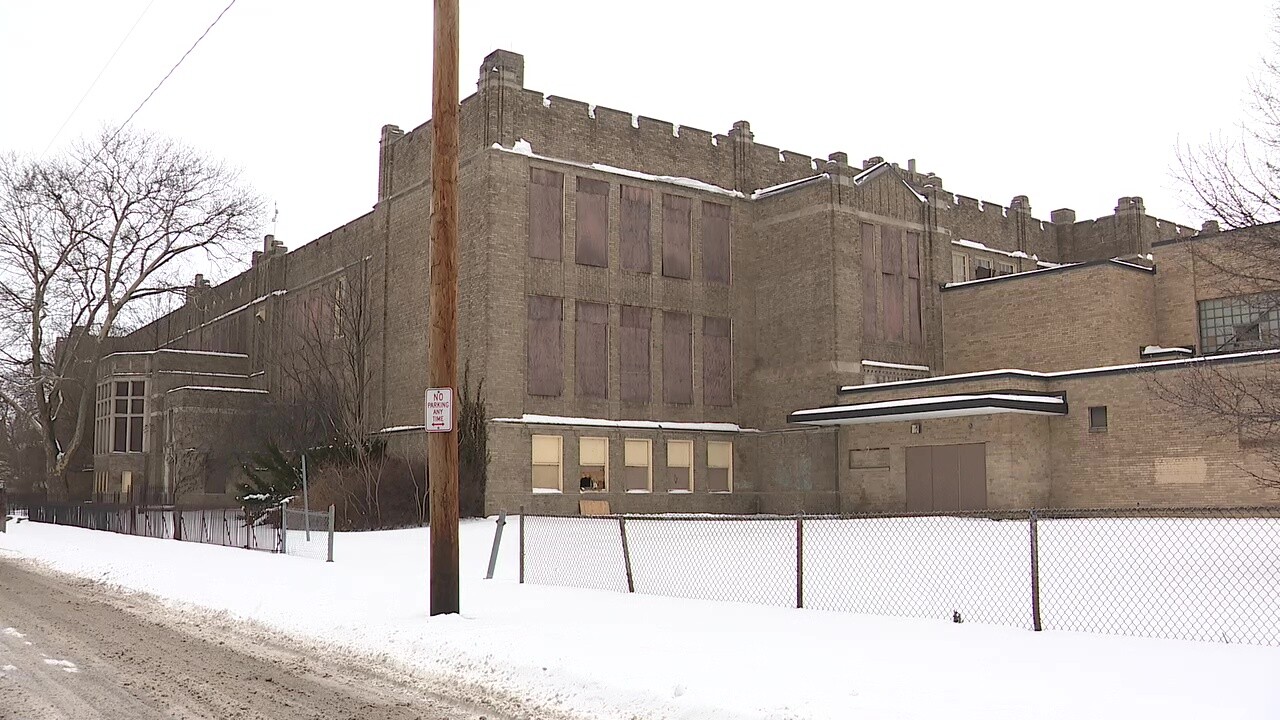
Some of the district’s vacant land is still languishing, too. But in Hough, on East 85th Street, the former Raper elementary school site is now a park. Last year, the district turned over another plot of land, in Slavic Village, to a trucking company.
“There are a lot of folks who really just want something – some sort of investment – to occur with these sites,” Andrzejewski said. “And I understand that. And we’re trying hard to figure that out.”
This time around, the city is trying to work proactively to identify potential sources of funding for projects. And the development department has identified ways to speed up and simplify the process for developers who want to tackle former schools.
Asking for community feedback now, instead of leaving that to developers down the road, is another significant change. In 2021, the district and the city didn’t solicit input from neighbors before putting the last big bundle of school sites up for sale.
“That was a great lesson learned,” Andrzejewski said. “What we really want to do is ensure that any redevelopment opportunity we’re positioning starts with that community voice and value as a baseline – and then we take next steps from there.”
She and Moss acknowledged that none of this will be easy.
Tremont’s bustling, but many of the neighborhoods set to lose schools are grappling with the fallout from decades of disinvestment. And developers are contending with higher construction costs and interest rates than they were a few years ago.
“I hope people understand, as we work through this process as a city, as a school district, as a community, that those challenges are real – and that we’re working and doing our best in the face of those challenges,” Moss said.
There are a lot of questions he can’t answer yet. But he’s sure about one thing when it comes to former school sites.
“They should continue to provide some type of public benefit,” he said.
Michelle Jarboe is the business growth and development reporter at News 5 Cleveland. Follow her on X @MJarboe or email her at Michelle.Jarboe@wews.com.
