

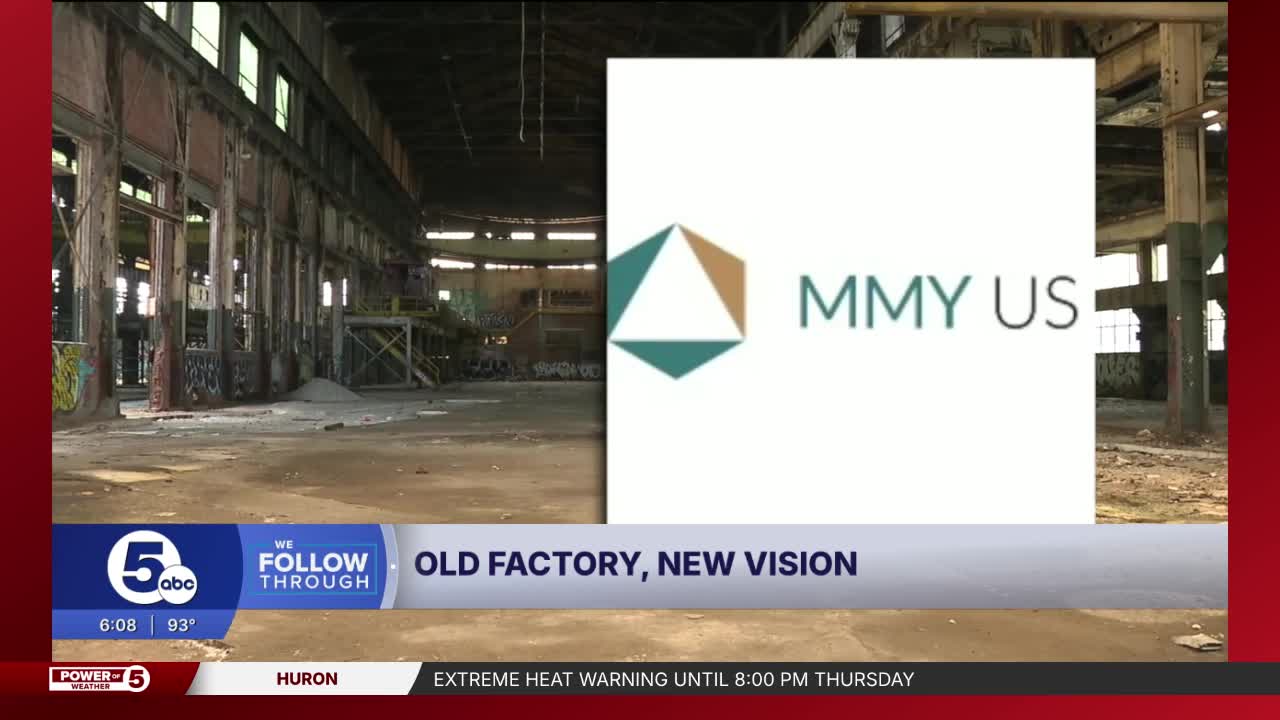



CLEVELAND — A modular housing manufacturer aims to set up shop in the Central neighborhood, bringing a historic factory back to life and creating up to 150 jobs as the business grows.
Cleveland Mayor Justin Bibb and the Site Readiness for Good Jobs Fund announced Tuesday that they’ve picked MMY U.S. to help fill vacant, city-owned lots with factory-made homes. The company, based in Kentucky, plans to restore the old Wellman-Seaver-Morgan Co. plant at 7000 Central Ave. as a modern manufacturing showplace.
The Bibb administration is looking to modular homes as one way to plug gaps in the housing market. A few developers in the city have toyed with modular construction. But officials believe a local factory will make the process more efficient and less costly while putting Clevelanders to work.
The MMY factory will be the centerpiece of a broader effort to bring companies and jobs back to a downtrodden stretch of the East Side. The Wellman-Seaver-Morgan complex sits right in the middle of a nascent business district called the Midline, where the nonprofit site fund has been acquiring dilapidated buildings and blighted land for redevelopment.
RELATED: Cleveland unveils major industrial revival push on the East Side. They're calling it the Midline.
“The Midline isn’t just a vision,” Brad Whitehead, the site fund’s managing director, said during an interview before Tuesday's announcement. “The Midline is a reality. And what we’re seeing today is that this is going to happen. This isn’t a pie-in-the-sky dream.”
Working with the city, the site fund sent a request for proposals to modular housing manufacturers in late 2024.
RELATED: Cleveland has 18,000 vacant lots. Could a modular housing factory help fill them?
MMY responded but wasn’t one of the finalists announced by a selection committee last summer. At that point, the company — a start-up with roots in the United Kingdom — was too busy getting a plant running in Louisville, Kentucky, to continue with the process in Cleveland.
But city officials, site fund leaders and MMY executives kept talking.
A group from Cleveland took a bus trip to Louisville last year to see the factory there. And MMY agreed to tackle a pilot project here — a three-bedroom, two-bathroom house that the company placed on a vacant lot on the city’s West Side.
Ultimately, MMY CEO Robin Bartram Brown said, the opportunity in Cleveland was too good to pass up.
“It’s a bigger market than Louisville,” he said during a phone interview. “And one of the, I think, underutilized assets for export in Cleveland is the port. It opens up Canada for us, which is a huge potential market … And Ohio’s such a big market.”
MMY will become a part-owner of the Wellman-Seaver-Morgan building, partnering with the site fund. The company is in talks about local and state incentives tied to jobs and investments in the property. The financial side of the deal is still being finalized.
“We just were able to get aligned … on how they’re going to be partners with the city and really be good contributors to the local community,” Joevrose Bourdeau Small, the city’s director of development, said during an interview before Tuesday's announcement. “All these kinds of things that you don’t really see at surface level, but just core values.”
Bartram Brown also fell in love with the building.
RELATED: Cleveland's new site fund buys huge, historic factory on city's East Side
Originally, the city and site fund planned to work with a modular housing manufacturer to build a plant in the Collinwood neighborhood, on the site of a former General Electric Co. factory off East 152nd Street.
That plan changed when Bartram Brown stepped into the 185,000-square-foot Wellman-Seaver-Morgan building, with its soaring roof, wide-spaced columns and huge cranes overhead.
“I have never been so cold in my life,” Bartram Brown said, recalling his first visit on a blustery winter day. “I walked through the door with a blizzard blowing in my face and said to Brad, ‘This is it.’ And he was like, ‘OK.’”
Whitehead couldn’t argue.
“This building is so majestic,” he said. “We wanted to save it. … When we talked to the neighbors in the community right around here, they said they wanted to save it as well.”
Last week, the site fund won $2.56 million in state historic tax credits to help restore the building, where workers once made hulking equipment for steel mills. Wellman-Seaver-Morgan also built the Hulett unloaders, machines that lifted iron ore off Lake Erie freighters.
RELATED: Cleveland Site Fund building, Akron's Quaker Square win tax credits for historic preservation
"This building was a great symbol of America's industrial revolution," Bibb said Tuesday. "Now it will be another great symbol of Cleveland's comeback, Ohio's comeback and America's comeback."
Councilman Richard Starr, who represents the area, said a generation of people growing up in Central only know the building as another vacant factory. Now that view is about to change, demonstrating what's possible through public-private partnerships and community advocacy.
"They deserve jobs," he said of neighbors. "They deserve investment. They deserve hope. And they deserve to see cranes replacing graffiti and opportunities replacing abandonment."
The renovation is a roughly $26 million undertaking. MMY, which is a general contractor, will oversee the project. Bartram Brown said restoration work could start in the fall.
“It’s a complicated capital stack,” he said.
The company hopes to launch the first of three production lines next summer. Eventually, the factory could churn out three homes a day — every day.
Some of those would be earmarked for vacant lots in Cleveland, where the city recently designated the Hough, Central and St. Clair-Superior neighborhoods on the East Side as a housing innovation district.
But MMY, which already sells homes in Kentucky, Indiana and southern Ohio, sees a chance to reach much more of the Buckeye State — and stretch east toward the coast.
Bartram Brown said the company is hearing from cities in the Columbus area about the need for more housing to accommodate construction workers who are building and maintaining data centers.
“They’re not just looking to build worker camps,” he said. “They’re looking to build long-term housing that people can live in.”
MMY specializes in single-family homes and small apartment buildings. The houses get high marks for energy efficiency and sustainability, qualifying for the top rating possible through the Leadership in Energy and Environmental Design, or LEED, program.
Instead of using timber, the company produces homes using light-gauge, American-made steel. The typical house is made up of two modules, or boxes.
“Imagine that the houses are Lego blocks, and we build those Lego blocks in a factory,” Bartram Brown said.
It takes about eight weeks to prepare a residential lot, produce and deliver a house and complete a project. Bartram Brown wouldn’t get into pricing for MMY’s houses, beyond saying that “from the marketplace … we understand that we’re competitive.”
From the start, city officials have said their goal is to build a range of housing, at sale prices of up to $300,000.
Small said she, like many people, had a lot to learn about modular construction. The city’s not talking about mobile homes or manufactured housing. These are houses that meet state and local building codes — just produced in a controlled, factory environment.
“There’s so much technology that’s been poured into that industry,” she said, adding that she’s particularly excited about MMY’s commitment to hiring and training locally.
“The modular housing manufacturer is one of the many things that we’re working on to kind of solve for housing in the city of Cleveland,” she said. “And this is one that we’re extremely excited about because it will bring housing really quickly and be able to provide quality, affordable product to the market.”
Michelle Jarboe is the business growth and development reporter at News 5 Cleveland. Follow her on X @MJarboe or email her at Michelle.Jarboe@wews.com.
