

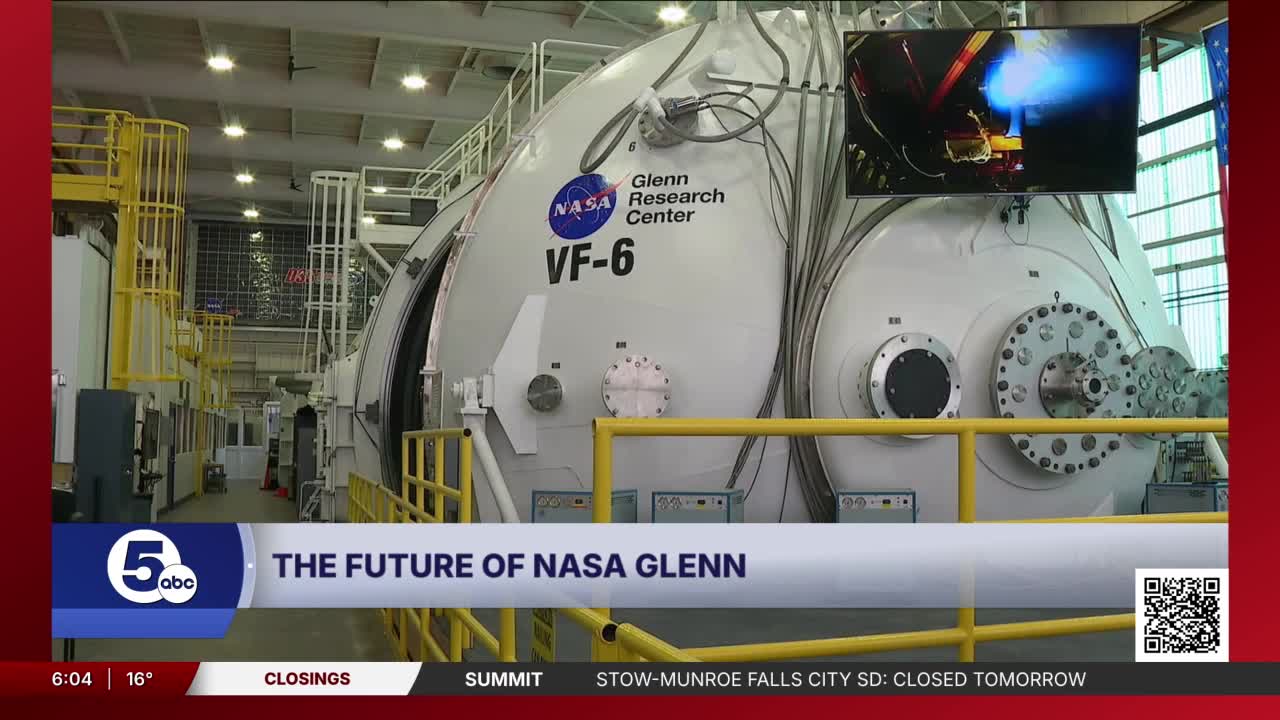


CLEVELAND — After a year of early retirements, voluntary buyouts and contract cancellations, NASA Glenn Research Center and the Neil Armstrong Test Facility continue their mission-critical space research, with about 600 fewer employees compared to one year ago.
News 5 obtained headcount numbers from NASA Glenn, which showed a loss of 288 civil servant employees, and an estimated loss of 323 contractors between January 2025 and today. That amounts to a 19% loss in workforce at the center, which previously employed bout 3,200 people
| 2025 | 2026 | |
| Civil Servants | 1458 | 1170 |
| Contractors | 1743* | 1420 |
| Total | 3201 | 2590 |
*Estimate based on latest CSU Economic Impact report (2023).
The cuts came as NASA and other federal agencies faced pressure from the Department of Government Efficiency to reduce spending in the early part of 2025.
"The one thing that stood out is the amount of people that ended up ultimately leaving NASA," said Jeffrey Hoyt, a former NASA civil servant who worked at Glenn for 17 years.
Hoyt chose to participate in the Deferred Resignation Program last year, which allowed him to leave his position in July, while still receiving payroll benefits into January. He had managed eight people and handled NASA's business contracts.
"Basically, we buy really cool stuff for really smart people," Hoyt said.
Not all departing employees received those same benefits. Rod Geschke, a graphic designer who worked as a contractor for nearly five years, told New 5 he learned of his termination during a phone call.
"We had two weeks, and we were let go, and there was no severance or nothing else," Geschke said.
News 5 has highlighted Glenn’s aeronautics division over the years, from a push to bring back commercial supersonic flight over the continental United States to helping map out a highway in the sky as more drones and self-driving aircraft enter the airspace.
As soon as next month, Artemis II, NASA's crewed mission, could launch and travel around the Moon for the first time since 1972. NASA Glenn Research Center helped develop and test the Orion capsule, which will carry four astronauts inside.
Just a couple of months ago, NASA Glenn was picked to oversee the development of nuclear power systems for lunar missions.
Watch that report here:
Many former NASA Glenn employees posted about their departures on LinkedIn, with some leaving the aeronautics and aviation industry entirely and others relocating outside Ohio.
We're going back to the Moon — very soon! During Artemis II, astronauts will venture around the Moon and back on their first flight aboard NASA’s SLS rocket and Orion spacecraft.
— NASA's Glenn Research Center (@NASAglenn) January 24, 2026
Get to know some more of the NASA Glenn employees who’ve made contributions to @NASAArtemis ⬇️🧵 pic.twitter.com/pJupn2EQnD
Both Hoyt and Geschke worry about what the workforce reductions mean for the remaining employees.
"The folks that are there are going to be stretched more thin," Hoyt said.
"Maybe we jumped the gun a little too much, that we took away people too fast, and we didn't really resolve it in the end," Geschke said.
Cheers to 85 years! 🎉 #OTD in 1941, the lab known today as NASA Glenn was established in Cleveland.
— NASA's Glenn Research Center (@NASAglenn) January 23, 2026
Our center’s innovation, research, and testing were crucial for the nation’s first step on the Moon, and we’re here for the next giant leap with @NASAArtemis.
More on this… pic.twitter.com/tEgNpfhq7U
As the head of the Greater Cleveland Partnership, Baiju Shah has kept close tabs on the movement happening at NASA Glenn Research Center and has advocated on behalf of the area for growing NASA's presence in Northeast Ohio.
"It was a challenging year," Baiju Shah, president & CEO of Greater Cleveland Partnership, said. "There’s a lot of talent that has now exited the agency that is going to have to be restocked with new talent, which is exciting. You always want to have a dynamic workforce, but it’s going to take NASA Glenn and other NASA centers time to bring staff back that are going to be able to fulfill the functions that are important for them to execute the missions of the agency."
NASA's new administrator, Jared Isaacman, who took over in December, addressed questions about the workforce changes in a wide-ranging conversation during his visit to NASA Glenn on Tuesday.
"2025 was a different year," he told News 5. "2026, I think right now, we’re absolutely embarking on a second space age."
Isaacman pointed out that once he took over, the President signed an Executive Order to have Americans on the moon by 2028 and to establish a lunar base by 2030.

"We always need the best and brightest from around the nation to contribute to NASA’s world-changing mission," Isaacman said. "No doubt. OPM, the Office of Personnel Management, is igniting a new hiring program for all the most important technological domains, including space, so we’re partnering with them on that. What’s different now than it was last year? We have a national space policy that says we need to do a lot of important things. The President says return to the moon, build a moon base, invest in nuclear power and propulsion, create a $50 billion orbital economy, and launch more missions of science and discovery. Of course, that’s going to require talent to do so."
RELATED: New NASA Administrator visits Cleveland, talks future with the moon, Mars and NASA Glenn
Watch News 5's full conversation with Administrator Isaacman :
And with Artemis II around the corner and other major missions happening at NASA Glenn, former employees that News 5 spoke with remain optimistic about NASA's mission.
"Despite a turbulent year and even though I don't work at NASA anymore, I'm still on the sidelines rooting for NASA and cheerleading for NASA, and I think there's still great things ahead," Hoyt said. "I don't know to what level or to what degree, but still think there's going to be a positive outlook, just might take a little time to get there."
Clay LePard is a reporter at News 5 Cleveland. Follow him on Twitter @ClayLePard, on Facebook Clay LePard News 5 or email him at Clay.LePard@WEWS.com.
