

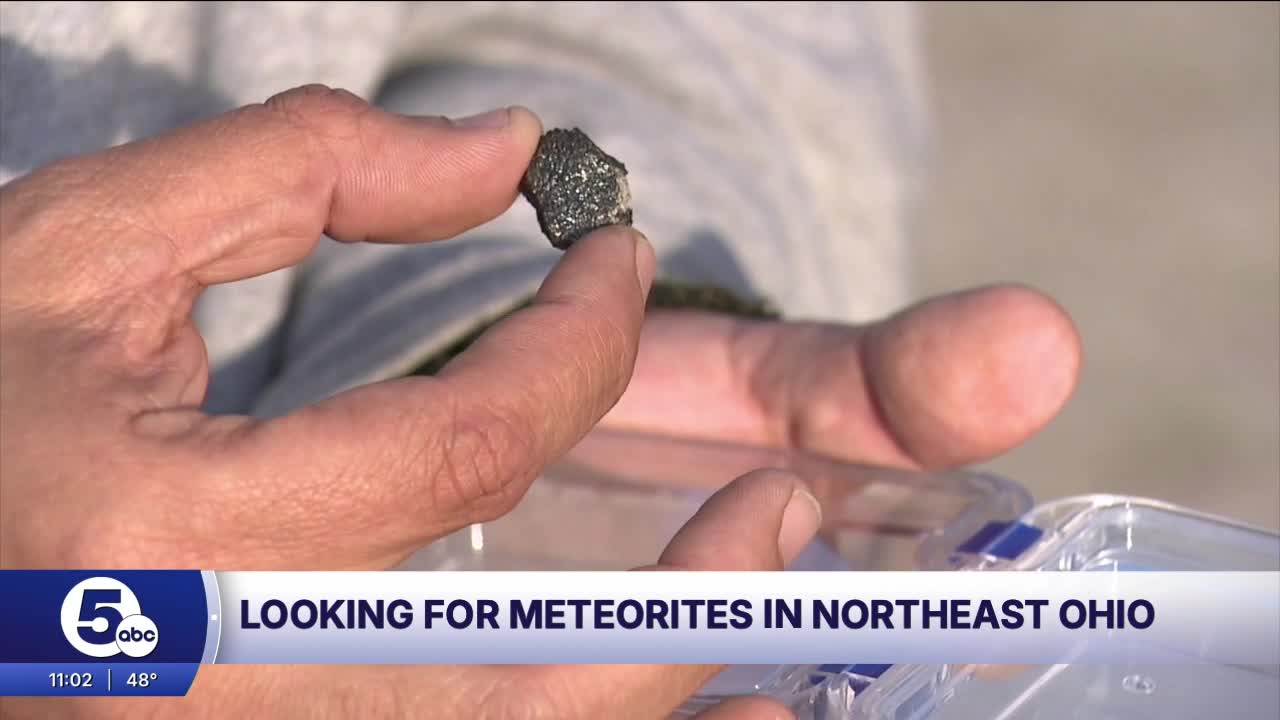



MEDINA COUNTY — Meteorite hunters have rushed to Northeast Ohio, including Roberto Vargas, who traveled from Connecticut to find fragments of a meteor that hit Medina County on March 17th.
“On my first day I was looking from sunup to sundown, and I almost called it a day but decided to look in one more cul-de-sac. As I was walking around the cul de sac I looked to the ground and there was a little fragment. I found a 12.2-gram fragment, the crust was gleaming in the sunlight,” said Vargas.

And for the last few days, he continued his search, finding a few more pieces he plans to donate.
“These rocks are like 4.5 billion years old, and they come in from outer space. They tell us about the origins of the species and the creation of the planets. I’m not a super smart guy, but I can contribute to science,” said Vargas.
The meteor that hit Medina County, a half-hour south of Cleveland, caused a sonic boom that rattled buildings and caused fears of an explosion. The fireball was seen from Wisconsin to Maryland, and NASA confirmed it was a 7-ton meteorite.
“Ninety-something percent of meteorites are what are called ordinary chondrites. They have a little bit of metal in them, they have chondrules and they're kind of what's left over from the creation of the planet. But this is not that,” said Vargas.
Vargas says the meteorite that hit Medina County did not have metal inside, the crust looks like glass, and they believe this meteor is what they call an Eucrite.
“The United States hasn't seen a Eucrite fall since 2004 so it's the first fall in over 20 years, which kind of a big deal, and this is historic for this area,” said Vargas.
Ohio hides a lot of secrets beneath its soil, and people had a chance to figure out what they may have unearthed at Firelands Archaeology Annual Artifact ID Day. Visitors were able to bring up to 10 specimens to be examined by the group’s volunteer experts.
“One gentleman brought in an artifact that was probably 13,000 years old, and it's one of the oldest artifacts we find in Ohio. It was made by the first people to come to Ohio at the end of the ice age,” said Director of Archeology Brian Redmond.
Amongst the group, a few brought in what they believed to be pieces of the meteor.
“They had a few people that brought what they thought were meteorites, but it turned out our experts don’t think they really were,” said Redmond.
Vargas urges people to continue looking, and for direction, he says people should rely on NASA’s map.
“If you're around here get out there and save these meteorites from the elements, which sounds crazy but that's honestly the case. The grass is going to get taller and it’s going to get harder to find,” said Vargas.
Vargas plans to donate some of his meteorites to Arizona State University.
