




STARK COUNTY, Ohio — In December, the electric bill inched past $500. By February, it topped $600.
Keith and Cheryl Kasnik knew what they were getting into when they bought an all-electric house in Perry Township, just outside Massillon, in early 2023. But their power bills have soared much more than they expected, straining the semi-retired couple’s budget.
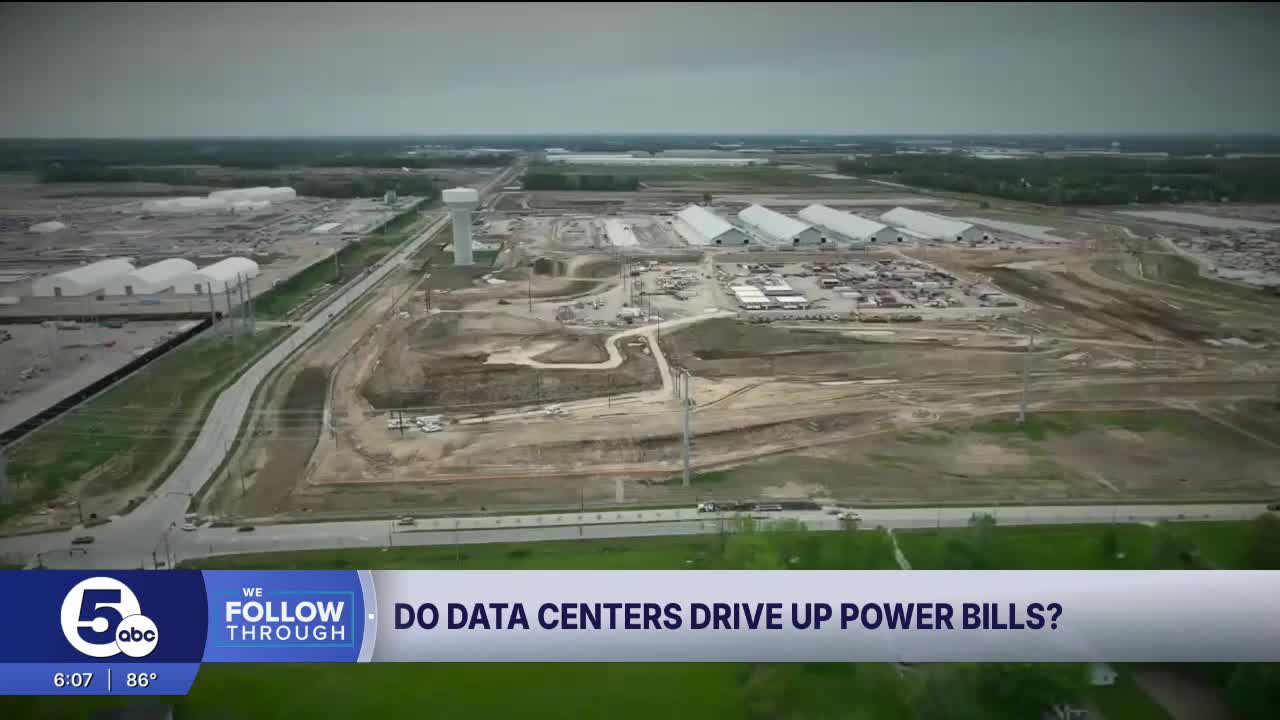
And Keith can’t help looking across the street — at a cryptocurrency mining campus that sprung up after the Kasniks moved in — and wondering.
"Something is having an effect on this area,” he said, “and that was the big thing to change.”

In nearby Canton, homeowners’ power bills have been climbing for years, according to surveys from the Public Utilities Commission of Ohio. Across the state, residential power pricing is up about 26% since early 2023, U.S. Energy Information Administration numbers show.
Experts say data centers are at least partially to blame.
“We have increased demand,” said Maureen Willis, who leads the Ohio Office of Consumers’ Counsel, a watchdog agency focused on investor-owned utilities. “And the supply is just not keeping up with that increased demand.”
As debates over data centers rage across Ohio, there’s plenty of disagreement about the merits of welcoming the large computing hubs — facilities that protect and process data for everything from medical records and financial transactions to video streaming, artificial intelligence and, yes, crypto mining.
RELATED: Is a data center a blessing or a curse? It depends on the community.
But there’s one thing everybody seems to agree on.
We’ve got to do something about electricity.
"The power issue’s 100% real,” said Steve Stivers, the president and CEO of the Ohio Chamber of Commerce, a powerful business association.
Major data center developers and tech firms say they’re committed to paying their fair share. In March, tech titans including Amazon, Google, Microsoft and Meta, the parent company of Facebook, signed a federal pledge to cover the costs for the power they expect to use and the infrastructure upgrades necessary to get that power to their data centers.
But it’s not so simple.
“Nothing is easy in the utility field,” Willis said. “It can be very complicated.”
Recent studies, regulatory documents and utility-industry reports make it clear that we need better safeguards to ensure that the costs associated with data centers — keeping servers humming and connecting them to the power grid — don’t spill onto everybody else.
“The number one thing I hear when people talk about data centers and power is they don’t want to subsidize the data centers, which is the same thing a lot of consumers are saying,” said Stivers, whose organization represents about 8,000 businesses. “And I think that’s a reasonable thing for anybody to say. Nobody wants to subsidize somebody else, especially somebody that is making a lot of money — and has a lot of money already.”
Just ask the Kasniks, who live in one of Northeast Ohio’s potential hot spots for data center development.
RELATED: As data center proposals spread across Stark County, neighbors fear what's next
They’ve saved money and tried to invest wisely over the years. They’re both still working part-time at Lowe’s.
But it’s not easy to stomach the surging costs to keep the lights on — and run the air-conditioning system, the furnace, the refrigerator, the freezer, the hot-water heater, the air fryer, the microwave, the washer, the dryer and other gadgets.
“The electric bill, when it becomes higher than most people’s car payments, that’s significant,” Keith said.

'Unlike any other customers'
In early June, state lawmakers proposed — but failed to pass — a series of data center reforms, including changes to how Ohio regulators and utility companies handle projects.
The fast-track package, House Bill 646, hit a wall as legislators squabbled over how much to reduce a state sales-tax break that’s helped fuel Ohio’s recent data center boom. That means meaningful progress on data center regulations isn’t likely to happen until the fall, since the General Assembly typically takes a summer break from early June to November.
“People want to see action, and I’m becoming frustrated,” said Rep. Tristan Rader, a Lakewood Democrat who sits on the House Energy Committee.
It’s unclear just how much data centers are impacting Ohioans’ pocketbooks today.
A lot of factors determine electricity prices, which have been rising across much of the country. Recent studies attribute part of that increase to fuel-price fluctuations, government policies, damaging storms and global events, including the escalation of the Russia-Ukraine conflict in 2022.
There’s also the challenge of replacing and upgrading aging infrastructure that's getting pushed to its limits by technology changes, advanced manufacturing and electric vehicles.
Ohio is part of a regional electricity market that includes a dozen other states and Washington, D.C., where an organization called PJM Interconnection acts like a conductor, controlling the movement of electricity to more than 67 million people.
PJM saw a spike in demand in 2024, after years of relatively flat hunger for power across the region. Data centers — existing and proposed ones — are driving much of that “generational increase,” Asim Haque, a PJM executive vice president, told lawmakers during a hearing before the General Assembly’s select committee on data centers in late May.
Some massive computing warehouses require as much power as a city. The cryptocurrency operation in Massillon, which is partially online and set to be finished in the fall, could draw more power than all the households in Stark County combined.
“They’re unlike any other customers,” Willis said of the new breed of data centers.

Researchers at Lawrence Berkeley National Laboratory point out that higher demand doesn’t always lead to higher prices. Your power bill includes three main components: The cost of producing the power. Long-distance transmission. And local distribution.
If more customers need power, the fixed costs of operating the electrical grid can be spread out more broadly, reducing everyone’s bill. But that only happens if the costs of serving new customers are lower than average — and if the costs get split up properly.
That cost-splitting math worries Willis, as utility companies and regulators try to figure out how much power data centers really need and what it will take to get them plugged in.
“That’s the real question,” she said, “is how do you allocate those costs that happen because of the data centers?”
Ohio lawmakers could require electric utilities to create a separate classification for data centers, which get lumped in with other customers today, and implement a special billing program, called a tariff.
The tariff model would require large, new data centers to pay hefty up-front fees, sign long-term power contracts and foot the bill for most of the electricity they think they’ll need — even if they don’t end up using it.
AEP Ohio rolled out a data center tariff last year. The company said the new rules caused the pipeline of projects and their power-demand estimates to shrink dramatically.
In other words, some of the data centers on the drawing board before were probably figments or duplicates — reflections of real estate speculation or cases where tech firms were kicking the tires on multiple sites.
That’s important, since power bills are shaped by current and anticipated demand.
"We don’t want to be in a situation where consumers are paying for something that’s overbuilt — and then they end up holding the bag,” Willis said.

'Who knows what's beyond that?'
PJM has been urging states to come up with rules to protect homeowners and other customers from costs associated with data centers. It’s unclear whether Ohio will be able to act quickly enough.
“The idea that there should be expectations, everybody agrees to that,” Stivers said.
But the details, in a state where utilities merely deliver your power, other companies produce it, a mega-operator oversees the grid, and it’s all regulated by an alphabet soup of federal and state agencies?
That’s where things get messy.
Stivers believes power prices in Ohio would have gone up without data centers. But they’re rising more because of the tech-driven demand — and a system that’s unprepared.
“We do need more generation right here in Ohio,” he said, adding that the chamber supports investments in all types of power, including renewable energy — though state laws make wind and solar tough to pull off.

Last year, the General Assembly passed a bill designed to encourage developers to build more electric-generation projects here. Among other things, the legislation made it easier for major energy users, including data centers, to build their own on-site power plants.
Now tech firms are investing in natural gas generation and other technologies to get online faster. It might take a year or two to build a data center, depending on the type of construction. But it can take much longer to get a project connected to the power grid.
“In college days, it was a BYOB party. Bring your own beer. Or bring your own booze,” Willis said. “But now, it’s bring your own generation, is what we’re talking about. … We think behind-the-meter generation is a good thing. And it could be a way of helping to resolve the demand and the needs that these large customers are putting on the system.”
Stivers said on-site generation is a good start. But it’s probably not enough.
“There’s things we need to try to do to make energy more affordable generally. And I think the legislature knows that. And they’re working on that, as well,” he said.

For the Kasniks, change can’t come soon enough. They’re tired of the sticker shock. From December through March, they paid 60% more for power than they did a year before.
“We have a good life here, and we can still afford it. And we’re not gonna run out of money in the next 10 years. But who knows what’s beyond that?” Keith said.
Still, he and Cheryl have no plans to move. It took too much searching for them to find their house, a ranch with a yard large enough for an above-ground pool, a garden and space for their two dogs to roam.
There's privacy. A small pond. A creek.
And now, just across the quiet, dead-end road, rows of computing halls are hidden behind a huge green wall.
“You know what I would like? If we could get the same electrical rate that they are,” Keith said of the cryptocurrency-mining operation. “I don’t know what it is. But I’m willing to bet it’s less than what we’re paying.”
Michelle Jarboe is the business growth and development reporter at News 5 Cleveland. Follow her on X @MJarboe or email her at Michelle.Jarboe@wews.com.
