

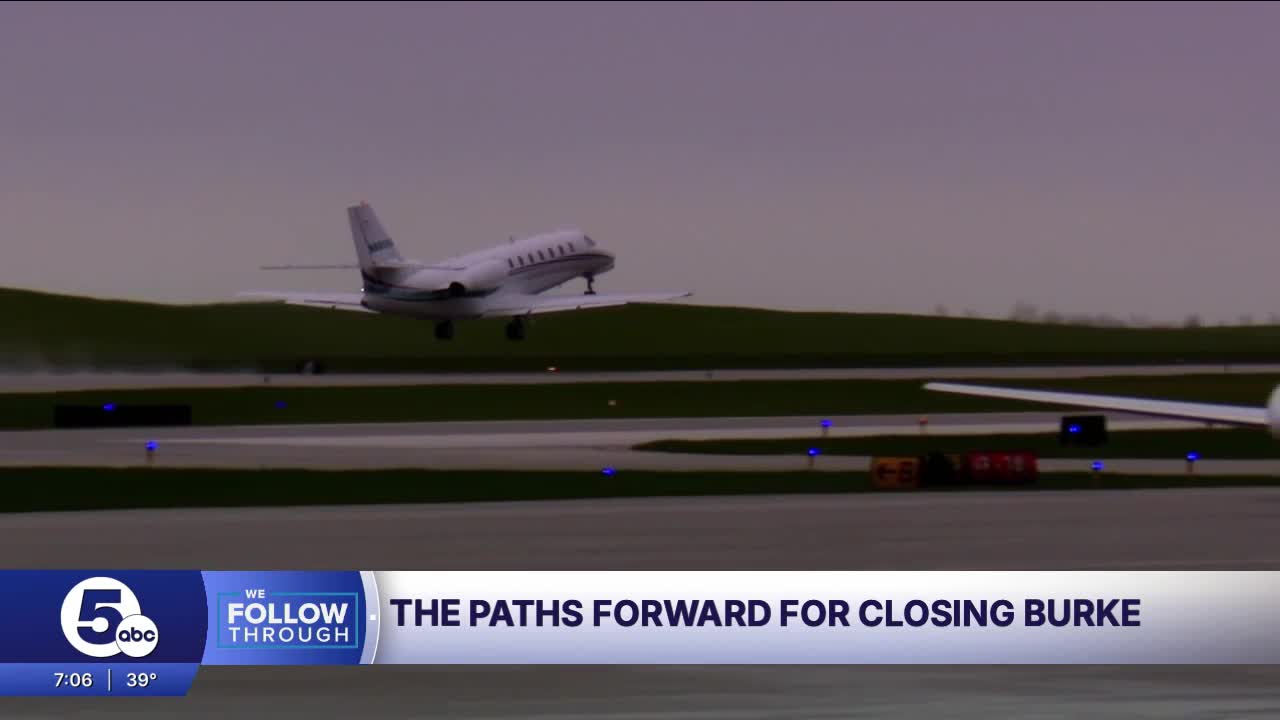



CLEVELAND — Closing an airport is rare. And it’s tricky.
The process can take years — decades, in some cases, based on what’s happened in other cities.
That’s why city leaders are attempting to cut through regulatory red tape by lobbying Congress to legislate the shutdown of Burke Lakefront Airport. And Cleveland isn't the first community to take that approach.
“It’s not easy to close an airport. … But there are paths,” said Jessica Trivisonno, the deputy chief of staff and chief strategy officer to Mayor Justin Bibb.
The battle over Burke’s future is escalating, pitting aviation groups against Bibb and other civic leaders who see an opportunity to reimagine roughly 450 acres of lakefront land.
This week, the Cleveland National Air Show urged supporters to bombard local and federal officials with emails asking to keep Burke open. And the Aircraft Owners and Pilots Association blasted city officials, saying they’re pushing a “false narrative” about Burke's shortcomings and the site’s potential.
RELATED: Burke Lakefront Airport stakeholders plan next steps
On Wednesday, Trivisonno told members of City Council that shuttering Burke is the best option for Cleveland — both for the city’s coffers and its residents.
“We are working with urgency with our federal delegation and the (Federal Aviation Administration) to get a decision on Burke, and we are optimistic that we’ll be able to get there in the next year or so,” she said during an interview after a council committee hearing.
But even if Congress signs off — and that’s a big "if" — Burke wouldn’t close right away. There are lots of complexities to work through, from moving tenants to navigating airspace demand to addressing a shortage of hangar space at other airports in the region.
“There are 15 different businesses that operate out of Burke,” Trivisonno said, noting that those tenants are a mix of aviation companies, nonprofits and office users. “And it’s really important for us that those businesses continue to operate in the city of Cleveland. So even with an act of Congress, we would be really intentional with those businesses, finding them other places to operate and then winding down operations … to then move into the future of what Burke can be.”

Flight path one: Waiting out the FAA
Cleveland has three potential avenues to closing Burke.
The first would be waiting until 2039 — 14 years — when the last strings attached to state and federal grants for the airport burn off. The city has used those grants for planning and improvements to runways, aircraft-parking areas and the paths in between them.
Once the grant-repayment obligations end, the city could file a 30-day closure notice with the FAA and subsequently shut the airport, without any need for federal approval.
That’s what Cincinnati did in 2012 with Blue Ash Airport, northeast of its downtown. Portions of the property are now a park, called Summit Park, and mixed-use development.

To take a similar approach, Cleveland would have to carry Burke — which already loses money and is subsidized by the airlines at Cleveland Hopkins International Airport — until 2039 without tapping any more state or federal funds.
That’s a tall order. And even if it’s possible, there’s no guarantee that future public officials and civic leaders will be as committed to remaking the lakefront and closing Burke.
“A lot of things could change between now and then, obviously, with city council and city administrations. … So I think waiting it out, for them, is not an option,” said Kyle Lewis, regional manager for the AOPA and an outspoken opponent of shutting Burke down.
Flight path two: Winning FAA approval
The second option is formally applying to the FAA to close the airport.
But the FAA would have to find that shutting Burke would be a net win for aviation. And the FAA, as Trivisonno acknowledged, is not in the business of closing airports.
Mark Heckroth of CHA, a consulting firm that's evaluated Burke for the city, said the FAA isn’t open to closing airports that serve unique roles in their communities — or that qualify as national or regional airports in the FAA’s national airport-system plan.
Burke is considered a regional airport, according to the FAA’s current system plan.
If the FAA did agree to a closure, Cleveland would have to pay back federal grants. The repayment obligations total $5.7 million today. Information presented to council members Wednesday shows the final expiration date on those grants is in 2034.
The city also would have to pay off nearly $1.4 million in state grants that carry repayment requirements until 2038 and 2039, according to documents provided to council. And the city would have to foot the bill for several federally required studies, at a potential cost of $750,000 or more.
“I think abandoning Burke tomorrow and owing millions of dollars to the federal and state government is not a responsible decision,” said Councilman Charles Slife, who leads the transportation committee.
Flight path three: An act of Congress
That’s why the Bibb administration is focused on Congress, with hopes of getting lawmakers to authorize a closure — and waive those lingering requirements to repay federal grants.
That's an unusual — but not an unprecedented — approach.
Congress has legislated an airport closure at least once before. In 2024, as part of an FAA funding bill, lawmakers cleared the runway for Banning, California, to close its city-owned airport.

That decision came with a few strings attached, though. Congress required Banning to first repay certain federal grants and to give any usable equipment from Banning Municipal Airport to other airports for free.
But the Banning airport still hasn’t closed. And it might not.
In an email, Banning Mayor Richard Royce said former city officials struck a deal with a real estate developer to reimagine the site — a deal he described as “one-sided” and based on inflated promises about economic development.
Now, Banning’s new city council and city manager aren’t moving forward.
“The current council is keeping the airport open until a favorable agreement can be made,” Royce wrote. “Such an agreement doesn’t appear likely.”
Ohio Senators Bernie Moreno and Jon Husted have said they’re open to discussions about closing Burke. But they want to see broad community support for a shutdown — and a plan for what will replace the airport.
So what about those plans?
In late March, the nonprofit North Coast Waterfront Development Corp. released a study that looks at two redevelopment scenarios for the property — along with the costs and potential economic impacts.
RELATED: What could replace Burke Lakefront Airport? New study shows the possibilities
The study concluded that even modest development, with a mix of low-slung buildings and public spaces, would generate more tax dollars for the city while giving Clevelanders better access to the shoreline and recreation.
Those redevelopment concepts — early ideas — are meeting with mixed reactions.
“We’ve heard from people who are really supportive — and from folks who have other ideas that are really interesting for Burke,” Trivisonno said during an interview Wednesday.
She stressed that the conceptual layouts aren’t a formal master plan for the site. They’re an ingredient in a complex recipe, part of the city’s effort to build toward closing Burke.
Council members, who will take a deeper look at the development prospects during a transportation committee hearing on April 15, are clearly divided — both on a closure and the concepts.
“We’re gonna close Burke airport — and do what with it? A golf course and ball fields? The only thing missing is a petting zoo and a putt-putt,” said Councilman Mike Polensek, his voice dripping with sarcasm. “Okay? That’s what’s missing. And maybe a big slip-and-slide.”
Councilman Austin Davis, whose ward includes the Burke site, fired back.
“Putt-putt’s a great idea. I just want to put it out there. My family’s talked about putt-putt on Burke for some time,” Davis said. “We don’t golf. We can’t afford golf. But we’re putt-putt people. And I can’t afford to fly out of Burke. And no one I know can either. It doesn’t drive any economic benefit to the city. It doesn’t help a single traveler.”

Lewis, from the pilots’ association, and other airport advocates argue that Burke could be a lot more. They accuse the city of neglecting the airport and, through short-term leases and a lack of spending, making it difficult for companies to invest there.
The city needs approval from the airlines at Hopkins to spend money on certain projects at Burke, since the airports operate as an enterprise fund — segregated from the city's everyday budget.
“Given the tone of the City Council today, there’s a lot of questions. And there’s a lot of, I think, pent-up desires for that airport,” said Lewis, who was frustrated that city officials didn’t include FAA representatives in Wednesday’s committee hearing.
“I’m not sold that Congress is behind this yet,” he said, “given what little information is out there about their conceptual, hypothetical plan.”
'The more voices, the better'
Trivisonno said Bibb administration officials expect to meet with the FAA this month.
They’re also talking with airport tenants and customers, including the hospitals that rely on Burke for patient transportation and organ-transplant flights. Most of the activity at Burke involves medical flights, private jets and flight-training schools.
Trivisonno said the city’s also been trying to meet with Air Show leaders. But that hasn’t happened yet.
And now the organization’s board is saying the end of Burke will be the end of the Air Show, a 61-year-old tradition. “This isn’t about modifying the Air Show. It’s about whether it can exist at all,” the board wrote in its letter to supporters this week.
Trivisonno still believes there’s a way to achieve City Hall’s goals and sustain the Air Show — if everyone sits down to talk.
“We are eager to work with the Air Show to find ways to keep the Air Show operating in Cleveland. … So I would just ask everybody that supports the Air Show to let them know that we hear all of their advocacy,” she said. “That we also appreciate the Air Show. And we would ask them to advocate back for the Air Show to work with us.”
Slife, who announced a series of council discussions about Burke early this year, plans to invite aviation groups and Burke advocates to present at a committee hearing. The date of that hearing hasn’t been set, but it’s likely to happen during the summer.
“I’m trying to facilitate a conversation here,” he said. “The more voices, the better.”
Council isn't being asked to consider any legislation related to closing Burke. And Slife doesn’t see a reason for council to vote on anything while the city’s waiting on action from Congress and the FAA.
“If that conversation is being had in Washington, certainly we should be having a similar conversation in Cleveland,” he said. “So that we don’t end up, at some point down the road, being asked a really, really big question without having all the information we think we need to make an informed decision.”
As the debate over Burke continues, there's consensus on at least one thing. Don't expect to see Cleveland draw inspiration from Chicago — where former Mayor Richard Daley had Meigs Field's runway torn up overnight in 2003, putting a premature end to the small airport along Lake Michigan.
"Bulldozing x's in the runway would be a very expensive choice," Trivisonno said, laughing.
"No one's gonna bulldoze anything," Slife said. "And they shouldn't."
Michelle Jarboe is the business growth and development reporter at News 5 Cleveland. Follow her on X @MJarboe or email her at Michelle.Jarboe@wews.com.
