

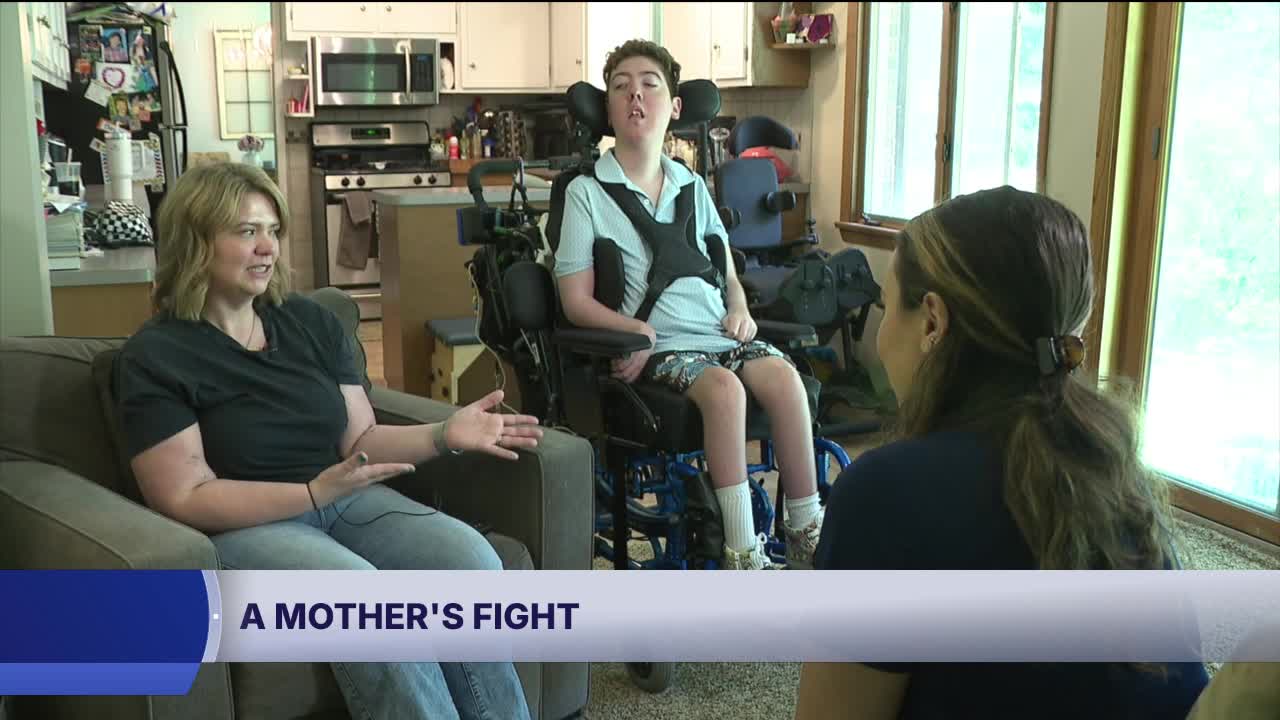


CLEVELAND — A mother should never have to choose between her kids, especially in a scenario that potentially poses a safety risk, but Kasey Sheets says the county and state are forcing her to do so.
Sheets is a mother of three: two boys and one girl.
One of her children, Finn, is 15 years old and has spastic quadriplegia cerebral palsy.
According to the CDC, spastic CP affects about 80% of people with cerebral palsy.
Spastic quadriplegia cerebral palsy is the most severe form of spastic CP and affects all four limbs, the torso, and face, per the CDC.
"He (Finn) is totally dependent on me and my husband; can't do anything for himself, and he requires full-time care," Sheets told me.
Three years ago, Finn had a health scare where he was put on life support for three days. Coming out of that, he contracted COVID-19 and pneumonia, forcing him to be put on advanced life support called extracorporeal membrane oxygenation.
"They told us that's like our Hail Mary. He beat it, he survived, but now his care is even more intensified. He now requires oxygen, respiratory therapies multiple times a day. My job got harder three years ago," Sheets said.
A year following that, in 2024, Sheets said even more complications struck her family.
"The summer of 24, like a tornado touched down right by us. Since Finn's hospital scare, he's actually gotten healthier and strong, so he's gained like 30 pounds. He grew like three inches, and I've never had to carry him down the stairs, but in that instance I was home alone," Sheets said.
As Sheets described it, she used every ounce of her "mom strength" and carried Finn down the stairs to the basement.
"I wasn't even sure I was going to be able to get him back up, honestly," Sheets said.
From that point on, she knew she needed some sort of device that would allow Finn to safely make it down the stairs without her having to carry him.
The device she's had her eye on would cost about $8,000. Sheets told me that money is already in an account in their name, but it's about getting permission to utilize it for basement accessibility.
Their need for the device has just kept growing over time, too.
According to Power 5 Meteorologist Allan Nosoff, there were three confirmed tornadoes in Cuyahoga County in 2024. There have been three more warnings since then. The latest warning was on March 31, 2026.
While the main concern for Finn's family is tornadoes, Cuyahoga County has seen dozens of severe storms in the last two years that have caused just as much damage as a tornado, if not more, including Solon's hurricane-force wind gusts and hailstorm, Nosoff said.
WATCH:
RELATED: Cars in Solon, including multiple police cruisers, damaged by hail
Because of the continual severe weather over the years, Sheets pleaded her case with the Ohio Department of Medicaid (ODM) and the Cuyahoga County Board of Developmental Disabilities (CCDD).
"In 2024, I asked for access to the basement. I was told no," Sheets said.
For those denied, ODM told me there is a due-process mechanism for families to appeal the decision.
Sheets has appealed the decision twice.
Finn even went as far as to tell a CCDD representative, through artificial intelligence, about his need for basement accessibility. A video of his plea was posted on social media to raise awareness.
"I need to live," a voiceover said on Finn's behalf. "Have you ever felt afraid and sad? You should help me because I’m smart and funny and we have the technology to do so."
Sheets told me she has also provided both the county and the state with medical professional referrals explaining why the accessibility device is needed.
Even after that, though, both appeals were denied.
According to records provided by Sheets, the Ohio Department of Job and Family Services says basement accessibility would not impact Finn's quality of life.
When making the decision in conjunction with CCDD, a county spokesperson told me it runs through these three questions:
- Is the service for exceptional situations or for everyday use?
- Is the service duplicative?
- Is there a less costly or other alternative service option or resource to meet the needs?
Sheets said her home already has a Hoyer lift, but she argues that's different from a stair lift.
"That was never ever brought to my attention when I was putting the first one in. I was told whenever you need to add track, we can do that if you decide. You know, I can't predict the future," Sheets said.
Cuyahoga County Board of Developmental Disabilities Communications Director Elizabeth Day told me via email, "How these questions are answered determines whether the request can be approved based on Medicaid rules. Individuals and/or their families have the right to appeal our decisions if they disagree, and those appeals are heard at the state level. Cuyahoga DD’s highest priority is ensuring that the people we support can live safely in the community. We cannot comment on this specific case due to HIPAA; however, there are clear rules about what Medicaid will support, and Cuyahoga DD is required to follow the rules about how Medicaid funding is spent."
Sheets said she feels as if guidance and support have fallen short in this scenario, though.
"I have my younger two who are terrified and they want to be downstairs. I feel like I'm having to choose kids. That's what the county is telling me. Just put him in a bathroom. And then what? What do I do? Leave him in there alone? I can't do that," Sheets said.
In arguing that Finn can sit in the bathroom during a severe weather event, Sheets said that's not possible because one of the bathrooms has a window, and the other is too small to fit his chair.
Her other argument is that by denying Finn basement access, both the state and county are dictating where her son can go in his own home.
"It's not like I would only use access to the basement during severe weather. I would use it for everything. Our basement is finished. I would love to spend more time down there, but I can't leave Finn alone," Sheets said. "I've been very lucky in the past that they (state and county) have given me everything I've asked for and usually when I present that it's a safety issue, they are like, 'You're right.' They kind of agree with me and they let me go through with the project. But this one, they don't think it's necessary. I don't think it's fair that you are telling me where I can spend time as a family, how we can spend time as a family. Like, no one else has to go through that."
Sheets received the latest denial in early June.
She can appeal a third time, but she doesn't see the point when she assumes she'll likely see another denial.
"It's just very frustrating. I feel defeated and I don't know what more to do," Sheets said. "I haven't given up. I can't. That's not an option. It's hard, you know, because Medicaid has had a lot of cuts recently. I understand that it has to be hard in their shoes trying to determine certain things, what people ask for. But this is a safety issue, and I think a quality of life issue."
Finn's younger brother, Wilder, said that he isn't giving up on Finn.
"I literally, I mean, like, [I'm] kind of like his guardian angel, like literally. I love protecting him," Wilder said.
Sheets isn't sure what the next steps are, but she's posted her story on social media and is now talking with us, hoping someone will step in and help her fight this.
"My younger one's afraid Finn's going to die. That was tough. It was really hard. And then hearing them think that I love Finn more because I'm choosing to stay up here with him. It's just, as a parent, that's really hard to hear," Sheets said. "No parent should have to make that choice."
Sheets said she has spoken with a state legislator about her situation. I reached out to that same lawmaker this week, but haven't heard back yet.
