

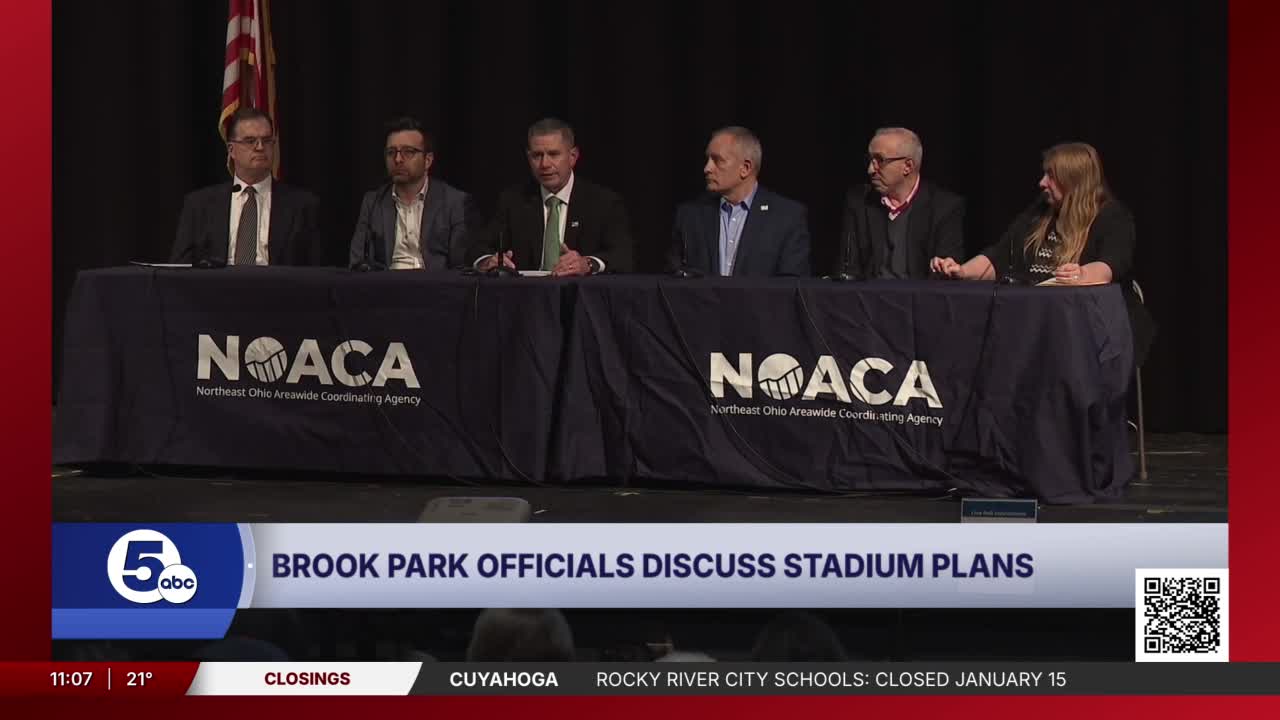



BROOK PARK, Ohio — More than 100 people – from homeowners and business owners to lawmakers and suburban mayors – braved the snow Wednesday evening for a regional public meeting about how a new Cleveland Browns stadium will impact traffic, pedestrian safety and parking.
Brook Park’s building department recently approved a mass excavation permit for the stadium site, where workers could start digging a huge hole in March. Despite a yet-to-be-finished development agreement with Brook Park and lawsuits over state funding, the Browns are forging ahead, with the goal of opening the new, enclosed venue in 2029.
Meanwhile, neighbors are wondering how the project will impact their ability to get around.
During the two-hour meeting at Brook Park Elementary School, the lead engineering consultant working for the Browns stressed that drivers won’t see big disruptions.
An analysis by the Northeast Ohio Areawide Coordinating Agency, a regional planning organization commonly known as NOACA, shows minimal snarls on highways – but slowdowns on local roads in Brook Park and neighboring communities.
“There’s going to be some delays. Not a whole lot,” Grace Gallucci, NOACA’s chief executive officer, told the audience. “And our region has excess capacity, particularly for the interstate. Our transportation system was built for a much larger population than we actually have.”
RELATED: NOACA advances Brook Park's plans for road upgrades around future stadium site
The biggest backups are likely on weekdays, during the afternoon rush hour, when there’s an NFL game or a major event, according to NOACA’s analysis.
“The weekends, we’re not so concerned about, ’cause people will trickle in,” Brook Park Mayor Edward Orcutt said during the meeting, which the city jointly hosted with NOACA. “If there’s a 1 o’clock game or a 4:30 game, there’s going to be folks that will be getting there all day. Some people like to start tailgating and cracking beers at 5 a.m.”
But Monday night football or a Thursday night concert will be a different scenario.
“If your routine Thursday is to go to the grocery store at 6 o’clock at night and there is a Thursday night football game, you will be impacted. We’re not gonna sugarcoat that,” he told the audience, which included homeowners who live on streets near the stadium site.
Brook Park is working with the Browns on a game-day playbook for handling crowds. The city is also seeking $70.3 million from the state to upgrade the Interstate 71 ramps at Snow Road; simplify the roads around the stadium site; and build a pedestrian bridge over Engle Road, near Hummel Road.
RELATED: Brook Park, Browns make their pitch for $70.3 million in state transportation money
The state’s Transportation Review Advisory Council is considering that request and evaluating other competitive applications from projects across the state. The council will release draft funding recommendations in February and make final decisions in late March.
On Wednesday, Gallucci said she views Brook Park’s proposed road changes as the first phase of what might need to be a larger infrastructure project. For months, NOACA has been urging Brook Park and the Browns to take a broader look at transportation needs and challenges – beyond the suburb’s borders.
The Browns recently agreed to pay for a separate traffic study focused on Bagley Road in Middleburg Heights, looking at the I-71 interchange and the area around Engle Road. The results of that study should be available within a few months.
At this point, NOACA’s in-house experts believe that stadium traffic will only add 30 seconds to a minute or two of extra travel time for drivers trying to reach Cleveland Hopkins International Airport or Southwest General Health Center in Middleburg Heights.
But on Wednesday, members of the audience still seemed skeptical about the data, based on their responses to a live, online survey conducted by NOACA’s staff.
People said traffic and parking are their biggest concerns. And most of them expect stadium events to cause moderate to severe traffic congestion. They’re also worried about game-day parking spilling over into nearby neighborhoods and business districts.
RELATED: Report says Browns will need 10,000 off-site parking spaces on game days in Brook Park
The meeting included a public-comment session that was supposed to last 45 minutes. But it got cut short, to only 20 minutes, because the formal presentation ran long.
You can find the full presentation below:
“I’m very excited for the stadium coming in, but I am a bit nervous. And I’m seeing all these numbers that are being projected, and it’s making my head spin,” said a woman who described herself as a Brook Park resident and local business owner.
She said she’s worried about being priced out of her home. And she doesn’t see how most Brook Park residents will even be able to afford tickets to Browns games.
“Where is the money coming from?” another Brook Park homeowner asked. “If you’re not raising property taxes, where is the money coming from?”
For roadwork and other public infrastructure, the city is looking at state and federal funding sources. Orcutt said he and members of the project team recently met with ODOT Director Pamela Boratyn. They’ve also talked to U.S. Transportation Secretary Sean Duffy.
“We are out there hunting for all of this money,” Orcutt said.
The Browns also are hoping they can land federal money to construct a Rapid train station along the western edge of the stadium-district site. The Greater Cleveland Regional Transit Authority, which already has a station on nearby Brookpark Road, has said it won’t pick up the tab. A new station could cost $40 million, according to preliminary estimates.
“Like the mayor said, we’re not gonna sugarcoat it or make false promises,” said Ted Tywang, general counsel and chief administrative officer for Browns owner Haslam Sports Group. “We don’t know when that will happen. We don’t know the funding for that station, either. But we’re working very collaboratively with RTA.”
Even if the money does come through, it’s unlikely that the new Rapid station would open with the stadium and nearby mixed-use development in 2029, Tywang told the crowd.
“But we’re committed to public transit. It’s really important to us,” he said.
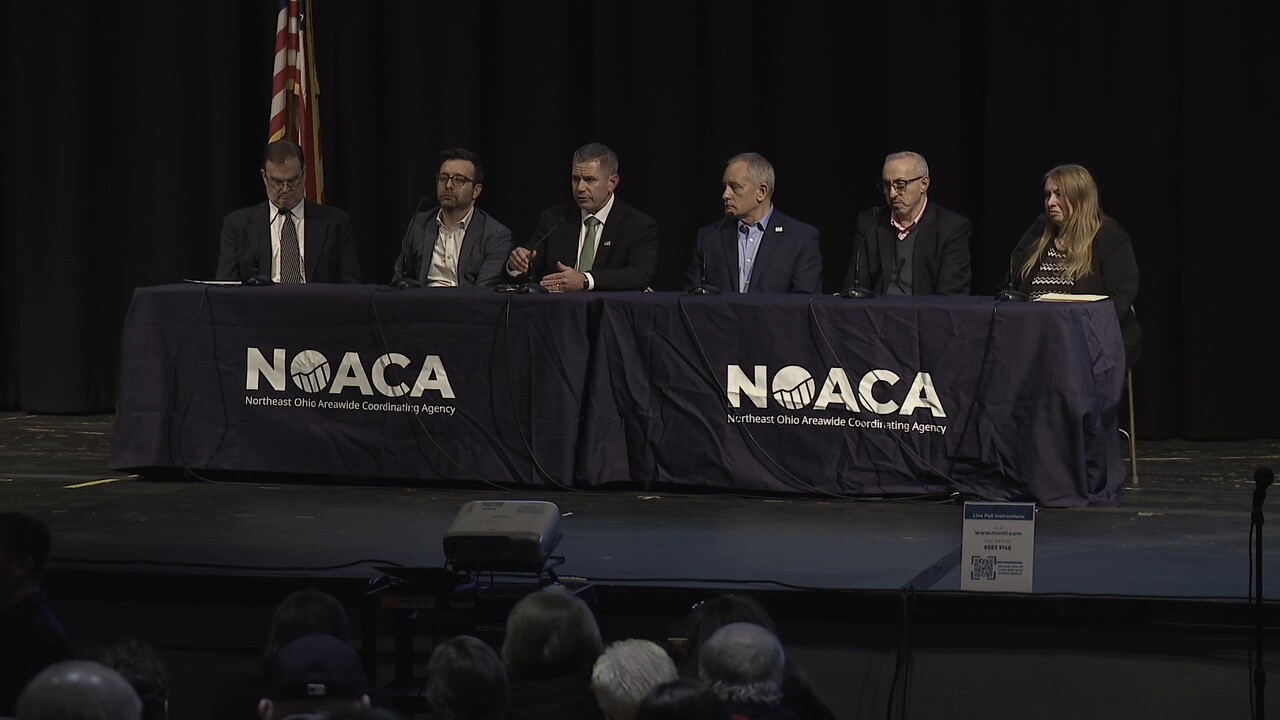
An audience member from Berea asked about how Brook Park expects to staff up – or work with nearby communities – to handle an anticipated influx of 65,000 football fans and more than 22,000 cars on game days.
Orcutt said the city does plan to do more hiring. But he’s looking to technology to do a lot of the work. “We’re not gonna go out there and go from 36 police officers to 100 because we need them 20 days out of the year,” he said.
Instead, Brook Park plans to buy and install hundreds of cameras over the next few years. The city will use those cameras to monitor the roads and adjust traffic signals on the fly. It’s still unclear how much that will cost and where the money will come from.
“It will not be big brother to watch you,” Orcutt told the audience. “But it has a lot to do with keeping that traffic flowing.”
NOACA’s board is still vetting Brook Park’s road proposals and considering whether to add them to a long-range transportation plan that’s a springboard for federal funding. A vote on that decision could take place in March.
Road construction is scheduled to start in early 2027 and will wrap up in early 2029, said Dennis Albrecht of Osborn Engineering, the lead consultant working with the Browns.
“There’s been a lot of, for lack of a better word, drama in the last year or so around our project,” Tywang said. “And I think that’s appropriate. And that’s fair. Because, as I said, it’s a big decision. But the local collaboration is headed in the right direction.”
With site work ramping up, he described the stadium project as a win for the region.
But before they’ll buy into that vision, some community members still want to see more victories on the field.
“The Browns need a winning team in order to go into this stadium,” one woman said, spurring applause from the crowd. “Can you work on that with Mr. Haslam?”
You can view the public survey feedback below:
Michelle Jarboe is the business growth and development reporter at News 5 Cleveland. Follow her on X @MJarboe or email her at Michelle.Jarboe@wews.com.
