

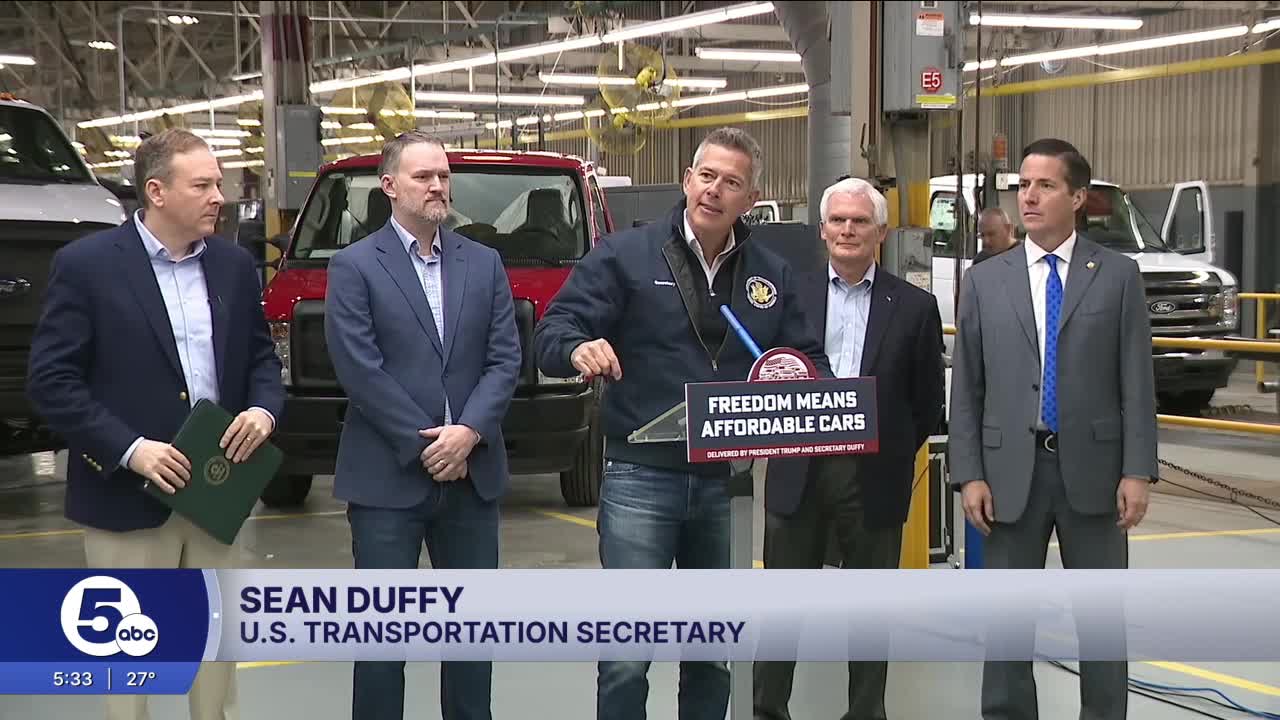


LORAIN COUNTY, Ohio — Ford’s Ohio Assembly plant in Lorain County is a throwback to the days when auto manufacturing was the state's largest employer. While those days are gone, the Trump Administration believes this doesn't have to be an industry in continuous decline.
"You know what? If you're going to sell your cars in America, you should make them in America with great American workers," said Secretary of Transportation Sean Duffy, who was among those on hand in Lorain County kicking off the administration's "Freedom Means Affordable Cars Tour." Highlighting their efforts to lower car prices in the face of rising costs. While many point to the administration's tariffs as a factor in that rise, U.S. Trade Representative Ambassador Jamieson Greer said that may be true of foreign imports, but the tradeoff is Lorain County jobs.
"The trucks that you make here, if they're coming now from overseas, if they're coming from a foreign producer, they have to pay an extra 25 percent tariff and that protects your job, it protects your production," said Greer.
One of the ways they say they're bringing costs down is by getting away from the Biden Administration's EV mandate and reducing Corporate Average Fuel Efficiency (CAFE) standards, which they argue will save $1,000 per car.
"So not only are we going to have cost savings with that, but now our car companies can actually produce cars that Americans want to buy," Duffy said.
The move away from electric vehicles is on full display here at this plant, as News 5 reported this week. "Corporate Ford made a decision that they're no longer going to pursue electric vehicles," Sheffield Village Mayor Bob Markovich said.
RELATED: Local leaders say Ford to pivot production, delay timeline at Ohio Assembly Plant
That means the plans for the new $1.5 billion expansion here, which was set to start producing a new all-electric commercial van this year, employing 1,800 workers, have been changed. The mayor's been told this addition will now produce a HYBRID commercial vehicle. A change that will mean a delay of three years for those new jobs.
"They had to go back to the drawing boad so to speak, to design that," said Markovich, "so they're telling us with the design and all of that that it's going to push it to 2029."
No one from Ford was on hand Friday to address that change. As a company, Ford's sales rose 6% in 2025.
In addition to changing fuel efficiency standards, U.S. EPA Administrator Lee Zeldin said they are also in the final stages of deciding whether to repeal the 2009 Endangerment Finding, which has served as the EPA's basis for regulating greenhouse gas emissions.
"Which includes a proposal to rescind all greenhouse gas emissions on light, medium and heavy duty vehicles from 2010 and beyond as well as the off-cycle credit on that universally hated, nearly, start-stop feature," said Zelden of the provision that encouraged automakers to install a system that shuts off the engine at idle to save fuel.
"If finalized, it would be the largest act of deregulation in the history of the United States of America," Zelden said.
Transportation Secretary Sean Duffy told News 5 when it comes to auto affordability, all options are on the table, including redundant safety standards.
"Safety is our number one priority, whether it's in cars or in aviation, but we always have to review our standards and marry those standards up with new innovation," Duffy said. "So just to take autonomous vehicles for a moment. We might have side mirrors, rearview mirrors backup cameras. We have to look at do we need that equipment in an autonomous vehicle?"
"I want to continue to advance the safety standards, but I always look back and review to go do we have old standards on the books that we don't need anymore that are driving up the price of vehicles," he said.
Also on hand was U.S. Senator Bernie Moreno (R-OH), a former car dealer who last year got his USA CAR Act, which allows Americans to write off the interest on auto loans for U.S.-made cars. "About a year ago half of the cars sold in America were made in America. Thanks to the efforts of these guys? It's almost 60 percent," Moreno said. "And we're not going to stop until we get that number to 70 percent."
