

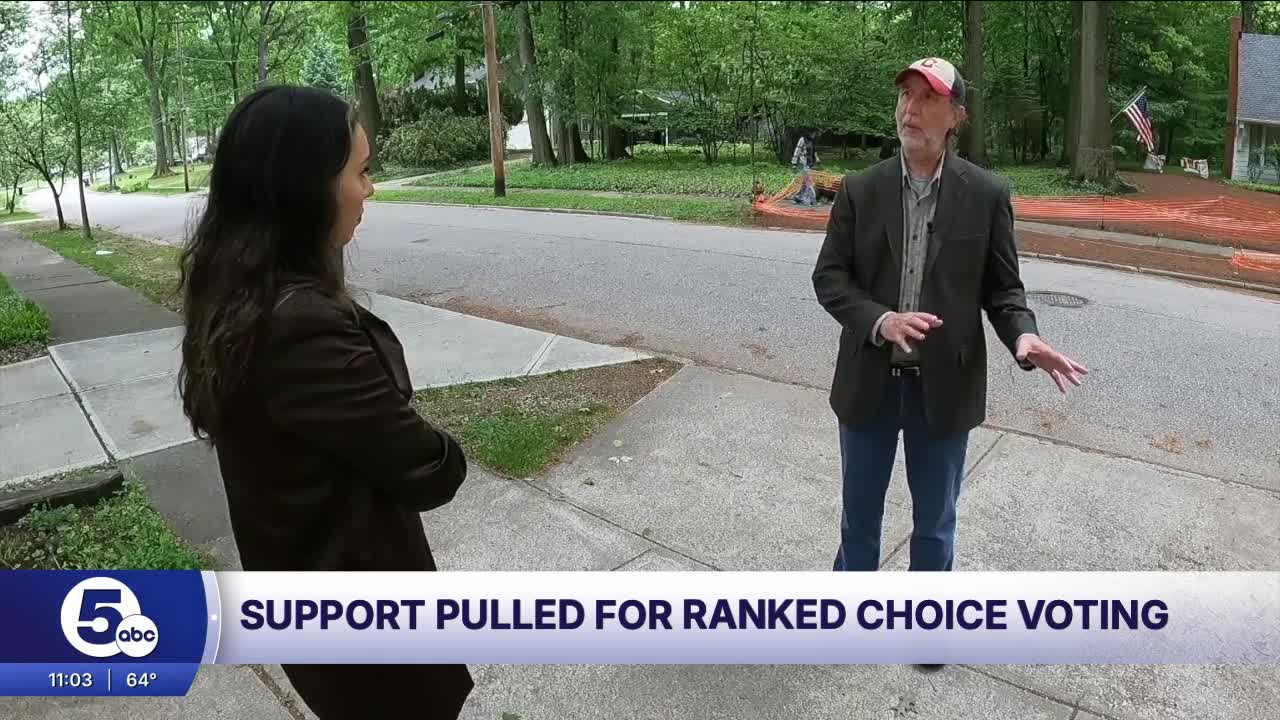


CLEVELAND HEIGHTS, Ohio — For months now, following a charter review commission recommendation, Cleveland Heights has weighed whether to allow its voters the option of ranking candidates at the poll both.
Instead of making a single choice, ranked-choice voting allows voters to rank candidates in order of preference. Whoever receives more than 50% of the votes would win.
RELATED: As Lakewood and CLE Heights decide on ranked-choice voting, lawmakers decide to ban it. Why?
Cleveland Heights City Council has decided not to move forward with it, though.
"Seven people talked about it, including me being one, and we all had different reasons. I think the reason that went across for all seven of us was the state funding that would be taken away if we were to pass it," Cleveland Heights City Council President Tony Cuda said.
If ranked-choice voting were passed in any municipality, that city could face financial risks.
According to the law's language, the Secretary of State would deem local governments ineligible to receive any general funding from the state if ranked-choice voting were to be adopted through ordinance or resolution.
The funding, per the legislation, would cease within a month of ranked-choice voting passing.
"Our finance director said we would have lost about $2.2 million," Cuda said. "We have very little discretionary money, so that's really where it would hurt us."
Cuda said there just wasn't enough time for the council to "thoroughly vet" the possibility of a new system of voting in order to put it on the ballot this year.
"We did a very thorough process. We had two community meetings and then we did a hearing at city council and then we just talked about it this last week," he told me.
While Cleveland Heights council will not put it on the ballot for the foreseeable future, Cuda said it does present a frustration that should be fought across the state: home rule.
"This seems to be a theme coming out of Columbus, you know, I thought federalism was something that conservatives were all for, meaning that, you know, you have the federal government, the state government, and local government, and anything that's not in the federal constitution gets passed down to the states and the states passed down to local government. You see it with schools and with, you know, this issue with ranked-choice voting and other issues where the state just keeps yanking home rule away from municipalities. I'm very disappointed," Cuda said.
Cleveland Heights residents could petition to get ranked voting on the ballot, but that means roughly 4,000 valid registered voters would have to sign it.
"I always want the residents to have that option," Cuda said. "If the majority of Cleveland Heights people think it's good for Cleveland Heights, then I'm fine with that."
For now, though, Cuda said he feels as if council made the right decision not to pursue ranked voting.
The option of a ballot initiative is something Rank the Vote Ohio is still exploring.
"We are definitely looking at a possibility of a ballot initiative," Rank the Vote Ohio Regional Organizer for Northeast Ohio, Michelle B. Jackson said Wednesday.
Jackson said that initiative would be no sooner than 2027.
According to Jackson, Rank the Vote Ohio has a documented Cleveland Heights supporter list of 300 to 400 people.
"Our list is growing," she said.
Jackson said she's disappointed to see cities like Cleveland Heights take a step back from ranked-choice voting, especially because Rank the Vote Ohio has submitted a legally approved escape clause for cities that take this on.
She said Cleveland Heights had two years to vet and consider this style of voting.
Jackson also said Rank the Vote Ohio hosted two informational events as an educational 501c3 organiation unaffilliated with any political entity, per their 501c3 status.
"Council held one hearing and the sparse audience was mostly RCV supporters," Jackson said.
"For communities who give up and acquiesce in advance, your legacy is gonna be that you did not fight for democracy when you had your chance," Jackson said. "I don't like the smokescreen. Just say that you're scared of it."
Jackson accuses Cleveland Heights of reneging on its commitment to put ranked-choice on the ballot this year.
"Cleveland Heights had made a commitment. The May ballot was not realistic given all the other things, but that is what council said. We didn't say it. There's no rush because even if you put this on the ballot, and then it passes, you still got three to five years before you could absolutely implement this, which is another thing about the ban because in that time frame, everything may look a whole lot different than it does now," Jackson said.
Jackson said she felt as if ranked-choice voting was never going to make it to the ballot in Cleveland Heights.
"They (Cleveland Heights) had information suggesting a severability clause that no matter what, if this happens, y'all are off the hook. My feeling, and I will say this, is that there was no real intention to put RCV on the ballot," Jackson said. "The real question is, what's up? It's one of those political gaming kind of situations."
She told me the more cities that give in to the state's requests and demands, the more will be taken.
"Give them an inch, they take a mile," Jackson said.
In Lakewood, council members are still deciding whether they want to pursue ranked-choice voting.
When I spoke with Councilman Tom Bullock in March, he told me the possibility of it isn't something he was fully on board with.
"We've got to be sound stewards of the public's tax dollars. We've got plenty of expenses. We're in a stronger financial position, but we wouldn't want to imperil that. But that said, what a frustrating move for state government to do," Bullock previously told me.
I followed up with Bullock last week to see if any progress had been made.
"It's not yet been decided, although several council members newly expressed concerns about moving forward with the state restrictions on this topic, including me," he told me last Friday.
Bullock said there is one more meeting scheduled on the books between council members to discuss ranked-choice voting, along with other potential charter amendments.
Jackson remains optimistic Lakewood will move forward with it.
"Lakewood is giving this very serious deliberate consideration. They understand the bigger democracy picture. Lakewood understands that this is bigger than RCV at this point," Jackson said.
Jackson applauded Lakewood for being transparent about where it is in the process up to this point.
"Lakewood understands that they have an opportunity to take a stand with zero risk," Jackson said. "Lakewood, to its credit, knowing that it's not its money, it's the public's money, is being very, very, very conscientious about that piece, but also recognizing that if we have no risk, the risk is that we are supporting an undemocratic action."
Once Lakewood makes a decision, We'll Follow Through.
