




COLUMBUS, Ohio — A bipartisan group of Ohio lawmakers wants to know how private schools are using taxpayer dollars, but Republican leadership likely won't require the EdChoice program to have more transparency.
For the past several years, Ohio leaders have given billions of taxpayer dollars to nonpublic schools using the EdChoice voucher program. It allows any family, regardless of income level, to get assistance with private school tuition.
In the last budget, EdChoice recieved $2.5 billion. But it is unclear where that money actually goes.
Senate Bill 443
State Sen. Bill Blessing (R-Colerain Township), Sen. Kent Smith (D-Euclid) and Rep. Justin Pizzulli (R-Scioto County) introduced S.B. 433, legislation that would dramatically increase the program’s transparency.
Among a dozen provisions, the bill would audit how state dollars are spent in both the EdChoice and the Pilot Project scholarship programs, create report cards for academic performance and require students to take the same end-of-course exams that public schools mandate.
"If you are taking state dollars, you have to show us results, statistics, data," Blessing said.
Schools would be required to conduct criminal background checks of their employees.
RELATED: Ohio judges question why taxpayers fund private school tuition
For admissions, the schools must detail their criteria and admissions, as well as share where the new student has come from.
Each school would have to submit its weekly attendance records, as well as report the tuition and fees charged by the school, including a five-year cost trend of those charges.
They would need to report the number of students using vouchers who have physical, intellectual or learning disabilities, are English learning students (ELS) and who are unhoused. Public schools are required to educate all kids, where privates get to pick and choose, Blessing added.
Like publics, the EdChoice schools would also need to report disciplinary action, dropout and graduation rates.
"Restore some oversight and accountability to the tax dollars that are being used for education in Ohio," Smith said.
When vouchers first started in the 1990s, it was just meant to help students with intellectual disabilities in Cleveland. At that time, it cost $0.44 a year, whereas now, it costs Ohioans $205 per year, Smith explained.
In defense of public schools
While EdChoice got $2.5 billion, K-12 public schools were underfunded by nearly $3 billion in the budget, according to the nonpartisan research group Policy Matters Ohio.
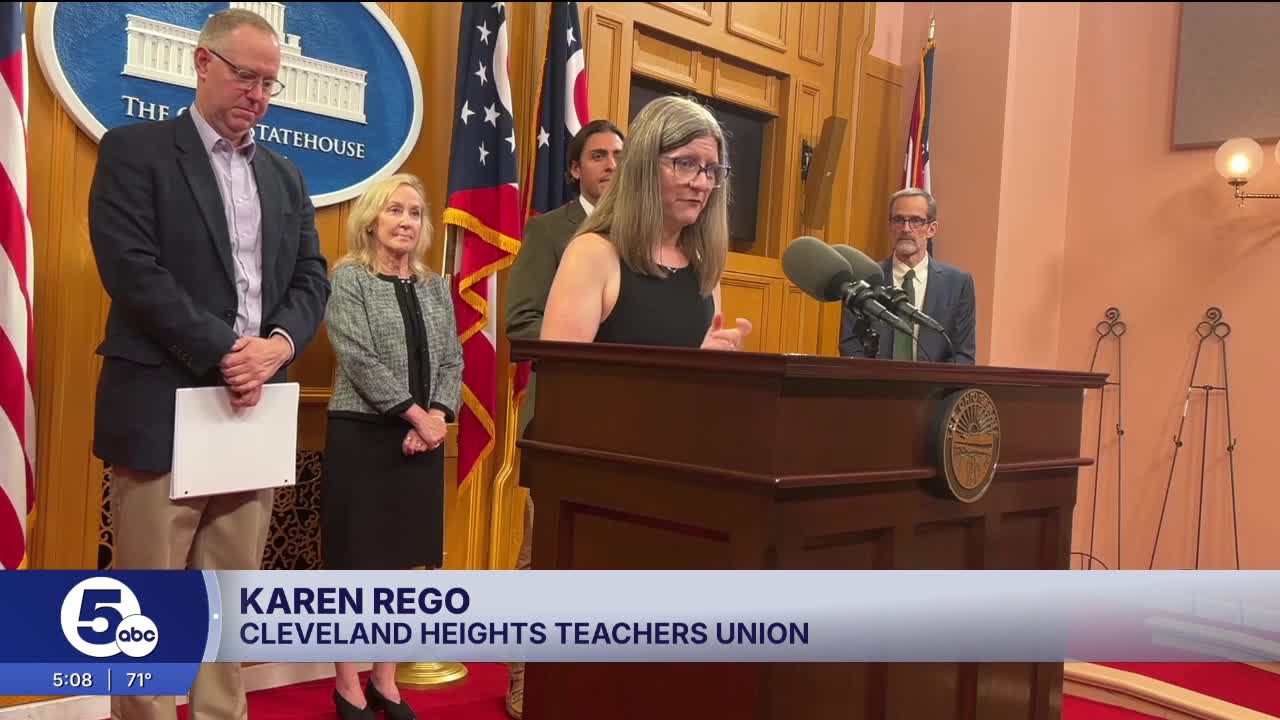
“We feel very stretched thin already,” Karen Rego, a teacher at Cleveland Heights, said. "To lose staff members that we've lost this year and the possibility of losing more next year is a really tough pill to swallow."
Cleveland Heights-University Heights City School District is facing a $7 million in cuts thanks to the state and federal government slashing expected funding.
While Rego is forced to watch her school struggle, she sees the academy across the street getting help.
"We have a very large number of private schools right inside our community, so we have been dealing with vouchers for years, and we have been fighting this for years, decades actually," Rego said.
RELATED: Why Ohio ballots are packed with school levies — and how we got here
But unlike public schools, private and nonpublic charter schools don’t have to disclose what they do with the money.
"We're asking for fairness," Pizzulli said.
Some of the largest advocates for public schools are the schools themselves and rural lawmakers.
"Many of us barely know what vouchers are because we simply don't have private schools," Pizzulli said.
He covers "one of the poorest corners" of the state, he said, pointing out that he represents the Appalachian areas of Ohio.
"We in rural Ohio are frustrated with how schools are funded," he said. "We see our tax dollars supporting a voucher system that largely benefits areas with access to private schools, while communities like mine receive no or little practical benefit at all because those options don't exist."
His community has to get "leftover" school desks from the prison, he said.
"The state is taxing disenfranchised groups of Ohioans who receive no benefit," Pizzulli said.
He is willing to help low-income students and families in other areas who are searching for better educational opportunities, but that isn't what the program is, the Republican said.
"What frustrates us is seeing our taxpayer dollars increasingly flow towards families who already had the means to afford private tuition," he continued.
Our investigations have shown, for years, that the vast majority of voucher-using families have always sent their kids to those schools.
In defense of EdChoice
Some Republican leaders like House Speaker Matt Huffman (R-Lima) have consistently pushed back against these kinds of disclosures, saying they have transparency in another way.
"The best example of accountability is whether a parent or a family willingly takes their child to that school," Huffman said, adding that parents aren't being forced to send their kids there.
He also brought up concerns about infringing on a private entity, a business.
"We need to make sure that the privacy part of it for the people, the kids and the families who are going to school and the people who are running the school, all of those things, are intact," he said.
RELATED: Where the gubernatorial candidates stand on education
In regard to rural Ohioans paying for schools they don't have, Huffman said that is part of life.
"There are a lot of people paying taxes for things they don't get a direct benefit from," the speaker said. "If you never had children and they're not going to school, you could say, 'Well, how am I benefiting from it?' 'If I don't use the parks, why should I be paying the parks tax levy?'"
EdChoice can be the last resort for a family running out of options, Keith Neely with the Institute of Justice said.
"[Without EdChoice, families are] going to be forced to send their children to a public school environment that might not have worked for them," Neely said.
More than 300 public school districts are suing over EdChoice.
A trial judge ruled last summer that the program was unconstitutional. The state appealed the majority of the ruling, while the schools are pushing back against the one charge that was decided against them. The school complains that the voucher program creates “segregation” in schools, but the judge said there was no evidence of that.
The state and a coalition of families that use vouchers are fighting back, arguing that the education funding isn't coming from the same pool of money.
"There's no inherent connection between the EdChoice funding and the public school funding," Deputy Solicitor General Stephen Carney said.
The voucher program remains in effect as litigation continues.
RELATED: Lawmaker reverses course on bill to restrict money for schools that sue EdChoice voucher program
Huffman questioned why the lawmakers were putting forward a giant bill this late in this General Assembly.
"If it's recently introduced in the Senate, one of the things I would question is whether the senators introducing it are serious about it since they waited till now to introduce it," Huffman said, seemingly ignoring the fact that, in his tenure, he has consistently passed consequential bills at the last possible moment before the G.A. ends.
The efforts for EdChoice transparency, though, have been proposed and stalled for years.
"What is your response to other Republicans who don't see this as an issue?" I asked Blessing and Pizzulli.
"Yeah... I really do think the thinking around this is going to change in the coming years," Blessing said.
The lawmakers acknowledge that it will likely not pass this year, but the proposal is a way to get the conversation started.
Blessing referenced how, in Kentucky, voters struck down a ballot measure that would have allowed public dollars to go to vouchers. Ohio isn't immune to that same fate.
"If there is a ballot initiative, or something goes sideways, I don't think it would end up being, 'Well, a little tweak here or a little tweak there,'" Blessing said. "I think it would be the end, potentially, of the scholarship system."
Follow WEWS statehouse reporter Morgan Trau on Twitter and Facebook.
