

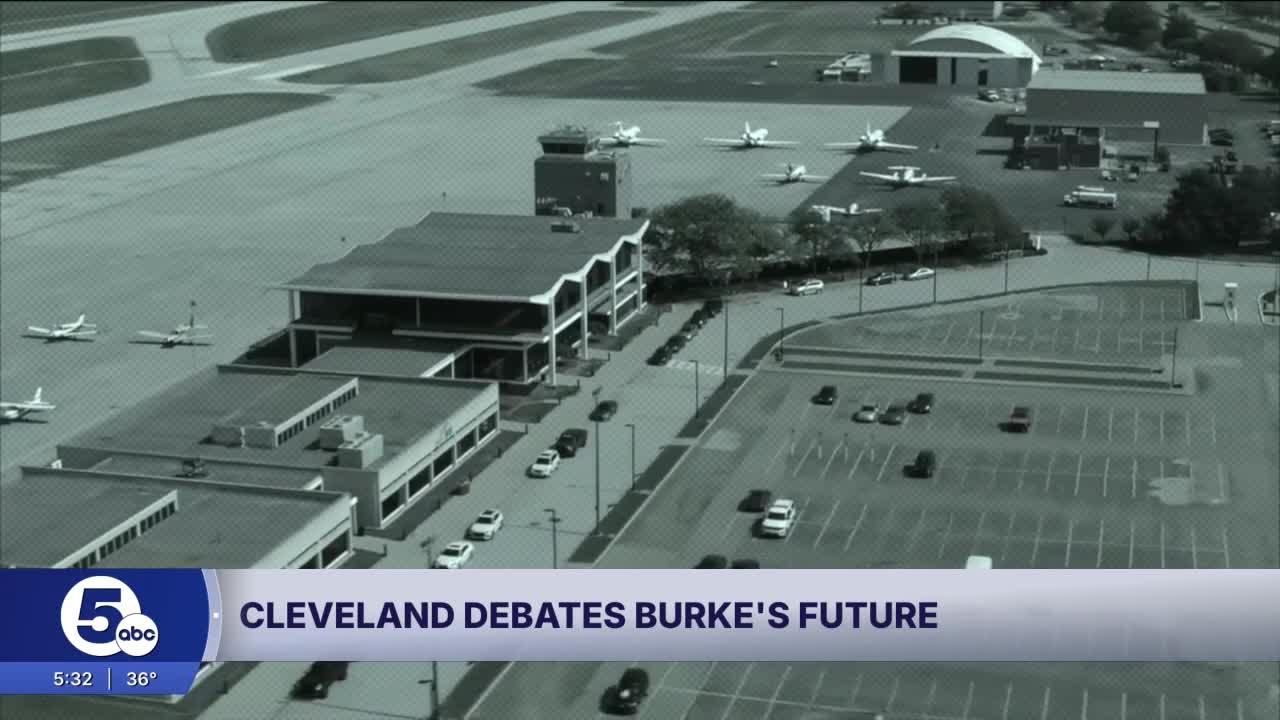


CLEVELAND — Redeveloping the Burke Lakefront Airport property is possible – and not as tricky as you might think, considering the site’s history as a dumping ground for Clevelanders’ trash and sediment dredged from the Cuyahoga River.
That’s one of the messages members of Cleveland City Council heard Wednesday, during the first of four planned committee meetings about the future of Burke. Council is digging into the dirt – 450 acres of the waterfront – as Mayor Justin Bibb and civic leaders are asking Congress to legislate an airport shutdown as part of a bigger lakefront vision.
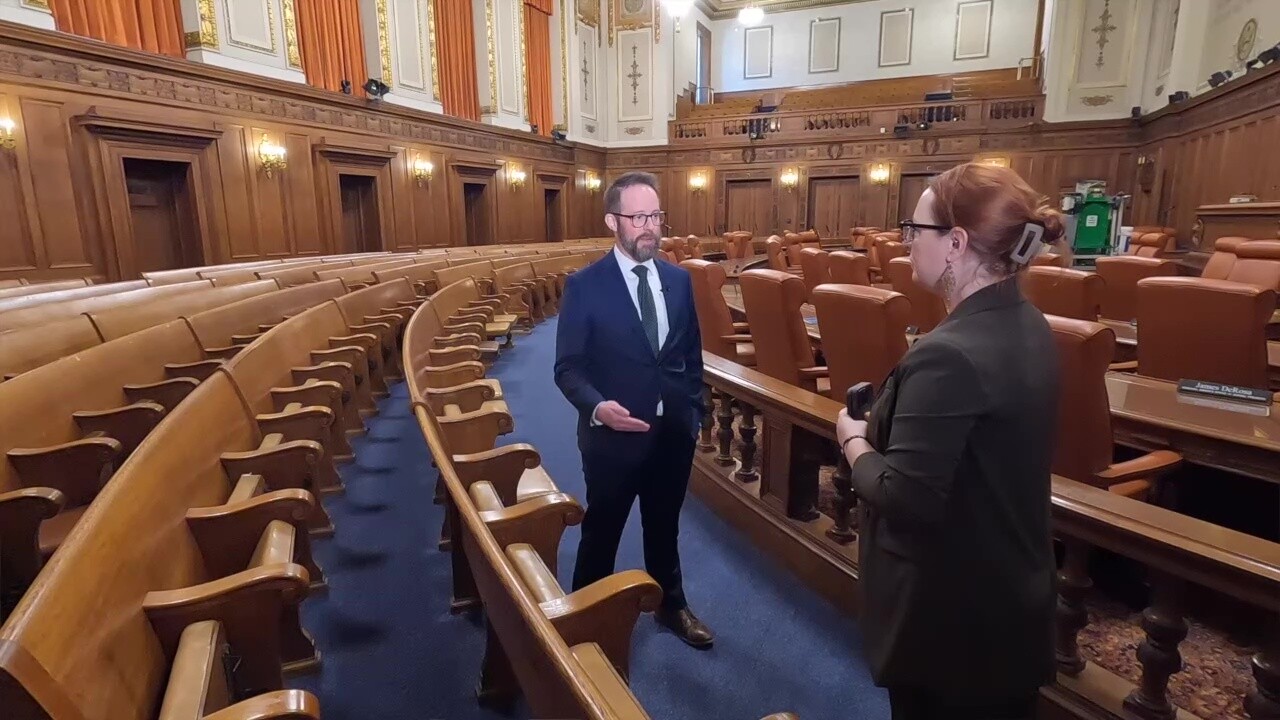
“There’s a lot more to be done to decide what to build on Burke,” Jessica Trivisonno, the mayor’s deputy chief of staff and chief strategy officer, said during the nearly three-hour committee hearing. “But we feel confident that we’ve done all the work that we need to do to advocate that closing Burke is the right thing.”
In October, Bibb and Cuyahoga County Executive Chris Ronayne asked Northeast Ohio’s Congressional delegation for help to close the city-owned airport. They’re hoping federal lawmakers can cut through red tape, providing certainty and speeding up a process that could still take years to pull off.
RELATED: Bibb, Ronayne say it's time to close Burke Lakefront Airport; ask Congress for help
Now the council wants answers about the challenges and costs.
Councilman Charles Slife, who leads the transportation committee, has scheduled additional hearings Feb. 4, April 1 and April 15. Those discussions, in order, will center on the financial implications of closing Burke, the process of closing an airport, and whether developers actually will be interested in the site.
During an interview Wednesday afternoon, Slife said he doesn’t have an opinion yet on whether closing the airport is a good idea. But he believes advocates for and opponents of a shutdown are both overstating their cases. And he’s not convinced that remaking Burke should be one of the city’s priorities.
“Burke airport is not what I hear from residents. … They want their leaves picked up. They want their streets plowed. They want the potholes filled. They want an ambulance to show up,” Slife said. “And what’s important to me is making sure that whatever happens at Burke isn’t going to undercut our ability to do basic city services.”
In previous interviews with News 5, Bibb has said the city can juggle many priorities – and needs to make bold bets to attract jobs, spending and investments. He’s talked about filling the Burke property with public space, recreational facilities, mixed-use development and even a vertiport, a smaller hub for helicopters, drones and other aircraft that don't need traditional runways.
All of those are just ideas, at this point. The city is working with the nonprofit North Coast Waterfront Development Corp. to launch a public-engagement process, which will start next month. People will be able to weigh in during community meetings and online.
“All of this engagement with city council and with the public is all helping to support our request to the federal delegation to help with an act of Congress,” Trivisonno said.
During an interview Wednesday afternoon, she said it’s too early to predict when the airport might shut its doors.
“We clearly are excited about the opportunities here,” she said. “So as fast as we can work on the closure, we will.”
Some history
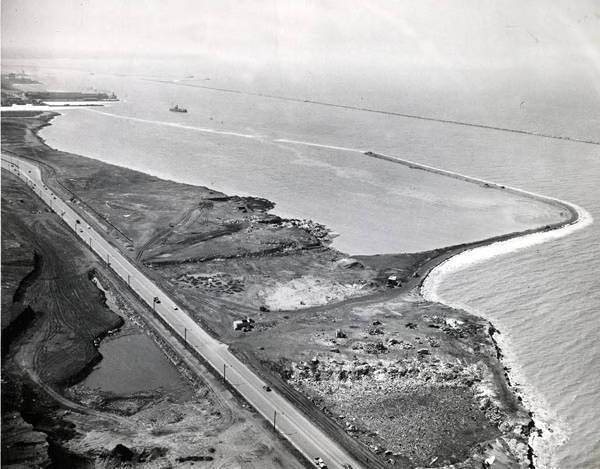
Burke opened in 1947 as the first Downtown airport in the United States. It’s built on man-made land – dirt dumped into Lake Erie to change the city’s shoreline.
Cleveland owns that dirt, but the state owns the former lakebed underneath it – an arrangement that requires a complicated web of lease agreements. State law and the city charter make it difficult – if not impossible – to sell lakefront land. But Cleveland can sign long-term land leases with developers and transfer lakefront sites to other public entities.
The southwestern portion of Burke is the most densely packed and buildable. That’s where the terminal, the parking lot and the runways sit.
The northeastern section of the property – more than 170 acres – is used by the U.S. Army Corps of Engineers and the Port of Cleveland to store and process sediment dredged from the Cuyahoga River.
The Army Corps periodically pulls sand, silt and other material from the riverbed to keep the shipping channel deep enough for ore haulers and other large ships. The dredged dirt ends up in storage areas called confined disposal facilities, creating new land at Burke.
The existing disposal facilities will be full by 2029. Only one of them – a 40-acre site where sediment gets cleaned up and recycled for use at construction projects – needs to stay open indefinitely, according to the Port of Cleveland.
Port officials participated in the council hearing Wednesday and said they support the plan to close Burke. They believe it’s possible for the recycled-sediment operation and parkland to coexist at the northern edge of the property, with a trail along the lake’s edge.
The port and a slew of partners have been working on a long-term plan to use river dredgings to build a new shoreline to the east, stretching from East 55th Street to Gordon Park. That project, called CHEERS, would buffer the Shoreway and create new places for fishing, boating, paddleboarding and other recreational activities.
Slife and other council members questioned whether there’s too much green space on the drawing board. They want the Burke site to be an economic engine – not an expense.
“We need jobs. We need opportunity. We need revenue into this city,” longtime Councilman Mike Polensek said.
He believes the city hasn’t made a genuine effort to invest in Burke for decades.

'Fewer unknowns'
Reports commissioned by the Bibb administration show that traffic at Burke peaked in the late 1990s and early 2000s at roughly 100,000 flights a year. Now, the airport handles just over 40,000 flights.
Burke primarily caters to private planes, flight schools and medical users, including air ambulances and pilots transporting organs for transplants.
“I have never once met a resident of the city of Cleveland who has utilized Burke Lakefront Airport,” Trivisonno told council members. “This is 450 acres of space that should be for our residents, whether it’s for economic impact or their enjoyment or a combination of those things.”
A study commissioned by the administration found that Cuyahoga County stands to lose $9.6 million in annual economic activity if the airport closes. But redeveloping the site – even if it just involves a park, athletic fields and an indoor sports complex – could lead to much bigger financial gains, according to the city’s consultants.
RELATED: 'Can we close Burke? We think we can.' Cleveland makes case for airport shutdown
Scott Skinner, executive director of the North Coast Waterfront Development Corp., stressed that repurposing the land is possible – and not necessarily a heavy lift, depending on the use.
He’s working with consultants to compile decades of research about the Burke site, the soil conditions and any environmental issues.
“In a strange way, Burke is an ideal development site because there are much fewer unknowns than there are on some of the other heavy industrial sites that have been built on in Cleveland,” he said, noting that developers across the country have successfully built on fill dirt and cleaned up once-contaminated properties.
“For recreation use, for park space, for low-density development, the initial findings – and this is still research that we’re doing – the initial findings are that the site would need very little if any environmental remediation,” Skinner added during an interview.
Some council members still want to see more details – and more concrete plans – before taking a stance on closing Burke.
“I think the real risk is closing the airport if we don’t have a clear-cut plan first,” Councilman Kevin Bishop said.
And Councilman Brian Kazy is skeptical. “Is this the administration’s field of dreams that may or may not come to fruition?” he asked.
But Councilman Austin Davis, whose ward includes Burke, described the existing airport as a missed opportunity to benefit Clevelanders and generate revenue.
“Burke is, in many ways, the future of Cleveland,” Davis told his colleagues. “What we do at Burke will affect our city for generations economically, in terms of residential value and population density.”
'If it closes, we gotta move'
Airport tenants, meanwhile, are still reeling at the prospect of a shutdown.
Matt Baker of Zone Aviation, a flight school and aircraft-management company, was part of a group of airport users that met with city officials last week.
“For us, it’s obviously going to affect business,” Baker said during an interview with News 5. “Because if it closes, we gotta move. And there’s no real good location to move to.”
Consultants for the city have said most of the businesses and flights at Burke could be absorbed by Cleveland Hopkins International Airport, the Cuyahoga County Airport and other airports in the region. But no other nearby airport can host the Cleveland National Air Show – at least, not in the show’s current form.
The air show takes over Burke on Labor Day weekend each year, drawing crowds.
“There really isn’t any airport in Northeast Ohio that has the runway length, the airspace, the spectator area that you would need to hold the caliber of air show that you have here at Burke,” Kim Dell, the air show’s executive director, told News 5.
Tenants at Burke have teamed up with the Aircraft Owners and Pilots Association to protest a closure. Critics say aviation-related businesses are willing to invest at Burke, but they can’t get long-term leases or assurances about the future from City Hall.
Kyle Lewis, the association’s regional airports and advocacy manager for the Great Lakes, said the recent meeting with city officials was a good first step.
“We’re really looking for that … I’ll call it a compromise, that really allows everybody to win,” he said, alluding to discussions about whether it’s possible to keep the airport open while making portions of the property available for development.
On Wednesday, Trivisonno said city officials want to work with airport tenants and pilots to keep them in Cleveland. That includes the air show, even if it looks a bit different.
“There are other cities that do air shows without having a lakefront airport,” she said. “So we’re looking to that as a model and figuring out what our options are.”
Those options – and other questions – are likely to come up at the council table over the next few months, as city lawmakers consider what should happen next.
“My goal is to start to bring council and the community along for a ride, where we can really understand all of the moving pieces that are associated with the idea of closing Burke and redeveloping it,” Slife said. “So we can ultimately decide, is this something that is the right thing to do for the city of Cleveland? Or is it not?”
Michelle Jarboe is the business growth and development reporter at News 5 Cleveland. Follow her on X @MJarboe or email her at Michelle.Jarboe@wews.com.
