



CLEVELAND — When Cleveland State University emptied out Fenn Tower in mid-2024, citing safety concerns, it wasn’t clear whether the landmark building would reopen.
The steel inside the nearly century-old walls was deteriorating. In some places, it needed to be reinforced. In others, it had to be replaced. The exterior brickwork required significant repairs. And the dorm rooms inside were tired, in serious need of a makeover.
University leaders considered whether to demolish the historic tower. Instead, they recommitted, working with a preservation-minded team to save it.
“Buildings are more than just bricks and mortar,” said Tim Cosgrove, a CSU alumnus and president of the university’s board of trustees. “They become a part of who we are. They become a part of our story. A part of our DNA.”
On Friday morning, officials marked the end of an $18 million revamp with a ribbon-cutting event. Fenn Tower recently reopened as a residence hall for first-year students, with 175 rooms, 431 beds and refreshed common spaces at East 24th Street and Euclid Avenue.
WATCH: Cleveland State leaders celebrate Fenn Tower reopening, discuss other real estate projects.
“Every part of this renovation focused on the well-being of students,” CSU President Laura Bloomberg said during an interview. “What do students, in this time, in this era, need to make this place feel like home? And that was our North Star.”
That’s the mission across Cleveland State’s roughly 85-acre campus, where officials are looking at renovating some buildings and tearing others down. The university is working with a consultant, a group called Brailsford & Dunlavey, to develop a real estate strategy by the end of the current academic year.
CSU’s latest campus master plan, unveiled in 2022, hasn’t been scrapped. But at this point, after recent shifts in the educational and economic landscape, it’s more of an inspiration than an actual development guide.
“I think the ethos and the vision underscoring or undergirding that master plan are still very much relevant,” Bloomberg said. “How that manifests in the built environment is probably changing substantially — and will continue to change substantially.”
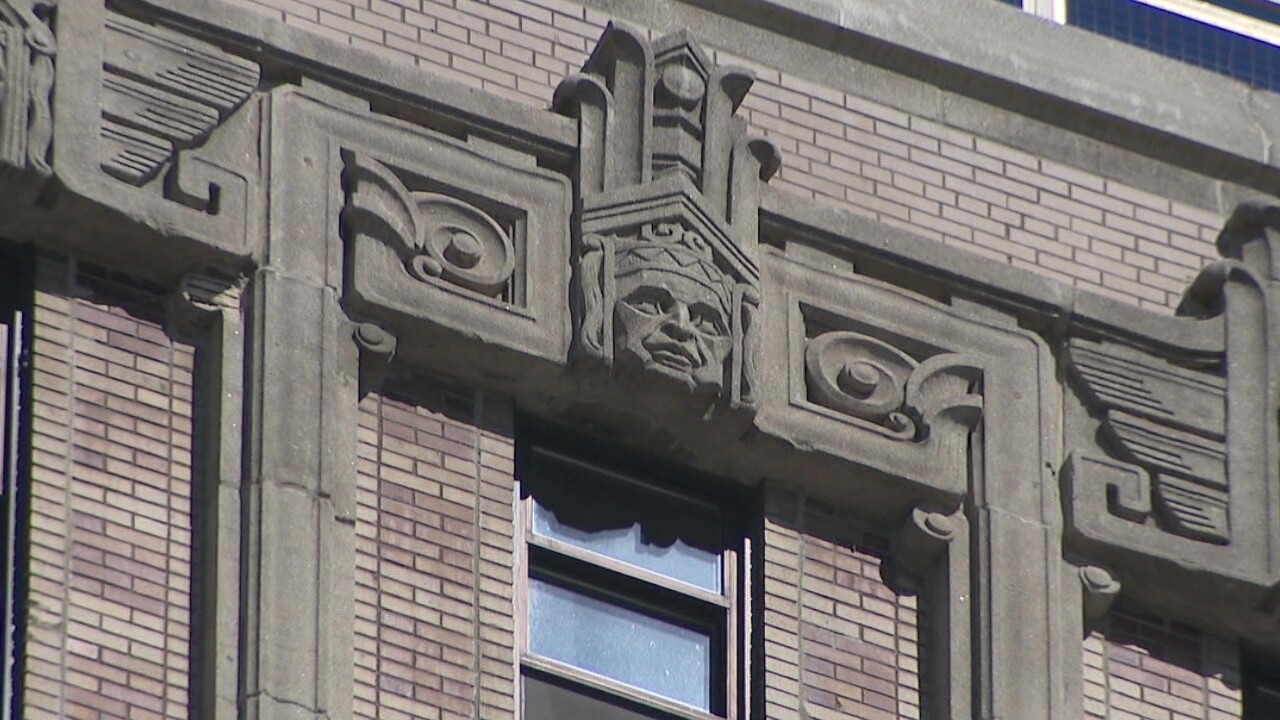
With construction finished at Fenn Tower, the university is turning its attention to nearby Fenn Hall.
That building, which started its life in the1920s as an automotive showroom, will be refurbished as part of a new biomedical research complex. The first phase of the project is set to cost $32 million. It will include more than 20,000 square feet of modern lab space.
Bloomberg, a home-renovation junkie, described Fenn Hall as “an old building with great bones” — but one that’s “woefully out-of-date.” The state-funded updates will give students and faculty access to high-tech classrooms and collaboration facilities focused on science, medicine, and engineering.
“We have a ton of other great buildings just like that,” said Nicholas Vande Velde, the university’s senior associate vice president for hospitality and facilities. “A lot of times, we’re playful about making new from old. And I think that’s what we have the ability to do.”
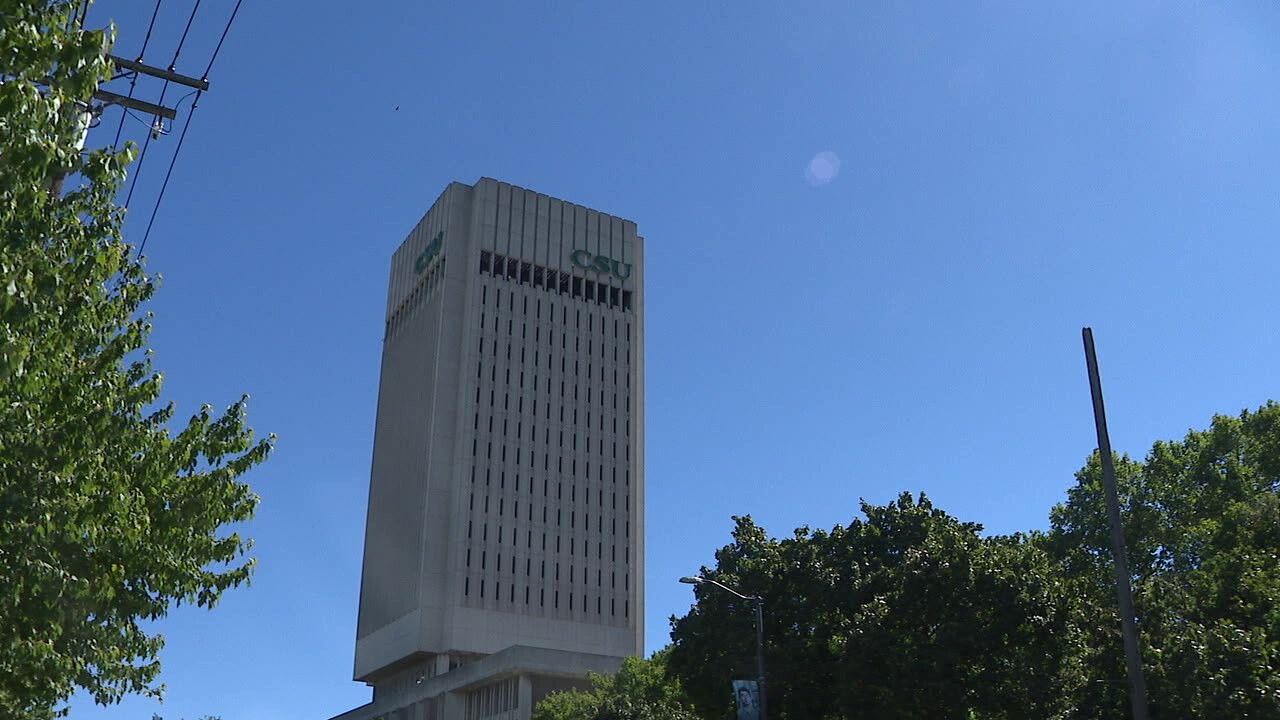
Workers are clearing out asbestos and tackling interior demolition at Rhodes Tower, the 21-story office-and-classroom building at the heart of the campus. That cleanup, aided by a $6.6 million state brownfield grant, will take about 18 months.
Vande Velde said the abatement work is about a third of the way done.
The university’s 2022 master plan called for transforming much of the aging building into student housing. But on Friday, Bloomberg said the future is still up in the air.
“I think that’s not likely, at this point,” she said of a residential conversion.
Rhodes Tower will continue to be an iconic feature of the campus and a part of the city’s skyline, she said.
But now Fenn Tower is the university’s “signature” first-year living space. And CSU is rethinking its approach to various buildings amid enrollment declines, financial pressures and growing demand for online education and night classes.
“What I imagine will come out of our larger study is some office moves,” Bloomberg said. “Some classroom moves. Also, in addition to looking at the buildings and what stays and goes, we’re looking at how do we schedule classes so it’s most convenient. … So we’re looking at the built environment but also the way we structure and activate the buildings.”
One thing hasn’t changed, though. Cleveland State is still committed to razing the Wolstein Center, which opened in 1991.
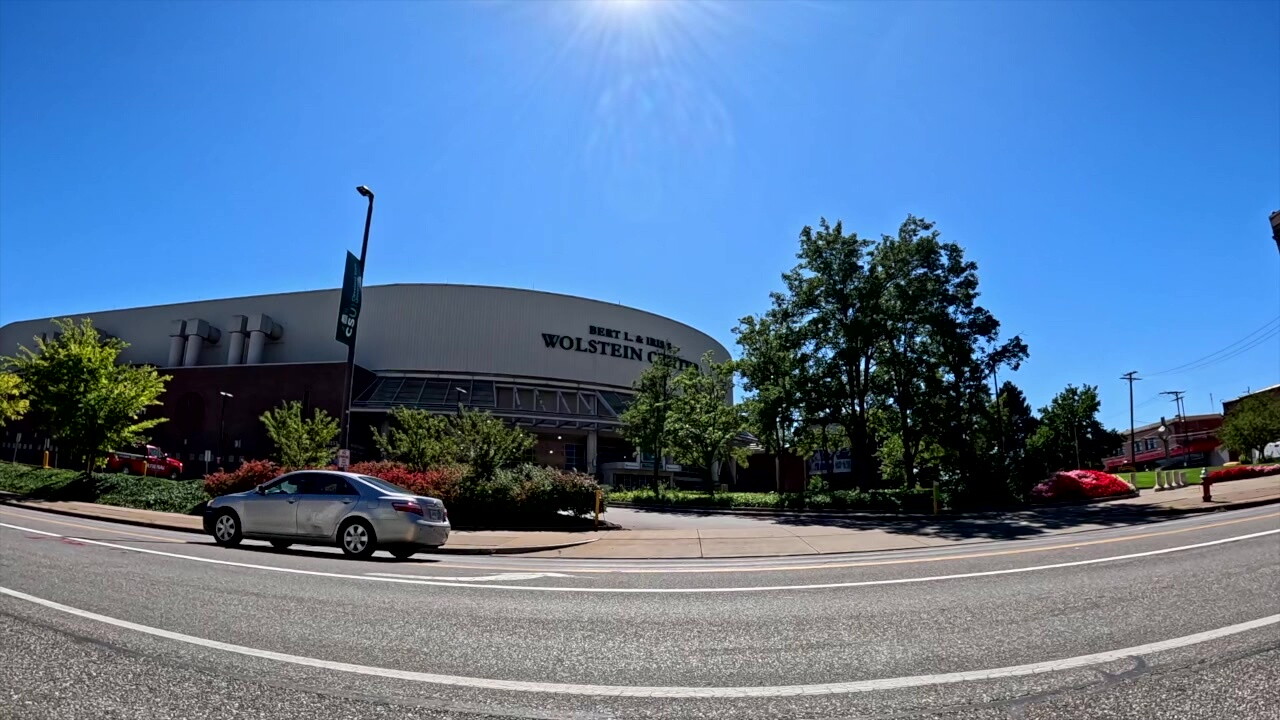
In June, the Ohio Department of Higher Education announced a demolition loan for the Wolstein Center through a new state program designed to help public universities and colleges get rid of obsolete facilities and reduce their operations and maintenance costs.
The preliminary award amount is $15.6 million. The total cost of the teardown isn’t clear yet.
In a solicitation to engineering firms in late July, CSU listed an estimated price tag of $27.6 million, with nearly $20.5 million of that earmarked for construction.
That document said demolition could start in early 2028.
An education department spokesman said the state is waiting for Cleveland State to submit a final quote from a contractor. Once it has that information, the department will decide on the ultimate loan amount and next steps.
“When you take a building down, it’s consequential,” Bloomberg said. “And we want to be sure we get it right. … That will take us some time, so I don’t think we’re ready to make more of an announcement than that, at this point.”
She said CSU doesn’t have firm plans for the 10-acre Wolstein Center site, once it’s cleared. A proposal to build a soccer stadium on the property surfaced last year.
But at this point, that’s not on the table.
“We are no longer negotiating,” Bloomberg said.
Athletic programs are likely to move to Woodling Gym, which the university hopes to spruce up as a new home for college basketball and other sports. The longtime gymnasium is just a few steps away from Fenn Tower.
“When you think about the whole student experience, to have that opportunity right next door to this beautiful old residence hall is a terrific thing,” Bloomberg said.
At Fenn Tower, students now have a dedicated lobby. There’s a refreshed game room, with pool tables and a movie projector. Upstairs, workers ripped out old bathroom fixtures and turned obsolete kitchens into dens.
“There’s never more than two students to one bathroom, which is a pretty big deal when you’re talking about freshman housing and our competitors,” Vande Velde said.
The project team included Perspectus, a Cleveland-based architecture firm, and the Ruhlin Company, a contractor and construction manager based in Medina County.
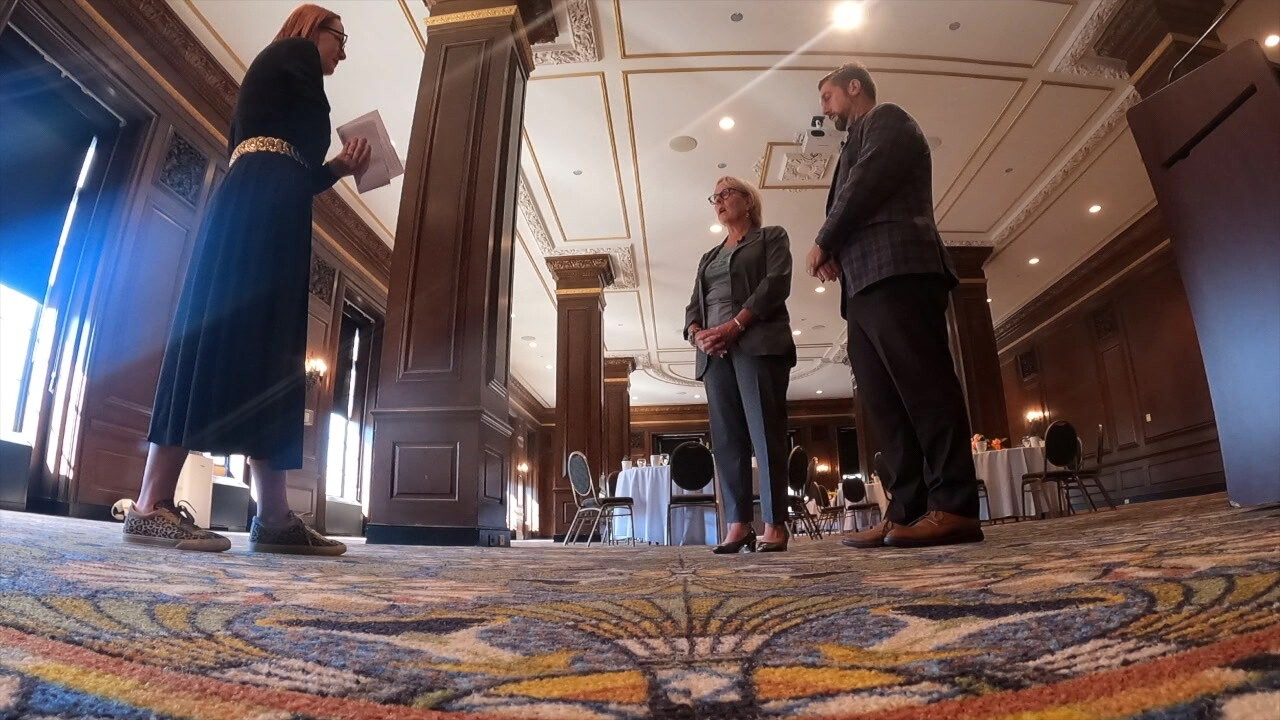
In the historic ballroom — one of the most popular event spaces on campus — crews deep-cleaned the carpet, oiled the woodwork and gave the ceiling a fresh coat of paint.
The 22-story tower was built for the National Town and Country Club, a private men's club. The building opened in 1930 but quickly went vacant. Fenn College acquired the property in 1937.
The state took over the private college in 1965, turning it into Cleveland State.
Generations of students have passed through the building, which has held offices, classrooms, a library, a swimming pool, and sleeping quarters over the years.
Now, after shoring up, the tower’s ready for the next chapter of that story.
“You can imagine, with 450 young adults living in this building, they’re building stories all the time,” Bloomberg said with a laugh during the ribbon-cutting event.
“We’ll just let it go at that,” she added. “Some of us have been parents of college students. You know what I’m talking about.”
Michelle Jarboe is the business growth and development reporter at News 5 Cleveland. Follow her on X @MJarboe or email her at Michelle.Jarboe@wews.com.
